By Matthew Dodd
‘Change my dear, and it seems not a moment too soon’
– The Sixth Doctor, Doctor Who, 1984
‘I don’t want to go’
– The Tenth Doctor, Doctor Who, 2010
In the most unceremonious of ways, a midweek Instagram post, a British cultural institution of more than half a century was, not for the first time, put to rest. Or rather, it was, like a wounded dog limping from showrunner to showrunner, lifeline to lifeline, finally put out of its misery in an overwhelming cloud of indifference. Doctor Who – the British science fiction show launched in 1963, cancelled in 1989, temporarily resurrected in 1996, and brought back proper in 2005 – was confirmed by the BBC to not be returning to screens this Christmas, as was previously announced. Indeed, the show will not be returning to screens at all, until such time as a new co-production partner can be found. The current showrunner and production company have left the programme, and the property is to be put out to competitive tender in the coming months. Russell T Davies, the man who has the peculiar distinction of having both resuscitated and euthanised the programme, washed his hands of the show he credits with launching his interest in television – as well as, in no small part, his career – with curious detachment: ‘and so GOODBYE from me to Doctor Who but HELLO to a big new future for the show’, he wrote in a rambling Instagram caption. In the same caption, he admitted that he never had a plan for the show going forward, and that previous assertions to the contrary were but a clever piece of theatrical misdirection.
As any fan of the longest running Sci-Fi show in history will know, Doctor Who has long been lumbering through crisis after crisis, constantly battling an existential danger far worse than any Dalek or Cyberman. The show has been haemorrhaging viewers for over a decade and hasn’t been the nationally unifying Saturday night staple it once was since Matt Smith left the TARDIS. Their own worst enemies, Doctor Who fans will endlessly debate when it was that the show went off – after David Tennant morphed into a CGI goblin, after Russell T Davies left the first time, after Matt Smith made an erection joke with his sonic screwdriver, after Chris Chibnall rewrote the show’s mythology and cast Bradley Walsh, etc., etc. – but the truth is that the show has been held hostage by its own mythology from the very beginning. For twenty years it has grown heavy under the weight of its own narrative baggage. In this way, it has become the archetype for the kind of cultural inertia experienced across our contemporary mass media: a self-reflexive world of ‘fandom’ written by and for people who already know and love the property. For a show so fundamentally about change, Doctor Who – like so much of our modern culture – is terrified of the unknown.
The great trick to Doctor Who’s longevity is both narrative and practical. In 1966, when William Hartnell, the first actor to play the titular role, was becoming an increasingly difficult and unreliable presence on set, the show’s producers came up with a novel idea to continue the show without its hero: regeneration. In regeneration – the in-universe mechanism by which The Doctor is able to heal himself from mortal injury by changing his chemical construction – had the effect of offering Doctor Who a method to continue in perpetuity. Regeneration allowed for characters to be reshuffled alongside writers, directors, and design philosophies. If the show was failing under one team, regeneration offered a mechanism to swap them out, supported by the show’s own mythology. Under such a guise have instrumental changes been made to the show’s format, soundtrack, logo, and everything in between. More than that, however, regeneration cemented the central theme of the show as one of change. When Patrick Troughton emerged as the Second Doctor, he proclaimed to his questioning companions that ‘life depends on change, and renewal’. It’s that notion of constant evolution, of the way in which we all live many lives in our one, which has guided the show for sixty years. As long as the show believed in that conviction, it could live forever. In recent years, however, change has been overtaken as the driving force of the show by its more sinister cousin, regression. So then, we might contend that the moment Doctor Who precipitated its own doom was not with any shift in writer, actor, or storyline, but rather when David Tennant’s Tenth Doctor looked towards the camera in his final outing and, with tears mounting in his eyes, proclaimed, ‘I don’t want to go’.
The moment functions well in its context. It is the tragic sight of a character, burdened by years of narrative angst, finally buckling under the weight of trauma and accepting, as we all must, our innate fear of death. A few seconds later, Matt Smith arrived on screen and the machinery of the Whoniverse began running once more, with a successful rebrand under showrunner Steven Moffat. Yet it represented a paramount concession to fan expectation and the reluctance to change. It was, perhaps, not a major incident at the time – the show would achieve wide international acclaim in the Moffat era – but nevertheless planted a seed of reactionaryism that would come to the fore years later. Tennant was, and remains, certainly the most popular of the modern iterations of The Doctor. As such, it was no surprise that his leaving the show should be worth a teary adieu. Yet, compared to the departures of previous fan favourites, his can’t help but feel egregious. When Tom Baker’s Fourth Doctor – by far and away the most popular of the original run – left the show, his final words were of hope and perseverance: ‘it’s the end, but the moment has been prepared for.’ The turn from one philosophy to the other, from the stoic farewell to the bleary-eyed plea, is a turn inward: the sign of a show rapidly becoming centred on itself.
Hayao Miyazaki, the great Japanese animator, courted controversy for his criticism of anime – a genre he helped to popularise – as being ultimately doomed in the modern day by its lack of inspiration. As a young director, he recalled being inspired by the films of Kurosawa and the writing of Ursula K. Le Guin, and how these broad multimedia influences came through and were synthesised in his animation. Now, he claims with regret, anime directors are expressly and solely influenced by other anime. As such, the genre becomes self-feeding and incapable of genuine growth. We can track the same trend in the sphere of western popular culture. In the 1980s, when Steven Spielberg and George Lucas wanted to make an homage to The Treasure of the Sierra Madre and the adventure films of their youth, they made cinematic history with Indiana Jones. In 2023, when James Mangold was tasked with making an homage to Indiana Jones, he made a sequel to Indiana Jones. In the same vein, we need only look at the most culturally ubiquitous of American cinematic exports: Star Wars.
With the first film in 1977, George Lucas was drawing on his love of Kurosawa’s The Hidden Fortress – at one time considering Toshiro Mifune for the role of Obi-Wan Kenobi – and concerns about the imperial machinery of the United States. In the franchise’s most recent outing, The Mandalorian and Grogu, the inspirational roots of the film are found nowhere deeper than those previous Star Wars films, as well as the attached apocrypha of television shows and comic books. The leads – heralded as the faces of a new era – are, in effect, stand-ins for two of the franchise’s original characters, Boba Fett and Yoda. This, concocted with a culture of ‘fandom’, has created a cultural ouroboros. As Roger Ebert observed in 2009, ‘a lot of fans are basically fans of fandom itself. It’s all about them. They have mastered the “Star Wars” or “Star Trek” universes or whatever, but their objects of veneration are useful mainly as a backdrop to their own devotion.’ It is these extreme fans who now hold the keys to our popular culture: either as the creative minds behind the latest Star Trek reboot, or else the ‘influencers’ endlessly agitating about their pet franchises. The studio system upholds this cultural stunting: why take the risk on a new property, or even a new character, when you can endlessly resuscitate an old one? In 2026, we reach a new low in this chronic resistance to the new with HBO’s Harry Potter. After J.K. Rowling’s prequel series Fantastic Beasts and Where to Find Them failed to live up to the box-office juggernaut which was its predecessor, Warner Bros have returned to the, by now, decomposing horse of the Harry Potter corpus to create a reboot which shares music, designs, plots, and even actors with the original films. There is nothing new to be extracted from this project, only subscriptions to the newly launched HBO Max streaming service. Popular culture is becoming a simulacrum of itself.
Doctor Who provides, perhaps, the clearest and largest scale example in British popular culture of this destructive self-reflexivity. The seeds of Doctor Who’s undoing have always been rooted in an over-reverencing of the show’s canon. When the show returned under Russell T Davies in 2005, it presented itself as something genuinely new. The original show, though a national institution, had become something of a laughing stock by the time of its cancellation. It was a show for strange, emotionally stunted men in anoraks, replete with over-complicated plots, flimsy sets, and saltshaker robots. With Christopher Eccleston, it became must-watch television. It was well-written, funny, and grounded. The world of the show felt genuinely relevant and rooted in the experience of 21st century British life. Rose Tyler, the Doctor’s companion across the first two series of the revived show, was a shop assistant who lived on a council estate, offered the keys to the universe. The monsters were analogues for trauma, weight loss fads, the Iraq war, and modern slavery. The stories were personal and drawn together by coherent thematic threads: escapist fairy tales that were never afraid to touch on the real. After twenty years in the wilderness, Doctor Who was a show that meant something again. Two decades later, with Russell T Davies once more at the helm, Doctor Who has never felt more out of touch.
A popular prognosis for Doctor Who’s decline has been its surrender to so called wokeism. Nigel Farage, leader of Reform UK, blamed the BBC for ruining a show he once loved with its flagrant kowtowing to the militant left (we are to assume this was an allusion to the recent introduction of Ncuti Gatwa, the first black Doctor). In their autopsy of the show, The Telegraph contended that its downfall was having become ‘mired in preachiness and identity politics’. The suggestion that Doctor Who had suddenly shifted towards social and political concerns in the last few years is both laughable and ahistorical. Genesis of the Daleks, one of the original run’s most acclaimed stories, drew direct comparisons between the creation of the villainous Daleks and the rise of fascism in Nazi Germany; in 1971’s The Claws of Axos, Jon Pertwee’s Third Doctor admonishes the nationalist Minister of Defence Mr Chinn for his cries of ‘England for the English’; the Davies written Turn Left depicts an alternate timeline where economic crisis leads the British government to intern settled immigrants, whilst the war veteran Wilf laments, ‘labour camps, that’s what they called them last time.’ Indeed, when it launched in 1963, Doctor Who was helmed by the BBC’s only female producer, Verity Lambert, and directed by the gay, Indian-born Waris Hussein. All this to say, the heart of Doctor Who has always been one of progressive social and political conviction. The issue with the contemporary show is not that it has become exceptionally left-wing, but rather that it has become painfully reactionary.
The major turn to wokery, in the popular consciousness, came about with the announcement in 2017 that Jodie Whittaker would portray the first female incarnation of The Doctor. The news was divisive: Fifth Doctor actor Peter Davison mourned ‘the loss of a role model for boys.’ Yet the show under Jodie Whittaker was not a polemic work of left-wing propaganda. Quite to the contrary, in Kerblam!, The Doctor comes face to face with a disgruntled worker at a space-age version of Amazon who turns to domestic terrorism to protest the harsh and dehumanising conditions at the company. Her response to him is one of chronic centrism: ‘the systems aren’t the problem! How people use and exploit the system, that’s the problem!’ In the same series, the Malorie Blackman penned Rosa sees The Doctor and co. have to help ensure that Rosa Parks ends up launching her bus protest – portrayed in the show as a random accident rather than a coordinated act of political disruption – and find themselves forced to sit and watch her be racially abused as, were they to leave, they would create enough space on the bus for the white man to sit down. The most egregious case, perhaps, occurs in the episode Spyfall, when The Doctor’s nemesis The Master – played by Sacha Dhawan – appears as a Nazi officer, using a perception filter to disguise his race. Having already foiled his plans, The Doctor deactivates the filter and warns that ‘now they’ll see the real you’. The rest of the episode implies that The Doctor had his archenemy sent to a Nazi concentration camp. Such episodes display a deeply noncommittal if not conservative politics, buried under the veneer of progressivism.
With the return of Russell T Davies, the disconnect between how the show presented itself and how it operated only deepened. His first episode back in post, The Star Beast, has The Doctor berated by his old friend Donna for his inability to just let things go – ‘something a male presenting Time Lord will never understand’ – mere moments after asserting the character’s fundamentally non-binary nature. The show integrated social politics in the most oblique and clunky of ways – often fundamentally misrepresenting sensitive issues – to become a kind of self-caricature, characters operating less as psychologically grounded figures but conduits for well-intentioned but frequently malformed social critique. Beneath this dusting of progressivism persisted the undercurrent of conservatism: in The Interstellar Song Contest, The Doctor appears to take pleasure in torturing a genocide survivor for his attempt at revenge against the corporation that destroyed his home planet. What has become increasingly clear is that the issue of ‘Doctor Who gone woke’ and the issue of its self-mythologising are one and the same.
During the ‘Wilderness Years’, those between Doctor Who’s cancellation in 1989 and return in 2005, the franchise was kept on life support by a dedicated fan culture, manifest in books, comics, and Comic Relief sketches. A key element of this culture met regularly in London’s Fitzroy Tavern, where they would, over some number of pints, wax lyrical on their love for the programme, and notions of how they might write it if they were only given the chance. Amongst this crowd were Russell T Davies, Steven Moffat, Chris Chibnall, Mark Gatiss, Nicholas Briggs, and Paul Cornell – to name a few. When Davies was offered the chance to bring back Doctor Who in 2005, he brought the Fitzroy set with him. Twenty years later, they have not left. This group of upper middle class white men have controlled the show’s direction since its return, and, like any group that governs for decades, the waning of their creative insight has become ever more apparent. Instrumentally, the show has not been allowed to change. This is, of course, not entirely the fault of the writers. When Chris Chibnall left (in something of a cloud) in 2022, the rumour mill suggested that Davies returning was the only thing that would stop the BBC from pulling the plug entirely. Just as Hollywood studios favour established IP over new ideas, the BBC sought the certainty of the old guard rather than risking anything on the new. Davies brought back Doctor Who in 2005 as a bright young thing, fresh off his groundbreaking series ‘Queer as Folk’, and made it something new and exciting. Increasingly clear now is that, despite his great recent successes with shows like ‘It’s a Sin’ and ‘Years and Years’, the attitude he brings to Doctor Who, alongside his Fitzroy peers, is quite simply at odds with the freshness of his original stint and instead feels blisteringly stagnant.
As with Star Wars and Miyazaki’s anime warnings, Doctor Who has become a show that self-destructively recedes into itself. In Davies’ second run as showrunner, he has leant on the show’s back catalogue in lieu of creative advancement. When David Tennant said he didn’t want to go sixteen years ago, we could accept it as a tragic denouement for a beloved character, rather than a genuine resistance to progress. When, twelve years later, Tennant was returned to the role in a move that amounted to little more than exaggerated fan service, it became more difficult to write off. In bringing back David Tennant as the Fourteenth Doctor, Davies seemed to concede that the best ideas were behind him, and that there was nothing wrong with regression into the familiar. Across the next two series he would make similar allowances – bringing back characters largely unremembered by those of us who hadn’t pored over the 700 episodes of the show’s original run. This kind of writing does nothing to bring in any new audience members, playing purely to those already caught up on at least two decades of narrative lore. For a show like Doctor Who, at its core a family show, this is especially fatal. No child can stumble upon an episode of this new series and be drawn into its wonder, because it functions in effect as half a story, with the other half scattered across 700 previous episodes. Davies’ final blaze of glory, the image on which Doctor Who appears to be left for the foreseeable future, was Ncuti Gatwa, having killed himself to ensure that his companion remains a single mother, regenerating into none other than Billie Piper, the actor who played The Doctor’s companion Rose twenty years ago. It was, perhaps, one wink to the camera too many, and an ultimate declaration that this was a show no longer concerned with change, or indeed anything other than itself. As Davies had sinisterly declared on returning to his role, the intention was simply ‘to generate content’ by an endless retreading of the past. No more were episodes inspired by geopolitical conflicts, or philosophical debates, or even simple interpersonal dynamics. Instead, the show is governed by a principle of content creation: of which surprise reveal can get the most engagement on Twitter. Doctor Who has become a show, more than anything else, about Doctor Who. Every episode, good or bad, is an argument for or against its own existence; every success is read as a manifesto on how the show ought to be.
Aside from its position as one of the longest running television shows ever made, Doctor Who is an institution of paramount importance to our national culture. It has, across the last sixty years, become a kind of oral poetry, passed down and shared, reiterated and expanded upon. It was a triumph of collaborative creativity – a germ of an idea, rolling through the minds of other writers until it became something far bigger than any one author – and remains a testament to the possibilities of televised storytelling. In its current state, it has become, like so much of our contemporary culture, drawn into its own centre of gravity, under the pull of which it is slowly crushed. If it wants to survive, it must be about something again. It must be a show both escapist and humanist, about the broad spectrum of experience and the wonder of the universe’s infinite beauty. Whether it’s with an allegory for radicalisation or a story that preys on an innate human fear of the dark, Doctor Who must blossom out of a novel idea, not a recession into its own history. No longer can it be inward-looking, speaking only to the faithful with no care for the as-yet-unconverted. Should it be allowed to wither away, a martyr for our modern culture of inertia, it would be a colossal failure of imagination. Doctor Who has, by nature, a concept of boundless inventiveness: an open invite to a universe of possibility. To turn from that, and regress instead into known territory, is to place a limit on our self-belief. Fundamentally, Doctor Who is a show that has meant perhaps too much to too many people – this writer included – and one whose personal importance to countless self-styled whovians cannot possibly be overstated. At its best, it is a grand narrative of hope, compassion, and growth; of triumphing good and the dignity of life; of the monsters who live under the bed and the imaginary friend who will always be there to save us. Like all of us, it must be unafraid of change, of jumping into the unknown with nothing but belief and hope. To be held hostage by our pasts is an affront to the possibilities of our futures. We all regenerate throughout our lives, casting off one skin for another, and it is the readiness to change and evolve that makes a life, to coin a phrase, fantastic. Our culture is a mirror, and what hope can there be if it reflects only itself?
‘One day I shall come back. Yes, I shall come back. Until then, there must be no regrets, no tears, no anxieties. Just go forward in all your beliefs and prove to me that I am not mistaken in mine’
– The First Doctor, Doctor Who, 1964
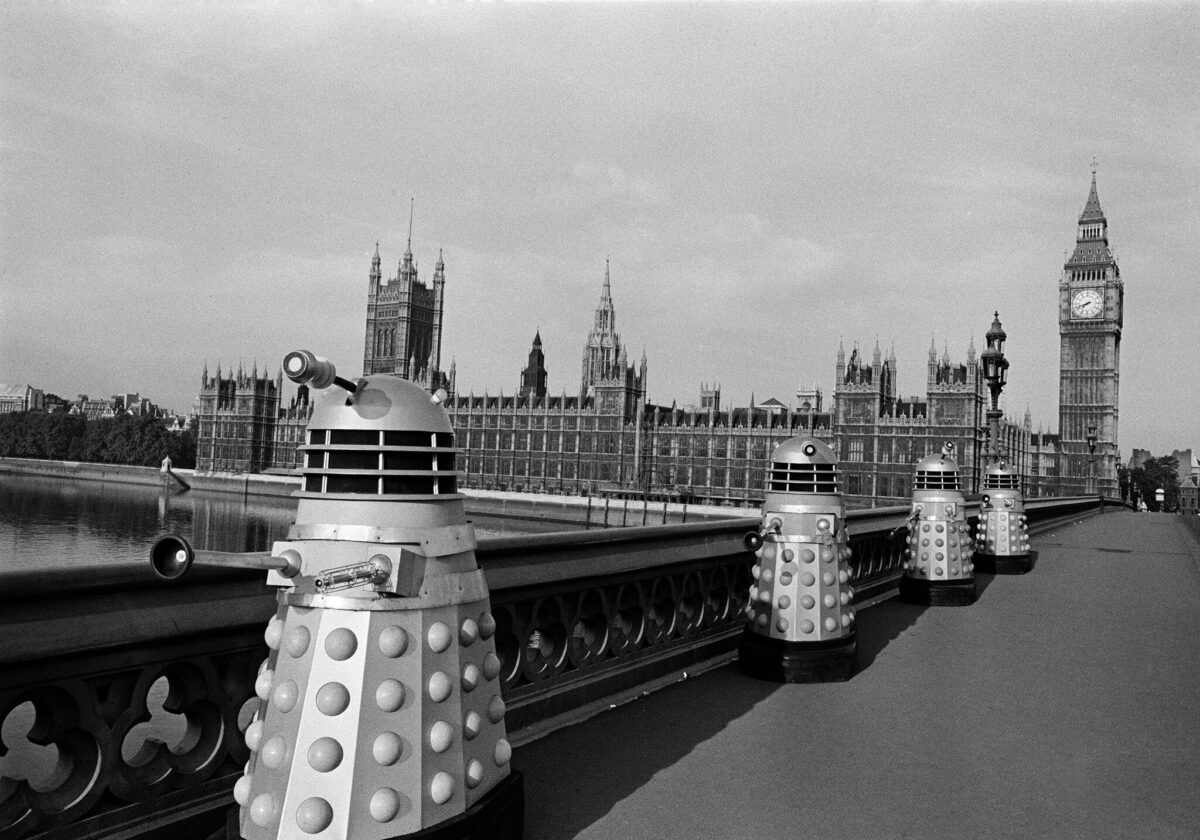
Featured Image: The BBC