
By Edward Clark
Today, gender variance is politicised. In the West, the liberty of transgender people and drag performers continues to be restricted by socially conservative politicians who see a minority population as a political football. For conservatives, resistance to gender variance is often connected to tradition and a belief that subversion of gender norms is a modern phenomenon. Cross-dressing revue troupe Les Rouges et Noirs, a critically acclaimed group made up of World War One (WWI) veterans, suggests the opposite – that a century ago, male gender variance was a commercialised form of entertainment with mainstream appeal.
‘The most attractive girl with short dress’
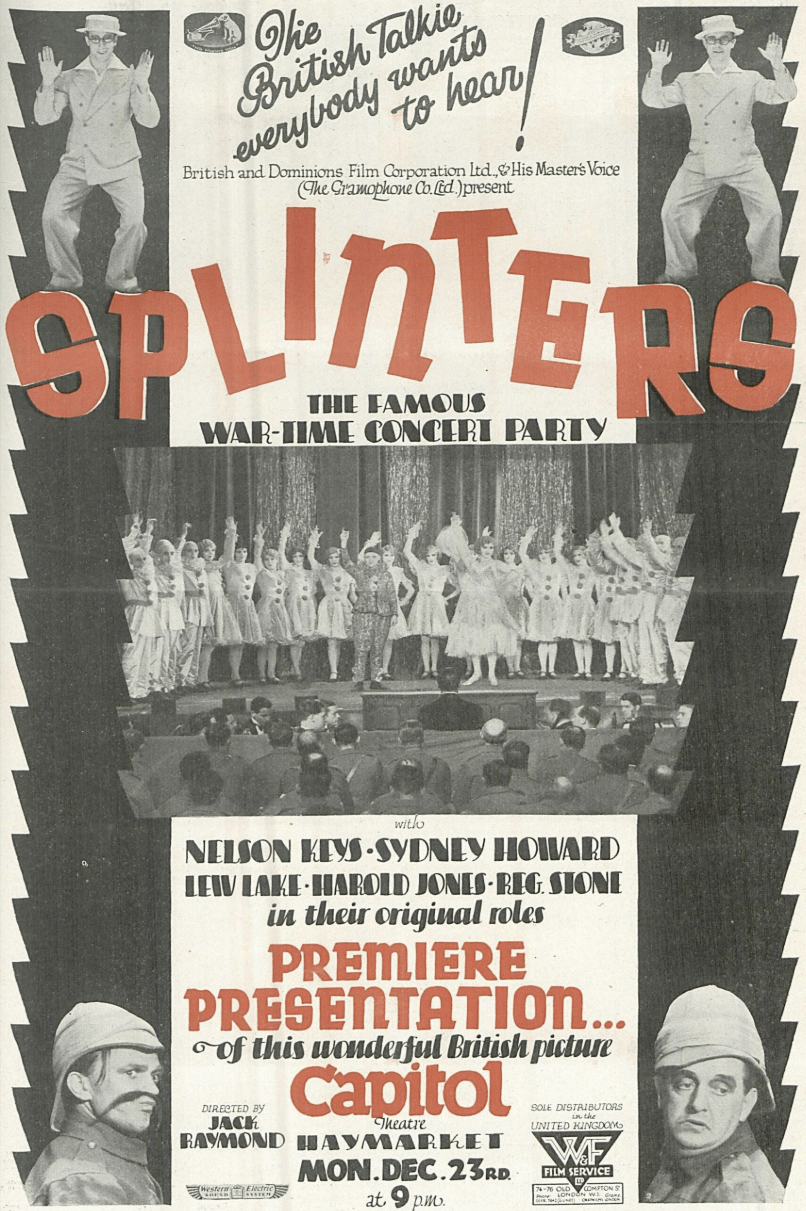
After refining their act during the war, where they performed at concert parties for other soldiers, Les Rouges et Noirs toured their debut show Splinters across England during the 1920s and 1930s, releasing a film of the same name in 1929. Rather than performing a mocking stereotype of femininity, the troupe were celebrated for the accuracy and sexual allure of their feminine beauty. In a 1919 review of Les Rouges et Noirs’ performance at the Savoy, the Evening Standard celebrated how lead performer Reg Stone ‘makes up into the most attractive girl with short dress’ and a ‘bewitching smile’.¹ The Times similarly lauded how the ‘illusion [was] wonderfully good’ and the audience refused to believe the performers were men until they removed their ‘golden tresses’.² The ‘real sex’ of the performers was an aspect drawn on comedically by the revue and Stone in performance. The show was alternatively titled Which is Which in reference to the sex of the performers, and the 1929 Splinters film contained a scene where a ‘Stage Door Johnnie’ pursues Stone to his dressing room after being enticed by his feminine appearance.³
Les Rouges et Noirs were extremely popular. The troupe performed to sold-out audiences across England and at Windsor Castle for King George V. Further, Les Rouges et Noirs’ cross-dressing performance was successful enough to inspire post-WWII veteran cross-dressing revues: Soldiers in Skirts and Forces in Petticoats both became widely popular.⁴ The mainstream appeal of Les Rouges et Noirs and its post-WWII successors rested on their ability to connect home front audiences to the experiences of soldiers. The troupe’s name itself, Les Rouges et Noirs, was a reference to the regimental colours of the First Army – red and black. Splinters was also key in expressing patriotic memory. Director of the Centre for the Cultural History of War, Ana Carden-Coyne, has argued that visual language was the ‘vernacular’ of wartime memory – this is exemplified in Splinters.⁵ By watching material which had been performed on the front lines, audiences felt connected to the soldiers they revered. In an article in London Life, writer Charles Dryhurst noted that he ‘admire[s]’ Reg Stone ‘so much’ because he helped British soldiers to ‘forget for a moment that there was such a thing as a front line’.⁶ A review of Splinters at the Savoy by the Pall Mall Gazette suggested that the performance was more enjoyable because it had ‘eased the monotony of life at the front for thousands of our fighting men’.⁷ The repeated use of war imagery in performance and on screen invited audiences to engage with patriotic wartime memory.
‘16 Soldiers and Every Soldier an Artiste’
The performers’ veteran status protected them from accusations of sexual immorality. Cultural historian Graham Dawson has argued that soldiers were the ‘quintessential figure of masculinity’, and although Stone’s cross-dressing act seemingly opposes Dawson’s argument, his masculine image allowed him to avoid accusations of sexual immorality.⁸ Notably, this was a period of British history where minor deviances from masculine norms were sensationalised in newspapers. After the 1932 raid on a ball at Holland Park Avenue where men were wearing women’s clothing, the Morning Advertiser boldly headlined ‘MEN DRESSED AS WOMEN’.⁹ Cross-dressing in private was also policed harshly. For example, twenty-three-year-old Thomas B. served three months in prison for ‘importuning male persons for an immoral purpose’, with the evidence simply being his possession of a ‘powder puff, powder and a small mirror’.¹⁰ However, at the same time as male gender variance was policed for its association with these ‘immoral purpose[s]’, Reg Stone was performing nightly to sold-out audiences.¹¹
This was facilitated by the ex-military status of the performers, which was repeatedly emphasised in their publicity. The programme for the revue’s 1919 Savoy Theatre performance detailed a story where the soldiers ventured under ‘shells screaming overhead’ to recover frocks left on the front lines – simultaneously emphasising their valour and their commitment to their revue.¹² The importance of the troupe’s military background is reflected in a poster advertising their 1919 performance at the Kennington Theatre, which reads ‘16 Soldiers and Every Soldier an Artiste’ on the left and ‘16 Artistes and Every Artiste a Soldier’ on the right.¹³ The troupe also negated potential accusations of immorality by emphasising that their cross-dressing was purely performative and a ‘huge joke’, as stated in their own promotion. In the Splinters film, Reg Stone’s onstage femininity is juxtaposed with his offstage masculine traits, as he is pictured smoking a pipe and removing his wig backstage. In the aforementioned scene where a soldier enters Stone’s dressing room, Stone is assertive, responding ‘Well what do you want?’ and ‘Now hop it!’ in a deliberately masculine tone, emphasising the divide between performance and reality. This has comic intentions: the soldier is embarrassed once he realises Stone’s ‘true’ sex. However, it also functioned to make clear Stone’s lack of effeminacy, and defuse potential connotations between cross-dressing and sexual immorality. The framing of the film itself as a ‘fly-on-the-wall’ depiction of the troupe’s wartime performances allowed for this distinction between performance and reality; through this juxtaposition, Stone and the other performers made clear their lack of effeminate or otherwise perverted traits offstage.
‘Of course, they get love letters’
Whilst the soldiers sought to protect themselves from accusations of sexual immorality, the homoerotic undertones of the troupe’s performances should not be separated from interwar LGBTQ+ communities. Reg Stone was interviewed by London Life, a well-circulated magazine which gained popularity due to its kinky subject matter.¹⁴ Cross-dressing was frequently addressed in the magazine’s regular correspondence column, and although these stories deliberately avoided sexology, they were told from a fetishist lens.¹⁵ Photos of cross-dressed members of the public were even included in some printings.¹⁶ Stone’s interview with this magazine indicates his appeal to those with a personal interest in cross-dressing themselves. Although the interview was largely concerned with Stone’s technical skill as an ‘impersonator of the fair sex’, complimenting his ‘distinction and artistry’ and lauding him as ‘the cleverest artiste of his kind in the country’, it was conducted to appeal to cross-dressing hobbyists.¹⁷ The troupe even emphasised the homoerotic undertones of their production in promotion. The programme for their Savoy Theatre performance in August 1919 bragged about how ‘of course, they get love letters’ from male admirers.¹⁸ The Splinters film includes moments where soldiers overtly flirt with Stone in female dress – Stone makes flirtatious eye contact with a soldier, eventually blowing him a kiss which the soldier mimes receiving. The cross-dressing performers adopted female dress, female mannerisms, and female social roles through implicitly sexual relationships with men.
Les Rouges et Noirs subvert modern arguments that gender variance is a twenty-first-century phenomenon. The troupe show that cross-dressing was a mainstream and popular facet of British interwar culture. Les Rouges et Noirs also challenge a popular narrative within LGBTQ+ histories of Britain: that queer expression remained largely ‘invisible’ and underground before the post-WWII gay liberation movement.¹⁹ The Splinters tour and film emblemise a unique moment in British history, as its cross-dressers simultaneously represented soldier-like masculinity and an idealised femininity. Whilst many modern politicians want to keep trans and gender-variant representation out of the limelight, it is clear that British history may not be as simple as they want to make it: a century ago, cross-dressers headlined the Savoy and performed for the King.
ENDNOTES:
¹ ‘“Les Rouges et Noirs”: Army Entertainers’ Programme at the Savoy’, Evening Standard, 5 August 1919, quoted in Jacob Bloomfield, ‘Splinters: Cross-Dressing Ex-Servicemen on the Interwar Stage’, Twentieth Century British History, 30.1 (2019), pp. 1–28 (p. 20).
² ‘Les Rouges et Noirs’, The Times, 5 August 1919, p. 8.
³ Bloomfield, ‘Splinters’, pp. 12, 21–22.
⁴ Bloomfield, ‘Splinters’, p. 26.
⁵ Ana Carden-Coyne, Reconstructing the Body: Classicism, Modernism, and the First World War (Oxford University Press, 2009), pp. 82–83.
⁶ Cross Dressing between the Wars: Selections from ‘London Life’, 1923–1933, ed. by Peter Farrer (Karn Publications, 2000), p. 247.
⁷ ‘“Splinters” at the Savoy: Capital Performance by “Les Rouge et Noir”’, Pall Mall Gazette, 5 August 1919, quoted in Bloomfield, ‘Splinters’, p. 4.
⁸ Graham Dawson, Soldier Heroes: British Adventure, Empire and the Imagining of Masculinities (Routledge, 1994), p. 1.
⁹ Matt Houlbrook, ‘“Lady Austin’s Camp Boys”: Constituting the Queer Subject in 1930s London’, Gender & History, 14.1 (2002), pp. 31–61 (pp. 31–32).
¹⁰ Matt Houlbrook, ‘“The Man with the Powder Puff” in Interwar London’, Historical Journal, 50.1 (2007), pp. 145–71 (pp. 145–46).
¹¹ Houlbrook, ‘The Man with the Powder Puff’, pp. 145–46.
¹² Bloomfield, ‘Splinters’, p. 10.
¹³ Poster advertising the revue Splinters, Kennington Theatre, 15 September 1919, Victoria and Albert Museum, Theatre and Performance Collection.
¹⁴ Lisa Z. Sigel, ‘Fashioning Fetishism from the Pages of London Life’, Journal of British Studies, 51.3 (2012), pp. 664–84 (pp. 664–65).
¹⁵ Sigel, ‘Fashioning Fetishism’, pp. 665, 672.
¹⁶ Sigel, ‘Fashioning Fetishism’, p. 670.
¹⁷ Cross Dressing between the Wars, ed. by Farrer, pp. 249–51.
¹⁸ Bloomfield, ‘Splinters’, p. 20.
¹⁹ George Chauncey, Gay New York: Gender, Urban Culture, and the Makings of the Gay Male World, 1890-1940. (Basic Books, 1994), p. 3.
Featured Image: Splinters (1929) on Letterboxd