By Saoirse Pira
“Michael, I told you already: you can go swimming later, when your father gets back,” from behind her sunhat – too big, he thought, ridiculous – “now eat your sandwich, please. You’ll be getting sand in it, Michael, do you want sand in your sandwich? I won’t make another sandwich if you get sand in that one, and dinner isn’t until six. Do you want to go hungry until dinner, Michael? Eat your sandwich. Christ, where is your mother? Anna!”
All in that horrible nasally lilt. He turned to watch her disappear up the steps, away from the beach, toward the house – calling, all the while, his mother’s name. He hated Aunt Helen, and thought she spoke too much: a feeling only made stronger, more pronounced, by that terrible radio voice she spoke with. Despite both Aunt Helen and his mother both being reared and raised in Ballina, only his mother retained this mark of her becoming in her speech. Aunt Helen moved to Dublin during the Celtic Tiger and made what they all thought to be a fortune selling office supplies to companies that were now most certainly out of business. Then, of course, she married Uncle Declan, who stank of stale tobacco and went red from walking up the stairs, and who had made an actual fortune selling American fridge-freezers to the upwardly mobile. Somewhere along the way, Aunt Helen adopted what Michael thought to be the most annoying accent that he had ever heard. Michael’s father said she listened to RTÉ Radio at night to absorb it as through osmosis. He also said she learned it through those tapes people would listen to to learn languages. Michael had seen those tapes at the back of the library, but they were all for people that spoke English to learn Spanish or French or German or Italian, not for people from County Mayo to learn Dublin 4. If his father was joking, as he suspected he was, the humour was most certainly lost on his mother, who would sigh and roll her eyes whenever his father got onto the subject of Aunt Helen and her middle-class metamorphosis. It was worse than the radio though, he thought, because at least he could turn the radio off. Aunt Helen just kept talking.
Michael looked down at his sandwich, sitting in a plastic bag on the hot sand. It was going to be horrible, and its contents getting warm from the heat of the sand couldn’t possibly make it worse. Maybe the cheese would melt, he thought, and mask the horrors of slimy pink ham. He prodded the bag there with a stick, flipped it over. It was no use. He wasn’t going to eat it anyway. He didn’t want to eat it; he didn’t want to eat anything. Besides, he wasn’t altogether convinced that this could be classed as food, legally, or maybe scientifically, speaking. It might be better used as a kind of glue or to manufacture bouncy balls. Now there’s an opportunity to earn a real fortune, he thought, if he could only find a way to mass produce them. He turned back around to the sea – yes, yes, that was it. He wanted to swim, he was going to swim.
Down the steps again came Aunt Helen, with her horrible frantic air that loomed about her like a stink, one of those cartoonish green clouds, and his mother. She followed Aunt Helen uneasily down the steps and toward the beach. A quiet woman was Mammy, kind and scared. He often thought her not unlike a stray cat in nature – skittish, that was it. She hated the family holidays, but insisted on them for a reason Michael couldn’t understand. It was different when there was Granny and Grandad. Now it’s just Aunt Helen and Uncle Declan and he just didn’t see the point. As the pair approached, Michael noticed the blue cooler bag in his mother’s hand, and the beach bag slung over her shoulder. Inside that bag he knew would be his costume, goggles, and towel, and this little piece of knowledge was enough to get his heart racing, anticipation settling in his body as though it were happening in real time.
His mother and Aunt Helen found their way to the deck chairs, where they joined Uncle Declan, who had been lying wordless on his stomach since breakfast, his back growing relentlessly pinker despite Helen’s periodical suncream applications. His mother unzipped the cooler bag and passed two cans to Helen, who passed one again over to Declan, calling his name as she held it out. This, it seemed, was the only thing enticing enough for the pink man to peel himself off his deck chair. He sat up, taking the can from Helen, saying something or other about the heat. Finding Michael’s eye then, he grinned, bearing his long yellow teeth, and popped the tab. “There’ll be no tins of mineral for naughty children!” he said, bringing the can to his lips and drinking it at such an angle and eagerness that the contents streamed down the sides of his mouth, dripping onto his shorts. Michael looked back down at the sand, at his sandwich, anything but the sight of that strange man. He noticed a shadow approaching and looked up to find his mother standing over him. She crouched down, her kind face meeting his, and revealed a small white package. “Here child,” she said, unwrapping it carefully, and pulled out a bright orange ice lolly, his favourite. His face lit up at the sight and he felt his spirits infinitely lifted, his faith instantly renewed.
He took it from her, replacing her fingers with his over the wooden stick. “Thank you, Mammy.”
She smiled softly, touching her hand to his shoulder before lifting herself back to a stand. With her hand to her brow, shielding her eyes from the sun, she glanced out towards the sea, then back to the house, then finally down at her son, the orange lolly already melting in his hand. She glanced down briefly, before walking carefully away, back to the chairs.
Whoever discovered the wonders that could be gleaned from frozen juice must be a genius, Michael thought. He should like to meet them, thank them for their service, and maybe if he asked kindly enough, they’d give him a lifetime supply, like those people that win truckloads of chocolate or washing up liquid on the television. Though, people have probably been eating the likes of these since the Ice Age, because well, if everything was ice, surely the fruits would freeze too, and someone had surely juiced something by then. They’d have dropped an orange at some point, at the very least.
It was gorgeous. Just wonderful. Almost perfect, if not for the fact of it melting faster than he could enjoy it, forcing him to lap it up with a rabid sort of gluttony. He was embarrassed, of course, but the rush with which he consumed it left little room for contemplation. It was a race against the sun and time and probably God, and one he simply had to win. He turned away from the deckchairs, toward the sea, to indulge this savagery in some sort of privacy; it was bad enough that he knew, there was no need for this affront to his self-image to be known to anyone else.
Soon enough, it was finished, and there was no way of knowing if he had won, just that it was gone, and his hands were unthinkably sticky. His face, too, he noticed, trying then to wipe his face clean, only to remember the thing about his hands. There was just no winning. His hands were coated with that thick orange stick, and now the wasps would be all over him. He had never been stung. A boy in his class told him once that he was allergic to bees. Michael had no way of knowing if he was allergic to wasps, and if he was and they got him then, that’d be the end, and he’d be dead, and it could have all been saved had he only not been so incredibly greedy. He looked up again at the sea, then back up towards the house, staring with such intensity as if he could will his father into being there, like if Michael looked and thought and hoped hard enough, he would materialise then, making his way down the steps toward him.
It was no use, he was not magic. He didn’t understand why he had to wait, anyway. He’d been learning to swim in school, he was one of the best in his class. He didn’t even need armbands anymore. It just wasn’t fair. He’d built sandcastles all that morning, there was nothing left to do. Though, there was the map. He’d started one of the beach that weekend, on his dad’s suggestion. It was fun enough, he liked playing pretend at being an explorer; he hated that everywhere had been explored now, satellites and GPS had ruined all the fun. There was still the sea, but he didn’t even want to explore that, he just wanted to swim in it.
He stood up, wiped his hands on his shorts, and turned to walk toward the deck chairs. If he walked with enough confidence, they wouldn’t notice the fresh orange stains – still, better his shorts than his hands. He made his way to his mother, rummaging in her bag no doubt for the same magazine she had been pretending to read all week. “Mammy, I’m an explorer. Is my map there? I need it.” Her head bolted upright – he had surprised her. Her shock softened into a smile, relief no doubt at the child being occupied by something other than that sea. She lifted the bag to her lap, fished out the folded-up piece of A3 paper and marker pen. “There you are,” she smiled, “don’t go too far.”
He took the paper and pen from his mother, promised to be back soon, and turned to plot his excursion. He pocketed the pen and considered the paper. It had softened already, its corners curling slightly from days of damp sea air, folding and unfolding, mingling with paperbacks and bottles of suncream. He smoothed it over with his fingers as best he could. Then he was really moving, darting down the beach with the tilted gait of a child absorbed, already elsewhere entirely.
He had already plotted the house, the chairs, the steps down, in careful lines to the left of the page, having decided to focus his expedition eastward. This was due, in large part, to the wall of rocks to the west that rendered any exploration in that direction near-impossible. He knelt down, marking the rocks on the page with an array of sharp, angry shapes, thinking himself remarkably useful – should somebody come to use the map, they would know to proceed with caution. There was the obvious business of the shore to attend to. He decided he would mark it as he walked, he would complete the whole map from left to right. Any approximation would defeat the point, he would have to be exact. And so he set off walking slowly, drawing carefully as he went; marking lines of kelp and shells and the small, wet signatures of footprints, pointing this way and that before being swallowed by the tide. On approaching a groyne, he would place his map flat on its surface, the pen on top to secure it, before fixing his hands on the wood, hoisting himself up, and standing there, basking in that glory, his sweet bravery, for a few precious seconds before jumping down, retrieving his tools, and marking the site on the page. The beach narrowed as he went, cliffs and tide closing in on the sand. He noted this discovery, slowing every so often to consider the shape of the cliffs, the best lines to draw. After some time, it occurred to him that he would soon run out of space, at which point he turned around and realised the chairs were almost completely out of view.
He didn’t need to be afraid; he had a map, he couldn’t get lost. And anyway, he was almost out of space, he would have to go back soon, and he would fill in any more details on his return. Fixing himself eastward again, he considered where his map might have to end. Ahead of him, the cliff closed in sharply to a point before receding again, at its point meeting a group of large rocks. The rocks varied slightly in size and shape, though altogether they gave Michael the impression of being not unlike small asteroids. And unlike the impenetrable wall by the deckchairs, the rocks here seemed relatively easy to climb. It was perfect, he had just enough space left. He would draw the rocks, climb them to be sure his depiction was accurate, and make note of what was on the other side.
He drew what he could see, set his map and marker down, and began the climb with relative ease. He was practised now, felt himself professional and decidedly athletic. The rocks were warm and damp, and after each successful summit, he would stop to admire the feat, his progress and new artificial height. Most were relatively flat, though some sloped slightly this way or that, and he would have to stick his arms out to catch himself from falling. The final few were anticlimactically easy, stacked as they were simply, altogether more like steep steps than satisfying boulders or asteroids. As he reached the top, it occurred to him that he could hear the sea a great deal louder than before, a theory confirmed when he reached the top, that final rock slanting off over the beating tide. The other side of the wall was pure water, all kelp and beating waves. He felt so powerful, there, standing over so much blue, he thought first of Poseidon and his trident, then of Lir and his children. Seagulls brayed overhead, and Michael closed his eyes and thought of Lir’s children, those swans. With closed eyes and slow breath, those gulls might be swans, their calls were almost song. Aoife couldn’t bring herself to kill the children, she took them to the water to bathe instead.
He wouldn’t be able to say, later, just how it happened – only that it did, only that he fell. He hit the water before he knew he was falling, he was under before he knew he was in. He was reaching for something and grabbing at nothing, he was trying to swim up but he was flat on his back. He was kicking and swiping but he knew that he was sinking. He didn’t want to be an explorer, he didn’t want to be brave. He was swallowing so much water and it occurred to him that people didn’t live forever.
Everything seemed suddenly remarkably slow. He knew it was the sky above him, the light blue and the white. He’d always drawn the sun yellow, he’d always been so wrong. It looked like there were dark blue clouds cast over. He thought again of Lir’s children. He was no longer moving. He wondered if they were scared, when they bathed in the Loch, if they knew what was coming, if the water was cold. Or if they played before the spell was cast, if they played when they were swans. He let his head fall back. It was all blue on forever.
He felt the hands before he saw the body, the shape fixing itself into meaning, pulling him in and lifting him up. It wasn’t Poseidon or Lir, no catalogue of gods, just kin. The yellow shirt he had worn at breakfast, the steady arms that carried bikes and bags and bedtime blankets – his Dad, finally swimming. The sea loosened its hold, with that crash through the surface, running off his face – it gave him back. Gulls sang in circles overhead, the impossible nearness of the sky. There, yes, sky – so close to taking flight.
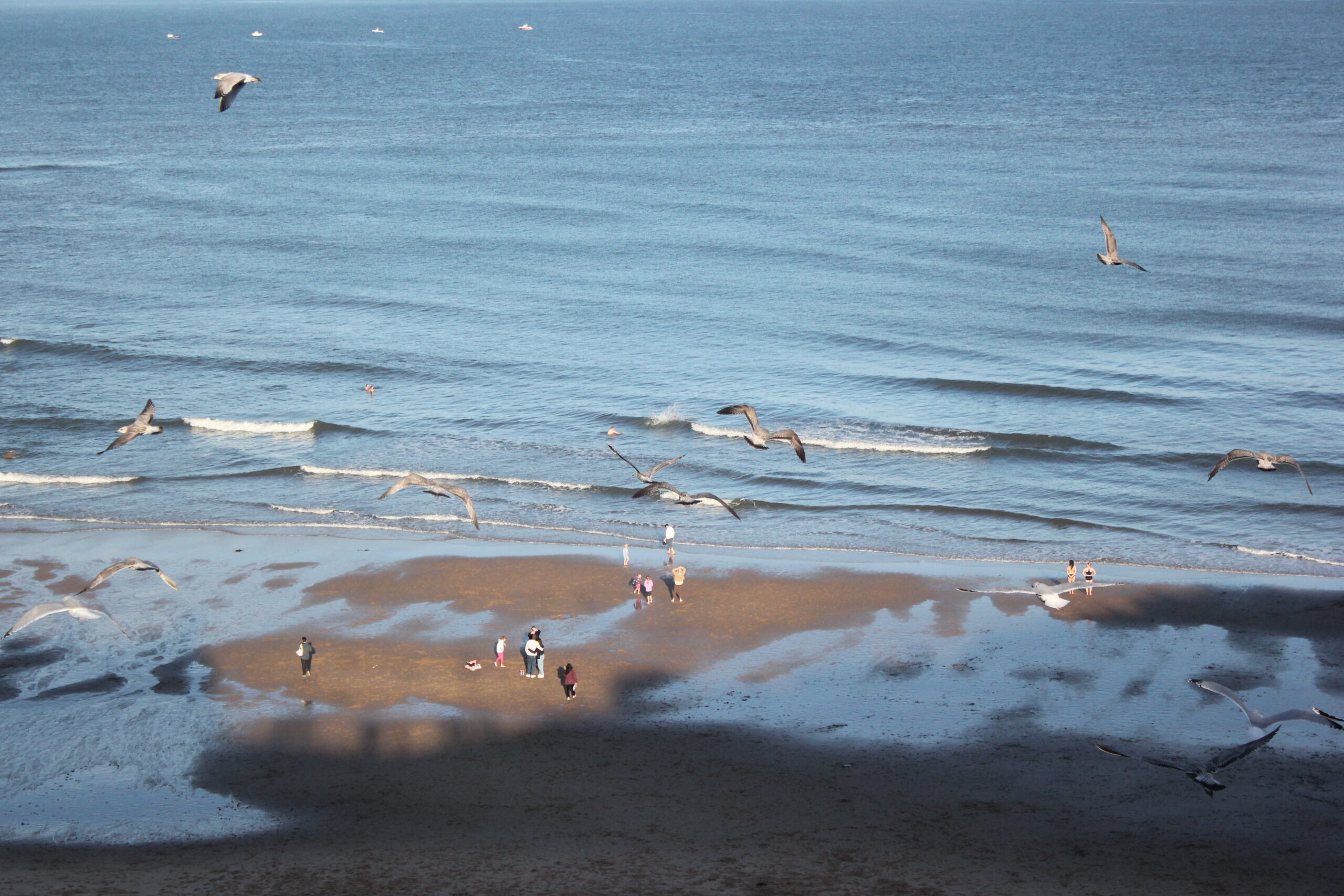
Featured Image – Toby Dossett.