
By Charles FitzGerald
Circa 2011, I was browsing the small film section of my primary school’s library. It housed the usual suspects – Barnyard, Open Season and, bizarrely, Bridget Jones: The Edge of Reason (one for the mums, I suppose?). Even stranger was the sun-faded, garishly noughties DVD – bearing its title in big, bold Comic Sans; Thunderpants.
The synopsis was weirder still: a ten-year-old boy with incredible flatulence who dreams of becoming an astronaut is recruited by NASA to assist in a life-or-death rescue mission. Upon reading the blurb, a resounding wave of ‘what the fuck?’ washed over me. I had another read before opting for Coraline.
Thereafter, Thunderpants haunted a young Charles. I couldn’t shake the confusion, bordering on concern – how on Earth could they make a children’s film about something so puerile? Who would green-light such a thing? Why was a bespectacled Rupert Grint on the cover? My father claimed he’d once caught a portion of it on TV – calling it “one of those British films that’s desperate to be American”. I asked if he’d recommend it and, with commendable economy of language, he replied, “No”. The conversation moved swiftly on.
Morbid curiosity eventually got the better of me. I searched for Thunderpants in my father’s old Radio Times compendium, where it received a scathing one-star review from Alan Jones. In an ingeniously subtle play-on-words, Jones hailed the film “an absolute stinker”, and “excruciatingly vulgar”. That clinched it; I had better things to occupy my mind with than a 2002 family comedy about farting – such as my forthcoming Year 2 SAT exams.
Thunderpants was co-written and directed by Peter Hewitt, whose resume is a diverse roster of light-hearted 1990s films, from Bill and Ted’s Bogus Journey to The Borrowers. The film was shot over the summer of 2001 on a modest $7 million budget, though it ultimately failed to recoup even half of that at the box office. Its production company, Pathé, must have had some faith in Thunderpants – as the film boasts a baffling all-star cast:
Paul Giamatti of Sideways, Ned Beatty of Deliverance (responsible for the titular quote), Stephen Fry of supposed ‘national treasuredom’, Simon Callow of Four Weddings and a Funeral, Rupert Grint of a little-known multi-billion dollar franchise about an adolescent wizard, and a young (uncredited) Keira Knightley. The lead, Bruce Cook, retired from acting following the film’s release in May 2002.
My first viewing of Thunderpants came in the advent of the first national lockdown. I can’t quite remember why I sought it out – probably the urge to extinguish the spectre which burned in my psyche for the preceding ten years. Within the film’s opening five minutes, something becomes abundantly clear: the blurb on that sun-faded DVD does no justice to the debauched lunacy that is Thunderpants’ plot.
Here’s a fun little exercise for you. Of the following, which do you reckon is a genuine Thunderpants plot point? Bear in mind, the British Board of Film Classification awarded the film a ‘PG’ certificate – citing “some crude humour”.
I.) A newborn baby quite literally flies out of his mother’s womb – as the doctor exclaims, “We’ve got a flyer!”
II.) A young boy’s flatulence becomes so unbearable, his father permanently leaves the family home – and his mother turns to chronic alcoholism.
III.) A young boy, named ‘Patrick Smash’, accompanies an opera singer on a world tour – producing an unattainable high note with his “unique gift”.
IV.) A young boy is placed before a firing squad after accidentally murdering an Italian man with his flatulence.
V.) A young boy is strapped to a methane-powered rocket thruster. The resulting flame prompts Paul Giamatti to punch the air and yell “hot dog!” for some reason.
Your suspicion is correct; they are all, indeed, real components of Thunderpants’ plot. Like young Charles, you are likely questioning how – and to what end – this made the journey from Hewitt’s ‘lively’ imagination to national cinema screens. Having had fifteen years to mull this over, I feel well-equipped to answer. Despite the feeble special effects, the unsavoury green set-design, and the off-putting inappropriateness of the whole thing, you’d be hard-pressed to call Thunderpants
a “bad film”.
Thunderpants treats its audience with respect – developing its juvenile premise with surprising restraint. In careless hands, Hewitt’s central, crude conceit would wear thin very quickly. And yet, in a film about a young boy’s inability to control his flatulence, the wind-breaking becomes almost incidental – a vehicle for an earnest message of overcoming adversity and pursuing your dreams. It’s just as schmaltzy as it sounds, but only the most cynical could fault the ambition.
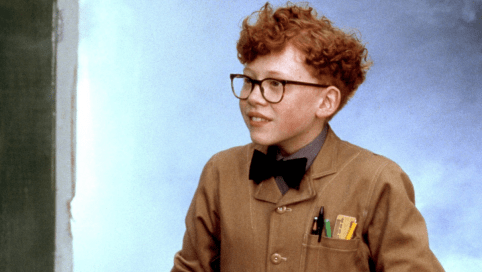
The central performances are similarly earnest, though they effectively serve their purpose. Cook plays ‘Patrick Smash’ with a perpetually gormless gaze, as unperturbed by his school bullies as he is by appearing before a firing squad. Grint echoes Jerry Lewis’ Nutty Professor in his role as Cook’s only friend – a child prodigy who lacks a sense of smell. None of the all-star cameos phones it in either – revelling in the material’s Viz-like absurdity.
Most striking is Thunderpants’ no-bars approach to cruelty. Under the guise of a Beano comic strip brought-to-life, the film is relentlessly bleak. The lead – a ten-year-old child, mind – is mercilessly bullied, neglected by his parents, insulted by a criminal barrister, and exploited by questionable NASA officials. Hewitt’s message – ostensibly “life is shit, so do what you can with
what you have” – is refreshingly honest, and seldom posed in children’s media.
Despite my modest praise, I find myself in agreement with young Charles. A children’s film with such a puerile premise should probably not exist. At risk of sounding puritanical, there’s a myriad
of subject matter Hewitt could have used as a crux for the ‘follow your dreams’ moral. Equally, I must concede, Thunderpants is as good a film about farting could possibly be.
Thunderpants was met with widespread critical derision and quickly fell into DVD bargain-bin – and school library – obscurity. It performed so poorly at the UK box office that Pathé released the film straight-to-DVD in the US, several years later. The US poster prominently features a much older Rupert Grint, bearing little resemblance to his appearance in the film; a desperate attempt to cash in on his Harry Potter fame.
For years, Thunderpants remained a barely-visible stain on the memories of those who saw it as children. However, recently, many have taken to TikTok and X to express their glee that Thunderpants wasn’t just a bizarre fever dream – and defend the film as a childhood favourite.
The cast seems similarly fond of the film. During a press junket for The Holdovers in 2023, Paul Giamatti was visibly delighted at an interviewer’s reference to Thunderpants. He states, without a sliver of sarcasm, “Thunderpants is one of the most remarkable movies I’ve been in… It is a brilliant movie.”
In a sea of AI-generated slop – functioning solely as cheap babysitting under the misnomer of ‘children’s entertainment’ – a film as humble, unpretentious and charming as Thunderpants is well worth reevaluating.