
By Aliza Hussain
It’s 1990, and a 28-year-old Meera Syal walks into Channel 4 commissioner Karin Bambrough’s office with a modest pitch: a comedy about a coachload of British Asian women on a day trip to Blackpool, lifted straight from the outings she used to take with her aunties. She gets about five minutes in before Bambrough cuts her off with a ‘Mmh, sounds great,’ and greenlights it on the spot.
At some point during the past decade and a half, we seem to have decided that the 1990s were a golden age. I’m sick to death of the compulsory nostalgia loop, but when I hear my parents talking about their youth again, I can’t help but understand the mythology. The picture comes quickly. It’s the mid 90’s and you’re young and South Asian in London; it was only twenty-five years ago that your parents started from scratch in Hounslow, cursing the bare knees and booze. You grow up not allowed to speak English in the house and wear your first pair of jeans at the ripe age of seventeen. But that all didn’t matter now, they were remixing your music and playing it at Ministry of Sound, you had Talvin Singh winning the Mercury Prize, Apache Indian and Cornershop on MTV. Nights like Anokha at the Blue Note and Outcaste at Heaven pulled in mixed crowds. You could buy T-shirts from Club Kali, read about Goodness Gracious Me in The Face, and hear a dhol loop sampled on Radio 1. For the first time, the British Asian sensibility felt legible to itself, there was a humour built on self-consciousness, that diasporic reflex to pre-empt the gaze, to mock what you love before someone else does. With this came a wave of British Asian filmmaking that was stylistically self-authored, produced by artists operating in a space with no market to please.
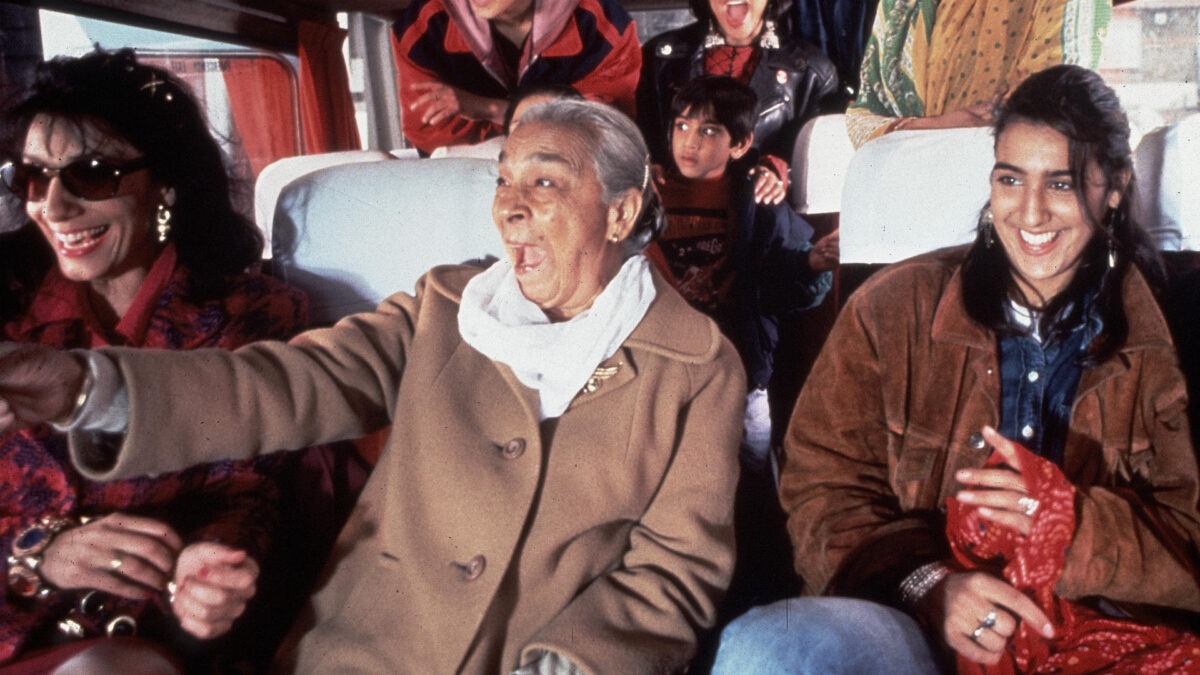
Syal’s 1993 Bhaji on the Beach follows a coachload of British Asian women heading from Birmingham to Blackpool, a trip rendered with warmth and acuity, and what sounds like a throwaway premise comes, in director Gurinder Chadha’s hands, a kind of moving chamber piece. The film gathers women at different stages of life and lets their fault lines rub up against one another: Asha, whose dutiful calm keeps slipping into lush Bollywood reveries, Ginder, brittle with the knowledge she might not survive her marriage, Hashida, gifted and frightened in equal measure, and the older women, who seem so sure of their authority it’s easy to miss the deep fear humming underneath.
Blackpool, with its rain slick neon and end-of-the-pier melancholy becomes a kind of diasporic purgatory, and, like David Leland’s Wish You Were Here or Andrea Arnold’s Fish Tank, Chadha understands the British seaside as a liminal space, a landscape that reveals the tension between who the women are and who they might briefly imagine themselves to be. Chada leans into this tension formally too, with the deliberately clashing colour palette externalising how the British and diasporic world never blend, only rubbing and scraping against one another. Saris flare violently under the North Sea light, and we are left with a sensory excess that becomes a kind of emotional distortion, with the environment exaggerating the feelings the women have learned to mute at home. We see this most clearly in the fairground mirror scene, where Hashida, pregnant by Oliver, a Black man her family would never accept, finds her crisis reflected back at her in warped glass, a private fear becoming theatrically public, with the carnival brightness stretching it into something almost surreal.
Ultimately, the cheap magic of Blackpool drains away, leaving the women back on a Birmingham pavement with nothing resolved, only with the film’s ending leaving us with the salty aftertaste of a long day. Chadha rejects the tidy dramaturgy of a social-issue film; her ending is closer to the British New Wave’s open wounds, but with a reconfigured centre of gravity. Instead of the working-class man railing against the system, we get women whose interior lives have simply been made visible, and that visibility is its own form of political charge. The movie’s themes; double lives, cultural drift, the choreography of belonging, have since become familiar to the point of cliché, but only because Syal and Chadha made them possible.
Around the same time, Hanif Kureishi was scripting My Beautiful Laundrette, folding Thatcherite greed and queer desire into one clammy Soho bedsit; Asif Kapadia was reshaping the British epic with The Warrior; and Chadha herself would soon make it to the mainstream with Bend It Like Beckham. These films, emerging under the flush of Cool Britannia, were made possible by conditions that now feel unreal. Public broadcasters still believed in cultural risk; Channel 4’s minority-voices remit had teeth, the UK Film Council was throwing real money at first-time writers, and London, under the soft-touch optimism of early New Labour, was busy selling itself as Europe’s great multicultural experiment. But that civically confident Britain is gone, and what replaced it could not be less hospitable to that kind of filmmaking. The broader guttering of working-class film culture, youth theatres, public bursaries, regional workshops, took this locally rooted, auteur-driven style of British Asian cinema down with it. What remains isn’t absence but attenuation. It’s not hard to spot a British Asian face in Netflix’s new wave of London-set diaspora romances; charming, energetic, but speaking the lingua franca of a global market where representation is inherently branding. And of course, immigration has become a permanent election-cycle bogeyman. We’ve lost the sense of a world built from the inside, and what’s taken its place is a cinema that performs identity outwardly. It’s telling that the two of the most interesting British Asian figures of the past decade, Riz Ahmed and Dev Patel, became themselves elsewhere. Ahmed’s most radical work has been funded across the Atlantic; Patel’s most substantial roles have come from directors who aren’t British at all. Their talent is unmistakable, but it has flourished in a vacuum. Britain grows the artists; it no longer grows the conditions that let them tell stories at home, and in a landscape where fewer artists can afford to begin in the margins, this realist, first-generation strand of filmmaking has dissipated.
This is where the 90s return in sharper relief. That brief British Asian cultural boom; the fusion records, the fashion, the films made from inside the community rather than at its expense was an infrastructure. A moment when Britain was porous enough, and publicly funded enough, for new voices to shape the culture rather than just appear within it, as Syal once did. Its disappearance matters less as a pang of nostalgia than as diagnosis: proof of how thoroughly we’ve dismantled the conditions that once made artistic risk possible.
Featured Image: BFI