
By Robin Reinders
‘In order to communicate the message entrusted to her by Christ, the Church needs art. Art must make perceptible, and as far as possible attractive, the world of the spirit, of the invisible, of God. It must therefore translate into meaningful terms that which is in itself ineffable.’
– ‘Letter of His Holiness Pope John Paul II to Artists’, 1999
The visual culture of Catholicism does not naturally derive from an appetite for ornament. The earliest occupants of its interior life were men who fled from it. In the deserts of fourth-century Egypt and Syria, the first Christian monks stripped worship of every available excess, reducing religious life to silence, fasting, prayer and the barest material conditions requisite for survival. That this tradition of radical asceticism lies at the root of Catholic theology already complicates any easy association between worship and sensory indulgence. Indeed, Catholic form does not intrinsically lend itself to illustration nor to expression nor even to the beautiful – but crucially it does not refuse these as byproducts of the sensible mediation of grace. To beg the question Why does Catholicism look like that? is to interrogate the means by which the Catholic church makes belief legible – why it translates scripture into bodies and things and space and craft, and why it continues to argue that beauty, when shepherded by the proper hands, is not betrayal of truth, but one of its modes.
At the root of Catholic visual representation lies the doctrine of the Incarnation: the assertion that the Word became flesh, and so the divine enters and inhabits matter without diminishing Creator or elevating creation. Catholicism habitually locates revelation in the transubstantiation of things: bread, wine, oil, water, fabric, light, gold. It is obsessed with the material, the corporeal and the kinaesthetic. The science of Catholic sacramentality firmly insists that the sign is not necessarily signifying in the semiotic, Saussurean sense of things, but efficacious, meaning it both points to and communicates what it signifies. The icon is allowed and venerated not for its own sake, but because it points beyond to the subject which it stands for. It is the sacramental telescope by which we see that which is invisible. Cardinal Nicholas of Cusa made this clear: ‘Creative art, which it is the soul’s good fortune to entertain, is not to be identified with that essential art which is God himself, but is only a communication of it and a share in it.’ (Dialogus de Ludo Globi) Communication, then, lends itself to teaching, does it not? The imagery of the church, as is possibly rather plain, once primarily served a practical purpose as the visual vehicle of catechism. For much of Western history, the fluctuating Catholic population remained largely illiterate. Pictorial gospel allowed for the narration of salvation to the faithful who could not consume the inaccessible Latin of vernacular texts. For this reason, such figures as Saint Thomas Aquinas and Pope Saint Gregory the Great endorsed the theological basis for an aesthetic that privileged intelligibility.
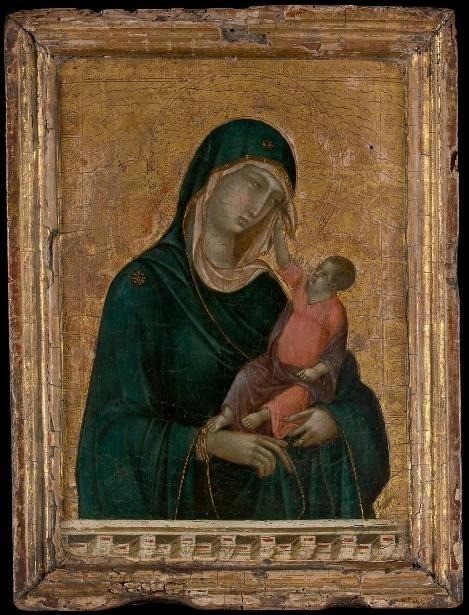
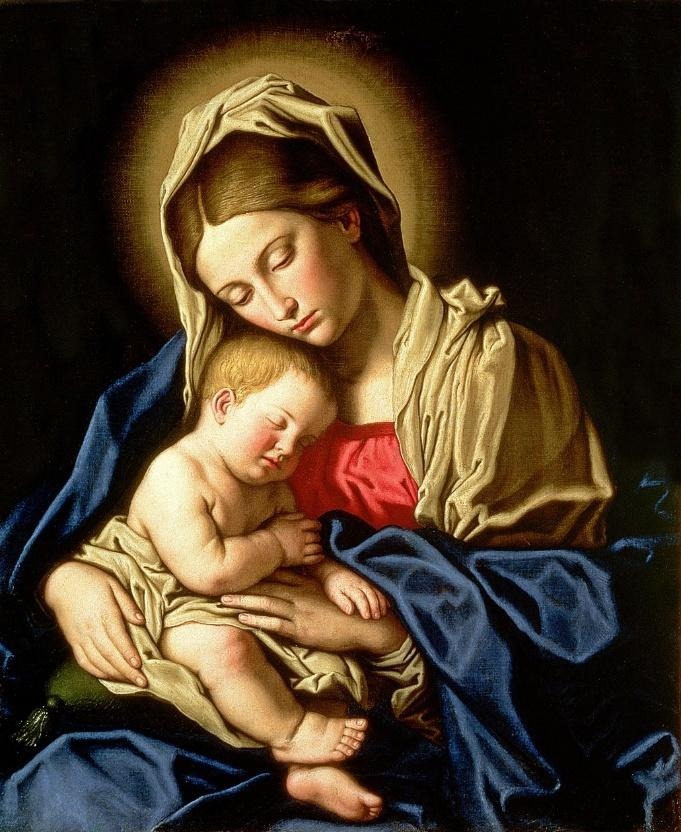
Madonna and Child, Duccio di Buoninsegna, ca. 1290–1300 / Madonna and Child, Il Sassoferrato, c. 1650.
If the visual culture of the Catholic church is solely fashioned for ‘the instruction of the uneducated’ (Aquinas, Commentary on the Sentences), why then do we begin with the dull, painfully emblematic representation of the Madonna and Child in the sacred catechistic art of the Middle Ages, and how do we burgeon into the diffused and delicate, near-ethereal proto-Baroque style of the Counter-Reformation? What necessitates and rationalises this shift? Theologian Hans Urs von Balthasar understands beauty as entirely inextricable from the glory of God, claiming that ‘beauty demands for itself at least as much courage and decision as do truth and goodness, and she will not allow herself to be separated and banned from her two sisters’. (The Glory of the Lord) Beauty is thus the manner in which earthly creatures manifest that glory, and thereby invite love and prayer. This synthesis of ideas finds parallel claim in the more classical, Greco-Roman metaphysic of beauty put forth by Plato: ‘The power of the Good has taken refuge in the nature of the Beautiful.’ (Philebus) It is also an idea agreed upon by ecclesiastical authorities of our contemporary day – the late Pope John Paul II concurred: ‘beauty is the visible form of the good, just as the good is the metaphysical condition of beauty’. The virtuous and the picturesque are essentially tied-up; that which is more lovely to look at is more noble by nature.
Early Christianity inherited from Judaism a deep suspicion of sacred imagery, shaped by Old Testament prohibitions against graven forms (‘Thou shalt not make unto thee any graven image, or any likeness of any thing that is in heaven above, or that is in the earth beneath, or that is in the water under the earth’, Exodus 20:4) and made sharper by the ever-present danger of idolatry (‘Confounded be all they that serve graven images, that boast themselves of idols: worship him, all ye gods’, Psalm 97:7). Under the Roman Empire – where Christians were a persecuted minority and pagan visual culture was both ubiquitous and polytheistic – Christian imagery emerged furtively, under a cloak of ambiguity. The earliest surviving artefacts of Catholic art are to be found in the subterranean caverns of the Roman Catacombs. The grapevine, the peacock, the Good Shepherd – each illustrated motif throughout the tombs deftly held a secondary latent meaning, operating as polyvalent signs intelligible to the initiated, yet inconspicuous within a familiar pagan visual economy.
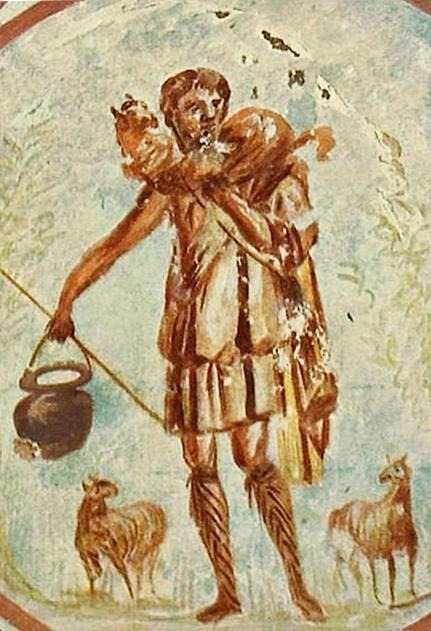
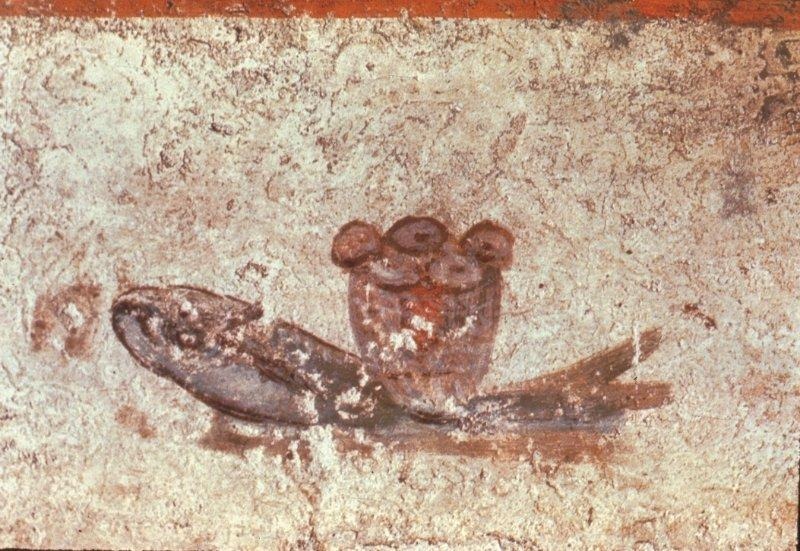
‘Good Shepherd’ fresco and ‘fish and loaves’ fresco from the Catacombs of San Callisto in Rome.
It was only by way of prolonged doctrinal discourse – finally culminating in the Second Council of Nicaea in 787 – that the Church formally resolved the iconoclastic crisis, and confirmed that honorary veneration of images was permitted, though true adoration was to be reserved only for God Himself. With this conciliar decision, the image was finally affirmed as a legitimate participant in Christian devotion: not an idol or a mimetic attempt at rendering the divine, but a relational object and instrument of worship. This hesitant and cautious quality of early Christian iconography reflects an aesthetic history rooted in vigilance and restraint – certainly not in excess – whether due to fear of persecution or of deceiving one’s own faith. The legitimacy of the Catholic ‘look’ has always been something earned with time.
As Christianity travelled from the margins of Roman society to its imperial centre, its aesthetic posture necessarily shifted. The legalisation of Christianity under Constantine in the early fourth century precipitated a dramatic change in scale: worship moved from the domestic home and secreted altars into public space. And with this transition arrived architecture.
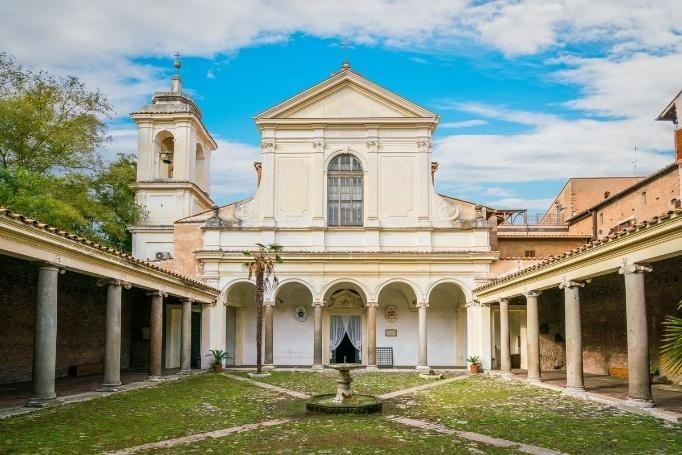
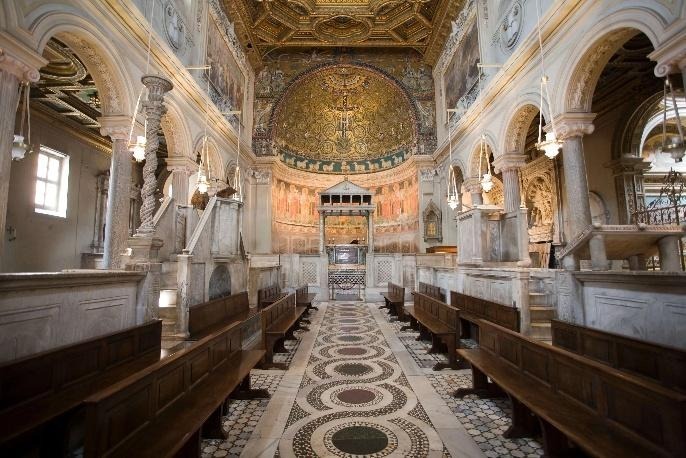
Basilica di San Clemente al Laterano in Rome. Once a private home and site of covert Christian worship in the first century, now a public basilica since the sixth century.
The earliest monumental Christian churches did not invent a new architectural idiom so much as appropriate one already embedded within Roman civic life. Ancient temples or civil buildings, such as the Pantheon in Italy or the Baptistère Saint-Jean in France, were common targets of conversion. Though it was the Roman basilica – used for legal proceedings, commercial exchange and public assembly – which offered a site uniquely suited to Christian worship. Unlike pagan temples, which functioned antithetically as enclosed dwellings for deities and were often visually inaccessible to the populace, the basilica was designed to hold bodies in common, encouraging ritual and interaction. This distinction is paramount: Christianity did not require a house for God, it sought a space for divine encounter. The basilican plan with its longitudinal axis, central nave, flanking aisles and projecting apse embodied the Church’s self-consciousness as a gathered community of people rather than a cult of contained divinity. Particular attention is paid toward space and orientation because this inscribes certain eschatological expectation into the building itself. As clerical hierarchies developed, so too did the structure of the church; the bema, transept and eventually the Latin Cross plan emerged among sacral architects to accommodate liturgical complexity whilst embedding salvation history into the body of the church.
Yet even as scope increased, imagistic restraint largely remained in situ. Early basilicas such as the Archbasilica of Saint John Lateran exhibit an almost paradoxical sobriety. Exteriors relatively plain, often brick, resisting the monumental façades of surrounding imperial architecture. Interiors luminous though hieratic: figures hovering static rather than occupying space as you or I might. Saints rendered frontal, flattened, deliberately dimensionless and disembodied by virtue of theological caution. The sacral image was not yet trusted with naturalism.
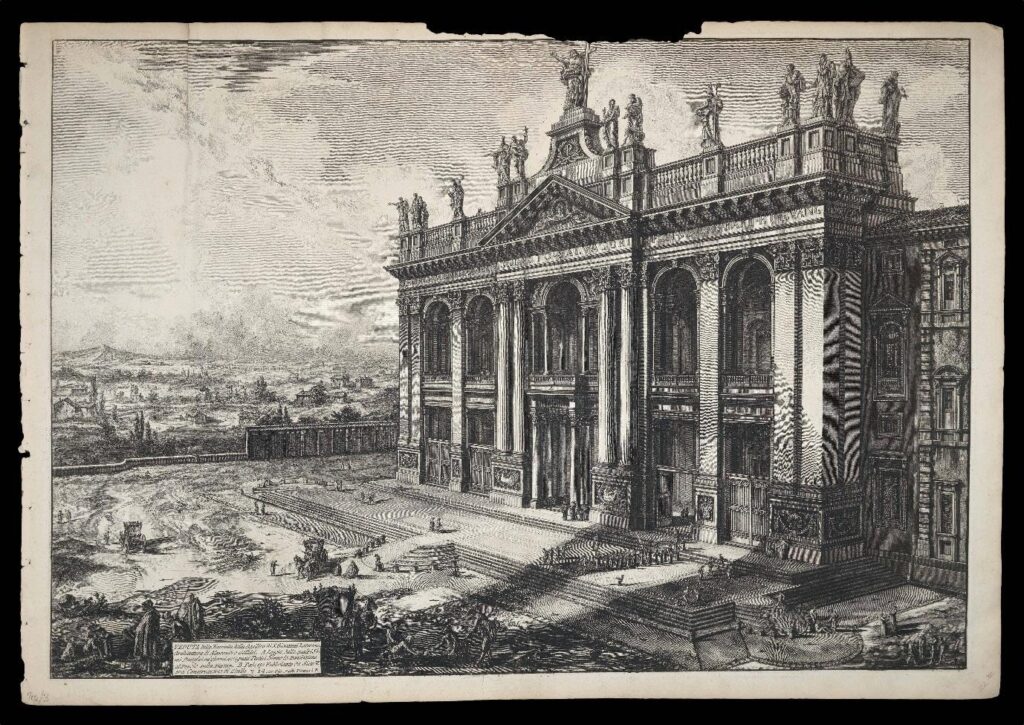
Archbasilica of Saint John Lateran, engraving by Giovanni Battista Piranesi (1775). Founded in 324, it is the oldest basilica in the Western world.
With the emergence of Gothic architecture in twelfth-century France came a decisive aesthetic turn towards aspiration and height – both literally and religiously. The introduction of such iconic features as the pointed arch, rib vault and flying buttress reconfigured the model understanding of how the Catholic church presents itself. By redistributing structural weight outward and downward, Gothic architects freed interior walls, allowing for new height and light. Churches rose vertically, straining upward as though neck vertebrae, their skeletal frames reaching into dizzying spires and dissolving into expanses of stained glass. Worshippers were bathed in truth and righteousness, God’s presence streaming in from the apertures, cradling faces with long, kind, coruscating fingers.
Characterised by immense human labour, intricate geometrical design and centuries-long construction projects, the building of a Gothic duomo or cathédrale must be understood first and foremost as an act of worshipful tribute, not an indulgence in creation itself. The church was a collective offering on behalf of the people, a sustained and painstaking liturgy enacted across generations of effort and attempt. Effigies grew increasingly vivid, rose windows with intricate mullions and tracery impressed the eye, detailed frescoes spilled marvellously onto lofty cross vault ceilings. The Church was no longer the self-effacing provider of a place of worship; it had now begun to shape the Catholic’s sensory imagination. Still, the visual of the Gothic remains vertical, gestures heavenward; it does not yet engulf. That shift only comes on the heels of crisis.
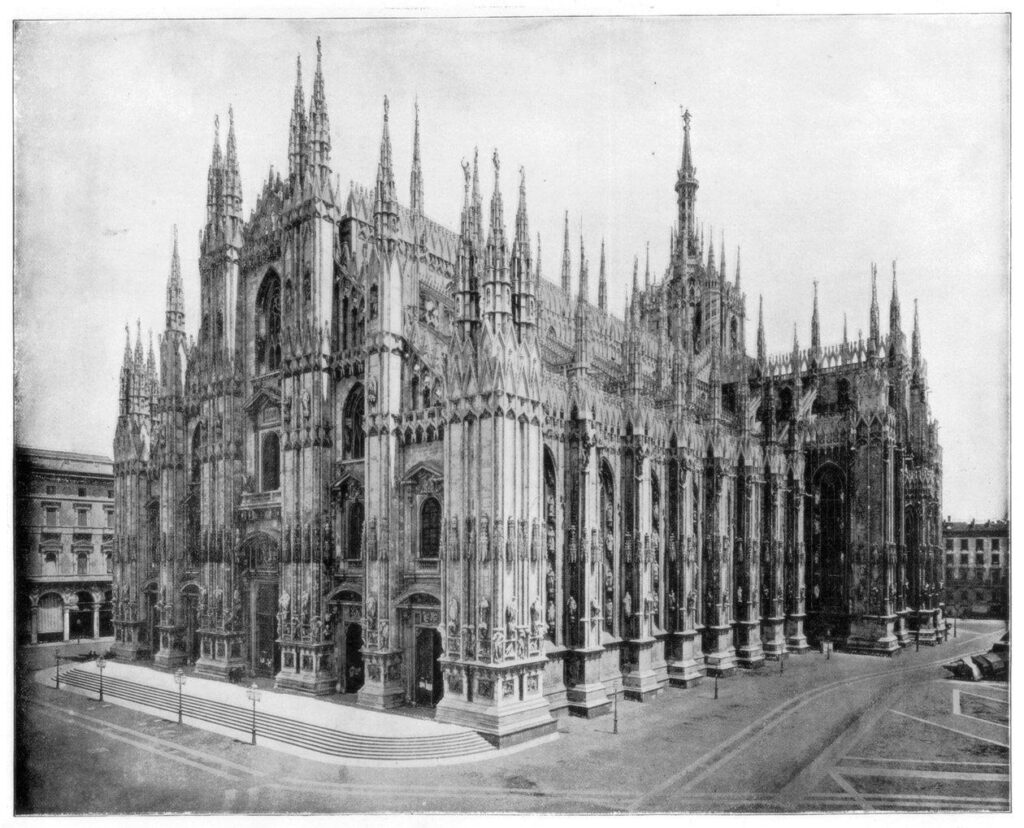
Duomo di Milano, John L. Stoddard, 1893.
The Protestant Reformation of the sixteenth century saw an attack on sacred material culture. Images were condemned as distractions, the splendour of structure as a corruption of pure faith. Iconoclasm was the logical terminus of reformist zeal, the consequence of a faith-branch which understood entitfied religious practice as an obstacle to worship rather than its vehicle. In response, the Catholic Church was forced to articulate – explicitly and defensively – the core principles which had long undergirded its aesthetic culture. The Council of Trent reiterated the legitimacy of sacred images as pedagogical and pastoral necessities: art was reaffirmed as the endeavour of teaching, moving and converting. The Counter-Reformation – soon to be followed by the Baroque – had settled upon the Western religious world.
Intensely concerned with the bodily, the Baroque church is the church of the corporeal. It is a space – elastic and kinetic where it was once static and axial – engineered to produce affective response. Awe, disorientation, intimacy, rapture, overwhelm. Columns twist and hurtle upward. Ceilings open into illusionistic heavens which collapse the now-foggy distinction between the earthly and the divine. Perhaps most critical is the dissolution of inherited boundaries between artistic mediums in order to overburden the spectator’s capacity for detachment. Architecture frames sculpture; sculpture erupts into painting; painting bleeds into the calculated orchestration of light itself. Nothing remains autonomous, nothing stands in solitary. The gesamtkunstwerk of the Baroque church constitutes a single persuasive apparatus, calibrated to render theological abstraction experientially irrefutable. Devotion is no longer confined to the mind or mediated primarily through scripture; it is staged as a transcendent encounter unfolding in real time before and around the worshipper. God feels proximate, inconceivably so.
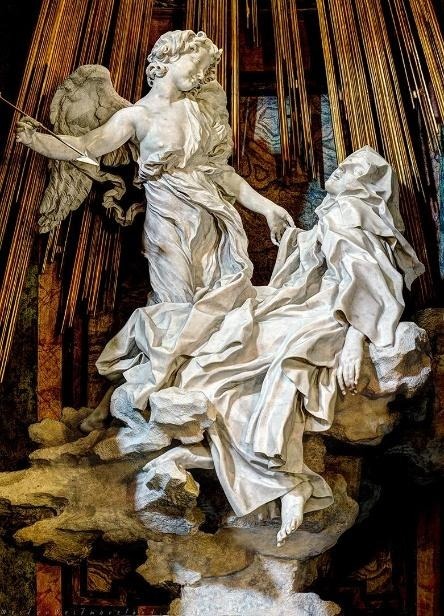
Ecstasy of Saint Teresa, Gian Lorenzo Bernini, 1652.
I ask you to consider Bernini’s Ecstasy of Saint Teresa as a prime instance. The collapse of the body, the slackness of the jaw, the give of the posture inviting divine invasion. Hidden windows flood the chapel with golden light; marble becomes skin before you; architecture frames the allegory of revelation as a spectacular event. Grace acts upon the body. We are less observer and more witness here, are we not? Hand over mouth, breath held, frozen in this theatre of the ecclesiastical.
At the risk of sounding impious, when one steps into a seventeenth-century cathedral at times it does very much feel like stepping into an opera house. The Baroque is infatuated with theatricality, with staging and motion and chiaroscuro and synergy with the senses. Gold leaf and incense and marble and mosaic and choral polyphony and monastic chant and processional banners. It adores texture and lustre and materiality. Urges lavishness as well as durability. And what of scripture – the written Word? ‘Forasmuch then as we are the offspring of God’, the New Testament insists, ‘we ought not to think that the Godhead is like unto gold, or silver, or stone, graven by art and man’s device’. (Acts 17:39) I remind you that objects of sacramental action command honour, serving as intermediaries between heaven and the earth. What are the vestments and vessels of Catholic worship if not the Church’s firm and concrete assertion that the sensible is our only means to communicate the eternal? To signify the worthwhileness of the world God has created? Gold cannot make God more precious.
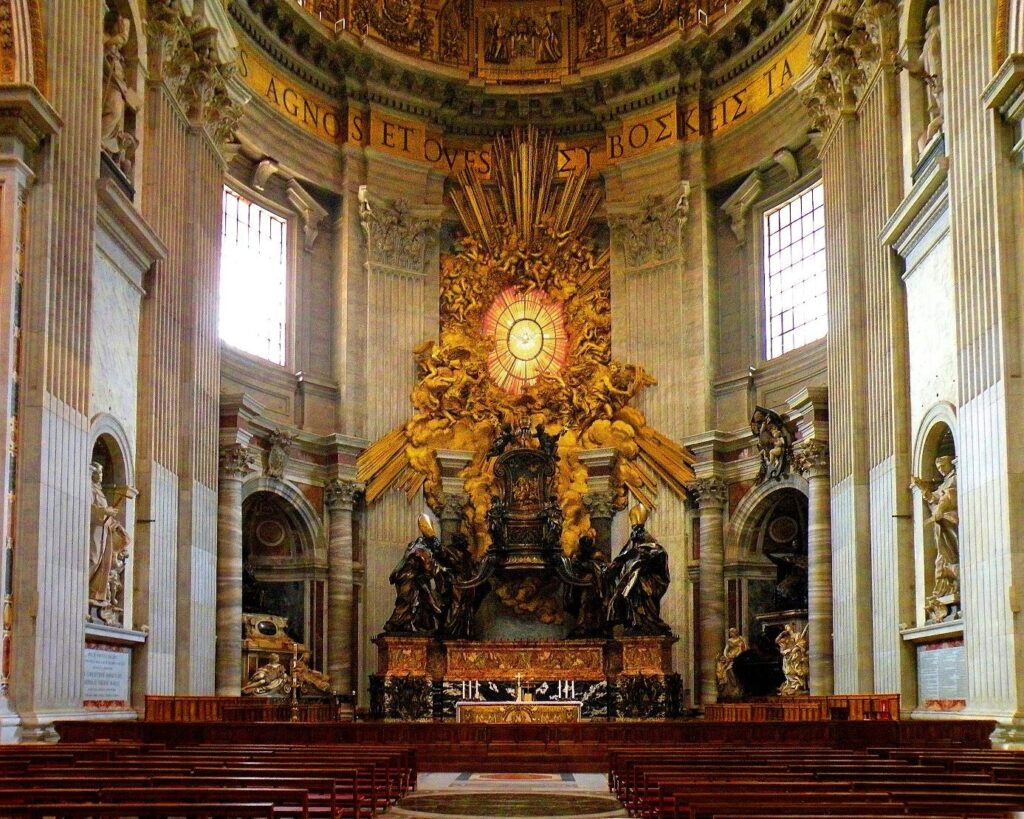
Apse of St Peter’s Basilica in Vatican City.
One of our greatest popes, John Paul II, wrote a deeply galvanising letter addressed to the artists of our day in 1999. Within this letter, he asks the question ‘Does the Catholic Church need art?’ He responds in the affirmative:
‘Art has a unique capacity to take one or other facet of the message and translate it into colours, shapes and sounds which nourish the intuition of those who look or listen. It does so without emptying the message itself of its transcendent value and its aura of mystery.’ (‘Letter of His Holiness Pope John Paul II to Artists’)
Though perhaps more of interest and quite remarkably, he also begs the question: ‘Does art need the Catholic Church?’ On this dynamic, he says ‘it has been a great boon for an understanding of man, of the authentic image and truth of the person’, and invites artists to ‘enter into the heart of the mystery of the Incarnate God and at the same time into the mystery of man.’ In our contemporary cultural economy, it is compelling and tremendously significant that the Catholic visual language survives in secular culture.
Its aesthetic vocabulary of precious metals, brocade, embroidery, architecturally-informed silhouette and sacred motif continues to resonate, particularly in the world of fashion. In 2018, the Metropolitan Museum of Art Costume Institute hosted an exhibition titled Heavenly Bodies: Fashion and the Catholic Imagination. Curated to explore the intersection of sacral visual codes and haute couture, it featured creations from Dior, Valentino, Jean Paul Gaultier and Dolce & Gabbana among many others, highlighting how liturgical chasubles, conical mitres and bejewelled reliquary crosses may function as purely visual language, divorced from worship though still inviting conversation and commemoration.
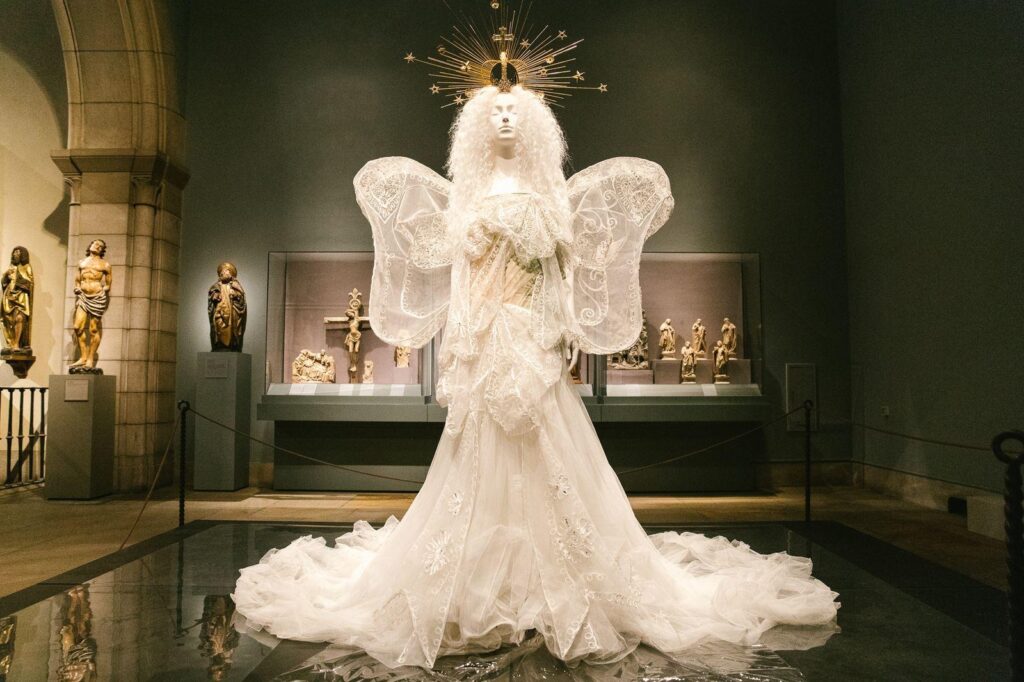
Heavenly Bodies: Fashion and the Catholic Imagination at the Metropolitan Museum of Art / John Galliano for Dior: Evening Ensemble, Autumn/Winter 2005–6 Haute Couture.
Catholic imagery seems to thrive in this postmodern cultural afterlife because it carries an almost preternatural formal logic. For non- or nonpracticing Catholics, its characteristic verticality, hierarchy, symmetry and ornamentalism are legible even without contextual doctrinal framing. Gold filigree retains its connotations of sacredness, authority and value whether it is found in the Igreja de Santa Clara or the bodice of a John Galliano gown. Crucifixes and rosaries become motifs in jewellery, home decoration, graphic design. Even sans liturgical function, they signal drama, gravitas or a sense of ritualised performance, making them attractive to visual directors and cultivators of culture. The potency of Catholic iconography persists – whether celebrated or critiqued – independently of explicit belief, and its visual lexicon continues to exert cultural influence even in a world that may no longer consciously acknowledge its origins.
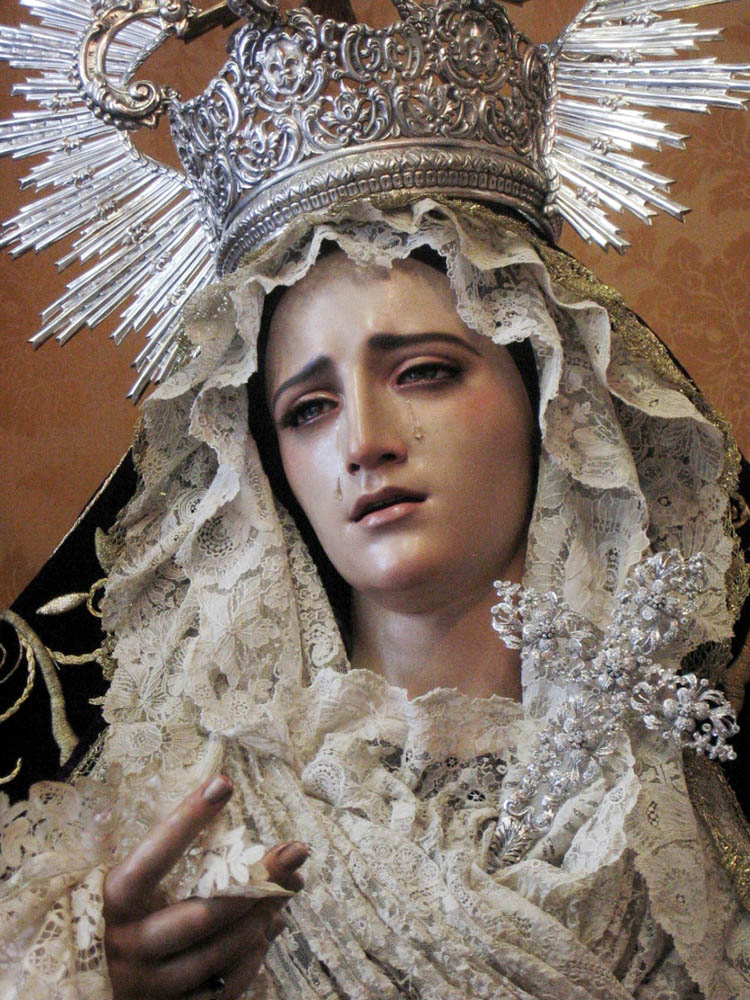
Featured Image: ‘María Santísima de la Aurora’, Francisco Romero Zafra, 2008