By Cara Cahill
I’ve been thinking a lot about Brian Friel’s masterpiece, ‘Translations’: a story of the anglicisation of Irish place names by the British government in the 1830s. I absolutely recommend reading this short wonder of a play, suitable for all journeys, such as my own on a dusty Transpennine to Manchester last summer.
Reading ‘Translations’ will not just imbue an intimate understanding of those of us across the Irish Sea, but communities across the world who have experienced similar numb erasure of their cultures, heritage, and identity. At a point in the play, a character named Hugh is talking to a British soldier and explains why he does not speak their language, saying ‘English […] couldn’t really express us.’
Why, apart from my deep-rooted Nationalism and unwavering resentment, did this line stick with me so steadfastly? My reason is not exactly what I feel Friel had in mind, and it is slightly ironic that I’m going to try to explain myself using English, but I really will try – just bear with me.
I’ve been thinking a lot about how difficult it can be to express ourselves, especially when it feels that language is failing us. It is noticed particularly when trying to cope with some sort of hurt or grief, how difficult (near impossible) it is to translate our own feelings. In Adichie’s ‘Notes on Grief’, she talks about how ‘glib condolences can feel’, and how much ‘grief is about language, the failure of language and the grasping for language.’ This failure, and grasping for something, anything that feels big enough. Some words large enough, massive enough, encompassing enough, to even touch the periphery of grief. Saying it over and over doesn’t help, saying it over and over doesn’t help. How can we truly express ourselves if language is incapable?
The ebbs and flows of our minds don’t always feel explainable by words. What I’m feeling in this present moment isn’t always able to be transcribed. How can we possibly convey the depth of our love for a friend, the joy or sorrow of a moment, feeling so frustratingly restrained by our words? English can feel so bland, so empty of all nuances. A feelings chart of choices staring back, suggesting mad, bad, sad, glad – how can we expect to slot ourselves neatly into such boxes, such maddeningly smug rhyming boxes?
For Irish people, at least, there seems a visceral reason for this weakness, which I can admit (humbly) was put more eloquently by Joyce than I ever could. He describes the Irish as a people, ‘condemned to express themselves in a language not their own’ (Portrait of the Artist in Exile). Following these meandering thoughts, it reminded me of something Woolf says in ‘A Room of One’s Own’ (please observe a moment of reverence for this hallowed work). She talks about the struggle of female authorship for the Austens, Elliots, and Brontës who came before us, illuminating their struggle of translating their ‘female thoughts’, when the only tools they had were masculine novels. For this intrepid female author, ‘there was no common sentence ready for her to use’ and instead she had to make her own.
Could something like the loss of language be the source of our emotional impotence, perhaps the reason we communicate through dry wit rather than emotive phrases and ‘feeling’ words? All Irish people, and I suspect many non-Irish people, can recognise the sometimes stifling, suffocating inability to express our feelings, itself a feeling of such intense discomfort at the thought of even approaching vulnerability that we’d sooner keep it inside.
To turn back to Friel, and with a more positive spin than the gloomy picture I have been painting thus far, it is through art and literature, and music and film that we become able to translate ourselves. A poem or song can reverberate across the world, regardless of language. It is writers, like Woolf and Friel, who can translate our suffering and struggles into something that makes sense, that feels that it does us justice.
It is art, and language, that can bring us comfort in these times, a fierce reminder that we are not alone. — Particularly the Irish language, which Friel so lovingly depicts in ‘Translations,’ a language that certainly was not created for efficiency. Some Irish is wonderfully silly, such as Smugairle ron (smug-AR-leh ROAN)– the word for jellyfish that translates to ‘seal snot’ and Bunbhriste (bunya-vreesh-ta), which are trousers that are nearly worn out but still wearable.
Then others can leave more of a mark, like one my brother ,Conall, shared with me recently – Aduantas (ah-dwon-tes), which is the feeling of being somewhere new, a light fear with a tinge of sadness. The idea that a language can describe something so familiar so perfectly, is encapsulated by the author Manchan Magan (man-han magan) who says the Irish language is not just ‘different forms of grammar and syntax, but different ways of seeing the world.’
How beautiful and comforting that someone before us has not only been through this same thing, felt these feelings, traversed the emotional landscape, but felt them to the extent that they needed a word just for it! I think this, for me, is the true beauty of Friel’s writing, every Irish word and phrase has SO much meaning in it. From our Irish souls to our history, conflict, and craic, it is a beautiful language that somehow says so much more than words usually can. It cannot really be translated because the words are a feeling and they are who we are.
So, whether you take from this that you should listen to more Kneecap (which you probably should), or learn more Irish (I definitely should), the language is closer than you may think. It surrounds us, and with words such as Saoirse (freedom) and Cara (friend) comes an ability to express something beyond words.
Grá mór.
(FOOTNOTE: Massive thank you to my dear friend Caleb for his recommendation of this play, and for all the books I’ve stolen from him since.)
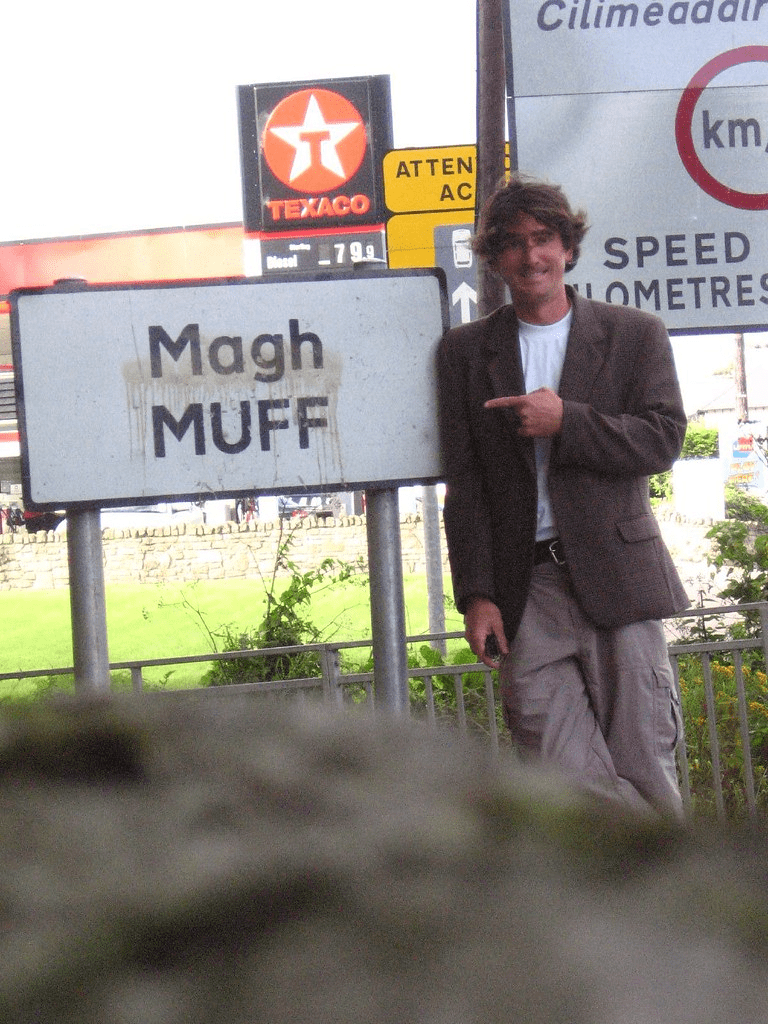
Featured Image: One of the more unfortunate results of the anglicization of place names – from the Irish word ‘Magh’, meaning ‘plain’. / Flickr
One reply on “‘What’s in a Name?’ (Quite a Lot, Actually): Exploring Friel’s Translations: In Pursuit of Translating Ourselves”
téann sé seo go crua