By Edward Clark
Wayzgoose’s Head of Reviews, Edward Clark, sits down with Laura Simpson and Lydia Jane Pugh – the writers of brand new musical Radio Silence.
This summer saw the world premiere of Radio Silence, a brand new musical about the Nazi occupation of the Channel Islands during the Second World War. Performed locally at the Princess Royal Centre for the Performing Arts in Guernsey, the show received glowing reviews from audiences and critics alike. Grappling with oppression, freedom, and resilience, the musical asks the same questions of its characters as it does its audience: “what would you risk to resist?”. After their first leg of performances, I sat down with writers Laura Simpson and Lydia Jane Pugh to discuss the musical, island identity, and its uncertain future against the backdrop of shrinking arts funding.
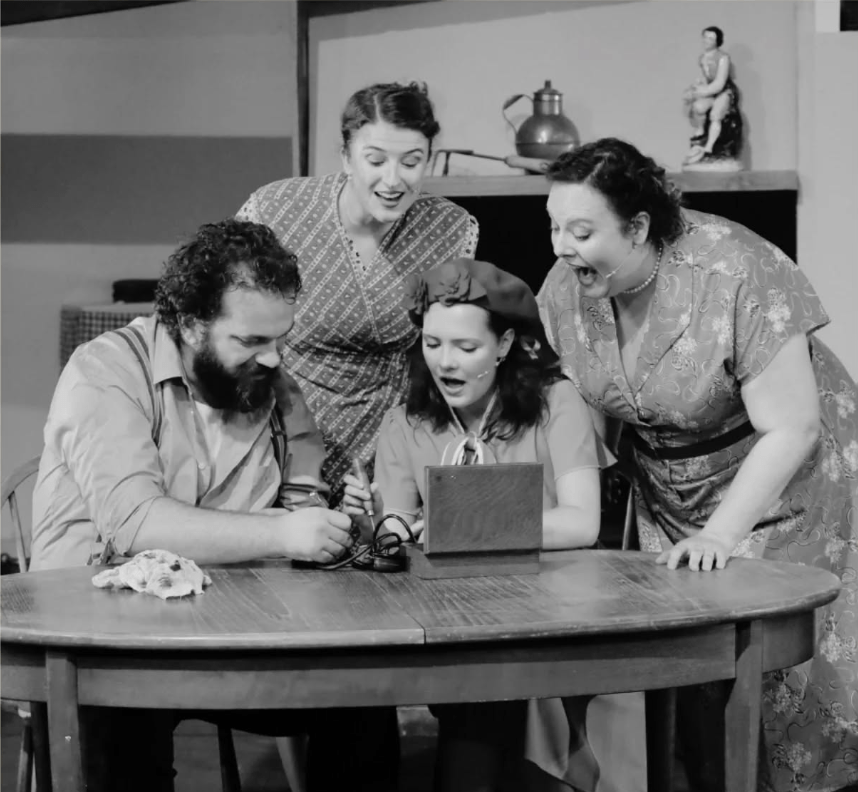
The narrative of Radio Silence follows the fictional Tabel family’s involvement with the Guernsey Underground News Service (GUNS), a secret movement during the island’s Second World War occupation which disseminated British news to islanders, banned from using radios by Nazi invaders. The detailed set of the Tabel family home offers a warm domestic sphere to juxtapose the unforgiving Nazi regime, as rules and taxes are imposed onto islanders. In response to this cold authority, the family begins to rebel.
The book and music are written by local writer Laura Simpson and musician Lydia Jane Pugh. Blending modern lyricism and raw emotion with period-accurate detail, the musical shines as an exciting exploration of Guernsey’s unique history. In the musical’s first moments, the string section’s discordant tuning transforms into the sound of an air raid siren. The oppressive atmosphere of the bombing of the Guernsey harbour in 1940 smoothly shifts into the opening number ‘Days of June’, setting a precedent for the rest of the play. Lydia spoke about her aim to embed the events and style of the period within the music itself: ‘the song ‘Spin That Dial’ is very much based on the Andrews Sisters, because we wanted that 1940s sound’. All six actors offer outstanding performances, imbuing Laura’s fictional characters with believable and gritty emotion – a believability necessary to match the detailed, period-accurate set. Many set elements were sourced from the Guernsey Rifle and Heritage Society, with genuine WWII identity cards, ration books, kitchen equipment and other elements utilised onstage. Props and costumes were recreated from original occupation artefacts. The generosity of locals speaks to the importance of art like Radio Silence. As Laura tells me, ‘we’re now at a stage where it’s coming out of living memory for the vast majority, and although it’s something that is an extremely traumatic period of our history, I think that because there’s that bit more space now, we can tell a more balanced, more human story’.
Fundamentally, the musical brings a story to life in a way that actually honours our local community. As Laura tells me, ‘we’ve seen other media interpretations of what Guernsey was like during the war, and they’re all often very inaccurate. And it was just that kind of feeling: why are other people telling our stories when we’ve got fantastic creatives. Our island produces a phenomenal range of really hardworking creatives. Why are we not telling these stories?’. Accordingly, there is a notable effort amongst the team to celebrate the island’s history. ‘I did manage to get a little bit of Sarnia Cherie [our unofficial “national” anthem] into one of the songs, which was so subtle that the violinist didn’t even notice’. An effort to celebrate island identity is reflected in the team’s detailed research, especially concerning accurate names and locations. Laura tells me: ‘that’s the thing that often, other representations have just got so wrong. I took it to the extreme because I’m a nerd, but you know, if I wanted to write a story set in Gibraltar, how would I find out what the local names were? I’d spend half an hour researching it.’
These references are not intended to ostracise non-islanders, but to celebrate Guernsey’s own community. When asking Lydia about the importance of a narrative faithful to our identity and history, she told me: ‘with a lot of those kind of subtleties throughout, in the lyric and the script as well, we wanted this to be accessible to any audience. But there will be audience members who are really listening, that will clock all those easter eggs. And that level of detail that we kind of layered on over time was really important to making it feel authentic’. That authenticity clearly resonated with the audience when I watched the sold-out second night: as a recording of Sarnia Cherie was played towards the end of the musical, older members began singing along amongst the crowd. The team were amazed by local support: ‘The response has just been obviously overwhelming’. ‘I mean I guess the thing that we are continually being asked is ‘when can we see it again?’. Evidently new art such as Radio Silence plays a key role in uniting local communities.
Looking forwards, Pugh and Simpson are hopeful about the future of the show. Laura comments that ‘I don’t feel like we’re done telling this story. Locally, we know that this is an audience for anything ‘occupation’. But when people who aren’t even necessarily die hard theatre fans are telling you it was extraordinary, you’ve got to take this further’. The team believe that Radio Silence’s characters and story are universal. ‘I mean, I keep going back to the quote from the line in the first song. “We should have seen it coming / We should have seen the signs / but our heads were planted deeply in the ever shifting sands.” I don’t think that line will ever not be relevant’. However, the team are unable to share the story of the Tabel family with new audiences without support. ‘In terms of taking this further, and as with all arts projects, it ultimately comes down to investment, and whether there are individuals, companies, organisations that want to get behind this project and help to take that piece of our history to a wider audience. Because ultimately, theatre is not a cheap sport. But we are both very passionate about it, and we do an awful lot just because we love it. You know, we cannot be asking people to work for free because that is not appropriate. It’s show business, and the emphasis on business is getting more and more significant’. To continue to share stories which connect with audiences on an emotional level, the team needs financial support – an ever-prevalent barrier to entry for emerging artists.
You can find updates about the future of Radio Silence on Instagram: @radiosilencethemusical
Featured Image: Radio Silence. Pictured (left to right), Michael Sullivan-Pugh, Lottie Ewin, Eve Le Sauvage, and Laura Simpson.