Categories
Perspective

Subjectivity and the art of Michelangelo’s penises

By Amelia Melvin.

About halfway through my audio tour, which guides me through the so-called Masterpieces of the Louvre Museum, I come across Caravaggio’s, ‘Death of a Virgin’. Placed in the centre of the Denon Wing, looming at a massive 370cm x 245cm, it certainly is hard to miss. The lady in my headphones speaks of its scandalous origins, and Caravaggio’s unpopular choice to depict the Virgin Mary as a prostitute, drawing on elements of the real rather than the sublime. The grieving apostles appear as ordinary men, and there is a darkness which emanates that is accentuated by the vivid use of the red and black background. What strikes me, is that despite my somewhat limited knowledge of Caravaggio, the artist, he was an artistic master of his time and thereby his art would be consistently valued. Needless to say, the grandeur of the painting before me does not disappoint. To learn, however, that this painting was rejected from the Roman Catholic Church of which it was commissioned, and that it was only venerated posthumously, definitely surprises me. Of course as a pretext to this, I am no expert in 17th Century Italian paintings, nor on the standards of Catholic art for that matter. However, learning of the Roman Catholic Church’s decision did get me thinking about the way in which there are no absolutes in our perspectives of art. The validity of an interpretation relies largely upon specific variables of time, place and person, all of which can be shifted through just a matter of opinion.

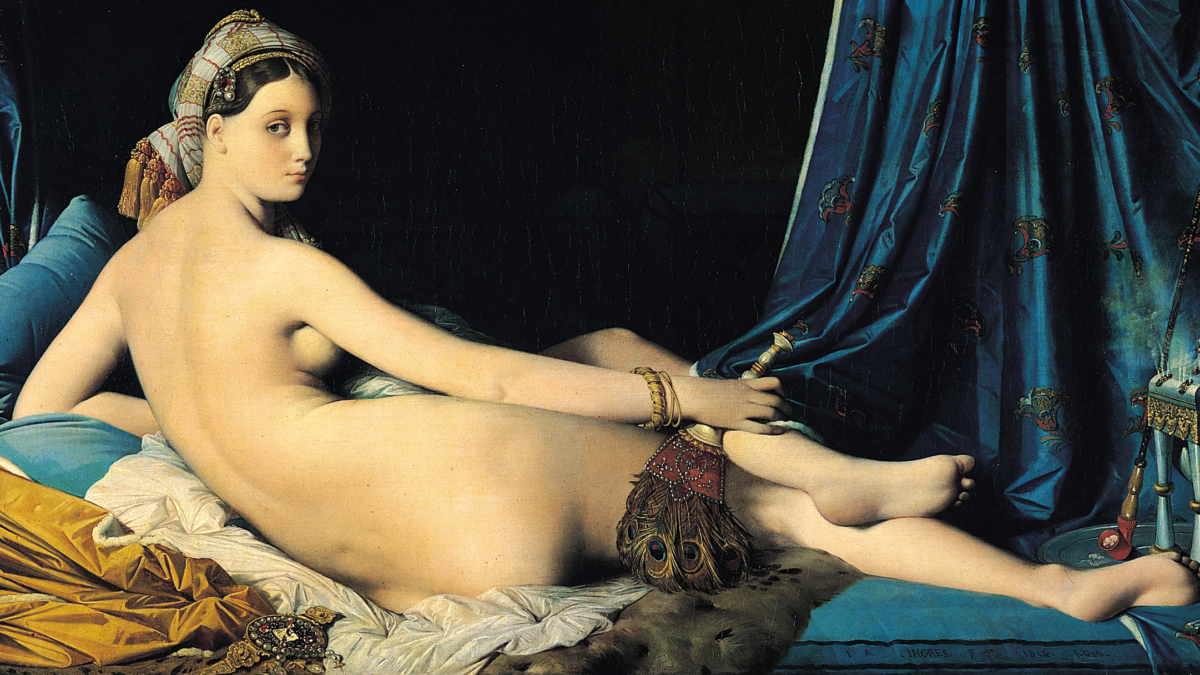
Later, I arrive at what has to be one of my favourite paintings in the Louvre: Jean-Auguste-Dominique Ingres’, ‘La Grande Odalisque’. Painted in 1814, I learn that Ingres follows traditions of Neoclassical art whilst drawing upon influences of Romanticism. The naked female body he presents is an image of sensuality and classic femininity, and yet as a representation of human form, it is deformed and inaccurate. The audio points out the overly long back, and the disproportionate size of her legs, and even the unnatural turn of her head to look at the viewer of the painting. On the whole, these distortions add to the illusion of the divine woman, and create this ethereal beauty that radiates from the work when I look at it. Despite the widespread critical acclaim the painting now receives, I am not shocked to learn that in 1819, when the painting was first exhibited, there were many who were outraged by the blatant anatomical inaccuracies in a supposedly naturalist painting. I, for one, can’t deny a certain unease I have with the idea of a male painter restricting his female subject to the mode of the aesthetic rather than the realistic. Indeed, when his later works began to take prominence, this piece too began to be regarded in a different light. Even further along, this painting, and Ingres’ techniques, became inspiration for future surrealist and avant-garde artists. I love this piece not only because it plays with ideas of beauty, but also because it seems to encompass three very integral ideas of art; that of the challenging, the inspiring and the subjective.

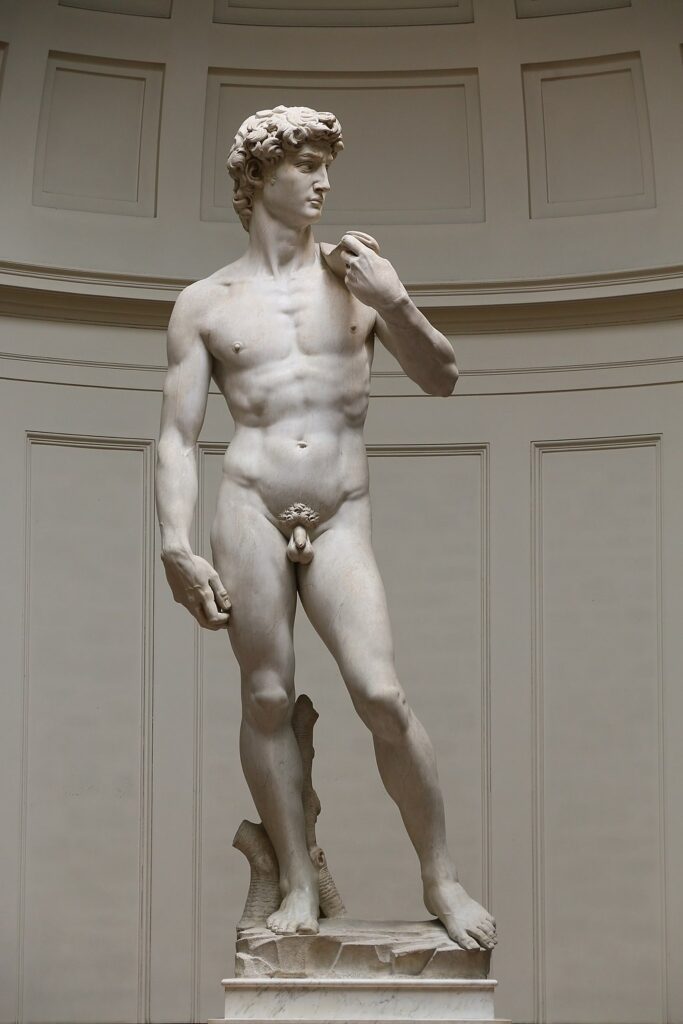
During my time in Paris, I was staying in a hostel in the local town of Belleville. There I met two backpackers from Germany, named Lasse and Rickie. Rickie studies Art History at The University of Hamburg, and Lasse is a mechanic. Over beers in the hostel bar, we began telling each other of our experiences of the city, in particular our thoughts on the exhibitions in the Louvre. Rickie offered an insightful overview of the Islamic Art exhibition, found on the bottom level of the museum. Her response largely focused on what she found particularly interesting, and what she had learnt and understood from some of the displays. Lasse described his enjoyment in finding the silliness in the gallery’s exhibits, and the absurdity he felt viewing some of these works for what they were. He began by getting out his phone, and chuckling to himself, showed us a collection of zoomed-in pictures of the penises of each of Michelangelo’s sculptures. Now, don’t get me wrong, my initial response, as I can only imagine some of yours may be also, was that of shock at the utter contempt for the high and classic that is Michelangelo’s art. But then I was pleasantly surprised. In boyish humour, Lasse described how absurd it was that all these people were standing so seriously and solemnly throughout the gallery, taking in every piece as it came, as if its value was set in stone by the very fact that it existed within this museum. He found humour in the pretentiousness, and was able to appreciate the art from this viewpoint. From what he described, I have this image of him wandering around, giggling and laughing incessantly, taking pictures of things others would ignore or see differently.

Though dissimilar, I don’t think that Lasse’s perspective is any less valid than the perspective of Rickie. I am sure that the latter may be more respected in the, quote, unquote, ‘Art World’, and it is hard to deny how Rickie’s art education might have shaped her experience, but I believe that Lasse’s refreshing interpretation is one that actually has the potential to open up new avenues of understanding and exploration of artistic works, in a way that a traditional viewpoint would not. In my eyes, the very nature of art begs to be subjectivised. It only comes alive when it is interpreted, misinterpreted and reinterpreted. Any hierarchy in which these interpretations can be placed are no more products of their time and influences, than the interpretations themselves. Just as in the rejection of Caravaggio’s, ‘Death of a Virgin’, or in the controversy of Ingres’ shaping of the female body, Lasse’s delight at the anatomy of Michelangelo’s sculptures will always be plausible even if it does not align with interpretations of the expected or of the norm.

Categories
Perspective

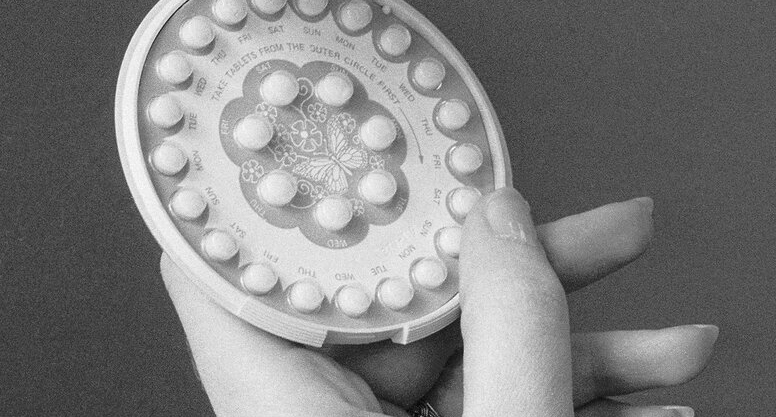
Conversations about Contraception – a difficult pill to swallow…

By Izzie James.

When discussing contraception with friends, there will often be someone who has a negative story to tell. Experiences of acne, mood swings, depression and weight gain often come up when talking about the contraceptive pill. 

Although this isn’t the case for all women, and the pill can be an effective option to prevent pregnancy, it is difficult to ignore the long list of side effects that taking the pill can have. Recently, a viral TikTok trend where women held up this list of side effects to the camera sparked a wave of frustration, with comments comparing the list to the ‘size of a large blanket’. It is hard to comprehend that a contraceptive option that is used so widely and by so many young women can have this many adverse impacts on the female body.

It should be made clear that I am in no way discouraging the use of contraception or saying that the birth control pill should not be used. Sometimes pills can even be helpful in combating problems such as acne, or reducing painful period cramps and heavy bleeding. However, I think that our attitude towards the impacts of the pill should be improved, and we should be attempting to dismiss the stigma around discussing birth control. Starting a broad conversation about the contraceptive pill and making sure that it is the correct option for you is essential for your health. Both mental and physical health should not be compromised by birth control, especially as educating women on their options can make an important difference.

Too many women settle with the pill they are first prescribed, thinking that experiencing effects such as acne, weight gain or tiredness is a small price to pay for preventing an unwanted pregnancy. A large number of women also experience stomach cramps from period pains, meaning that they’ll be used to the uncomfortable realities of the female body. However, being aware that your current pill is not suited to your body can make a world of difference. 

For women considering taking a combination pill, knowledge of something called ‘the pill ladder’ can be very useful. Combination pills contain both oestrogen and progestogen, however there are many different types, some containing more oestrogen, some containing more progestogen (it should also be noted that there is the option of a progestogen-only pill). If a woman takes a combination pill with higher levels of oestrogen, and experiences effects that can be blamed on this, she should consider taking a pill with lower levels of this hormone. The same can be said for progestogen dominant combination pills. This means the woman would move along ‘the pill ladder’, moving left for less oestrogenic impacts and right for less progestogenic impacts. An example of this would be if a woman is experiencing acne and mood swings on a progesterone dominant pill such as Microgynon, it is worth moving right across the ladders to a more oestrogen dominant pill such as Cilest.’ (This is quoted from the ‘GP Notebook’, which is linked below and highly recommended for more in-depth detail.)

I decided to open up a conversation with my housemates. These opinions are not being included to discourage anyone from taking the birth control pill, and I would like to preface them by stating that we all agreed that access to birth control is extremely important for women today. One girl emphasised that she found the birth control pill to be effective and stress-free, and that she did not experience any negative side effects. However, the general consensus of the group was that to improve women’s experiences on the pill, we all need to prioritise education, conversation and support. 

It was clear that some of my housemates thought that the pill was prescribed to them flippantly, and one claimed that she was advised to persevere through any immediate symptoms, as they could ‘settle’ after some time. She now regrets staying on this pill for so long, as she later found another form of contraception much more compatible with her body. She added that taking the pill becomes built-in to a daily routine, so much so that transitioning off it seems like a huge step. This leads to further worry about the sudden hormonal change that women could experience all over again, even though, for my housemate, this transition actually helped her find a more suitable form of contraception.

Another one of my housemates spoke about how she had gone to her school’s medicine centre with some friends, and they were all automatically prescribed the same pill. Looking back on the experience, she spoke about how they all would have had different hormonal makeups, and that their individual reactions to this pill would have been different. However, none of them were told that a check-up on their birth control journey was necessary. She thought that a scheduled check-up with her GP would have been very useful, as she could have listed any side effects that she had experienced and they could have considered whether that specific pill was right for her. 

We all agreed: the realisation that you do not have to settle for birth control has only come to us in our twenties. Although the fault does not lie with us, we all wished that we had been educated on information like ‘the pill ladder’, so that we could have had more productive conversations with our GPs about what was best for our bodies. It is therefore vital that young girls who want to begin taking the contraceptive pill have the right information and education to put their bodies first.

Recommendations:

https://gpnotebook.com/en-gb/simplepage.cfm?ID=x20130725203135685340

Sophie Smith Galer’s ‘Losing It: Sex Education for the 21st Century’

‘Your brain on birth control.’ From Women’s Health Weekly (available through Durham online library)

Categories
Perspective

The Allure of Fred Again

By Samir Singh.

On the 29th of July 2022, a twenty-eight-year-old, mild-mannered Londoner performed an hour-long Boiler Room set to an energetic crowd. The artist in question, Fred John Philip Gibson (more commonly known by his stage name Fred Again) had been a somewhat elusive figure as a musical producer, despite working alongside the likes of Burna Boy and Stormzy. Preferring not to share the limelight with the commercially successful artists he worked with, Fred Again remained something of an enigma to his contemporaries.

Fast forward three months, his boiler room performance had amassed millions of views on YouTube, meaning Fred is quickly becoming a household name in electronic music. Just by watching his performances online, the underlying reasons behind his meteoric rise to stardom become apparent. Fred Again possesses a certain talent for inducing complete elation in the crowds that gather to see him play. His rare mix of vivid storytelling and euphoric instrumentation is reminiscent of a previous era of dance music, a time that seemed less digital and uniform, and therefore far more tactile and human.

A few minutes into his boiler room set, I was hit with a wave of intoxicating nostalgia; somehow this platinum-blond-haired Londoner seemed to encapsulate the pure joy of early Daft Punk, the honest storytelling of Kendrick Lamar, and the addictive basslines of Chase & Status. Fred is a breath of fresh air to a genre that is suffocated by formulaic, synthetic dance tunes devoid of real personality. Fred is able to separate himself from other artists by providing music that is as fiercely intimate and personal as it is sonically enjoyable. Brutally honest anecdotes of substance abuse and mental health problems interweave the melodies of Fred’s house inspired tracks. In a digital age, where human connection is a rare commodity, Fred Again’s music is something of a saving grace.

The rapid ascent of Fred Again to fame, and the cult following he has amassed along the way, is indicative of an important sentiment – there is an intrinsic gravitation towards art that is honest and vulnerable. While Fred’s music is being played in virtually every underground club in London, it is important to recognize that Fred’s newfound acclaim is a consequence of how unapologetically human his music is.

Categories
Perspective

Should Women Behave More like Men to have Application Success

By Ella Bishop.

Are graduate applications geared against women? The never-ending process of situational judgement tests, numerical reasoning, online tests, interviews, is draining enough without gender bias coming into it. Women hear well-meaning advice, such as ‘Men are assertive…be more confident…’, but is this just a thinly veiled version of telling women to ‘Be more like men’? Instead, should we be advocating shifting the system to value more stereotypically ‘female’ qualities? Of course, many companies assess applications ‘blind’, but this may not be enough, given that ultimately the goal is to reach an in-person assessment like an interview. Moreover, the debate ostensibly relies upon the massive generalisations and gender binaries of ‘male’ and ‘female’ characteristics, but so too does the gender bias of the system. Importantly, there are far more biases – racial, sexuality, gender expression – that happen within applications that are incredibly problematic and deserve great attention and endeavour to correct, however I am purely discussing the gender bias that occurs within graduate applications/tests/interviews. Here’s what companies from a range of industries had to say on the question of the difference between male and female performances within applications.

Numerical reasoning tests, such as the ones necessary for consultancy applications, are potentially the most unbalanced, with men often outperforming women. The very layout of the test appears to disadvantage women: multiple choice questions under timed conditions. Generally, men are more comfortable guessing the ones they have not had time to answer, whereas women are more likely to leave them blank. However, making an educated guess, especially if you can eliminate one or two options, yields higher results and thus men are more successful at it: women are less like to take this risk and it is to their detriment. Whilst on the whole, there was not a significant difference in performance based upon gender, the general feedback was that women could and should be promoting themselves more, being more explicitly proud of their achievements and being more assertive. In case study interviews, men will answer more confidently and will attempt to answer even if they are unsure, where woman can be more hesitant even if they have the right answer. Of course, alternatively, more nuanced and flexible opinions are also valuable, and the advice is definitely not to unthinkingly assert yourself if you know you are wrong, but to confidently present your ideas even if you are not sure.

Interestingly and perhaps predictably, the most generic, unhelpful response was from the investment sector, who gave an, ironically, unconfident, vague account of gender diversity improving. It was decided that generally, they think that last year the gender split at that stage of first interview was proportional to candidates they received, but there is a higher percentage of male applicants, so even by the first stage there tends to be an imbalance. Despite the lack of actionable advice, the evasive answer does suggest that there is an undercurrent of gender bias at graduate application level, even if unconscious, that is not being addressed or solved. But is it the responsibility of companies to level the playing field or does the weight fall upon women to be aware and make these changes?

The most balanced response, a middle way between both recognising bias and creating realistic ways to generate a fairer application system, came from within the consumer goods sector. They identified bias in the system they had set up and altered it, so that it produced a more balanced group of applicants. For example, when listing qualifications needed for a particular role, they will not ask for more than three or four, knowing that women are more likely to only apply to a job if they meet all of the criteria, whereas men are happier applying even if they only meet a few of the required qualifications. Additionally, they acknowledge that women are more likely to talk about their achievements in terms of what ‘we’ or ‘the team’ did or use verbiage such as ‘assisted’ or ‘helped’, rather than focusing on what ‘I’ accomplished. Therefore, they bring this awareness into an interview and practise asking what interviewees themselves did specifically.

Realistically, I think the responsibility remains upon women to make the changes that enable them to perform better in interviews. There is a clear variation of approaches towards gender bias across various industries and of course for the majority of jobs, hiring should not be based upon gender, but regardless of gender. But it is undeniable that this bias, as well as many others, does exist and therefore there is a need to equalise applications. There does not seem to be an overall, external pressure on companies to be levelling the playing field. Fundamentally, it rests on the individuals who are in positions of power within companies to be pushing for this internal change and it should be on all of our agendas for when we are able to make these changes ourselves, in order to help the generations that come after us.

Categories
Perspective

SIMPLY THE BEST

Simply the Best

Ben Hutchison


Simps are a much-maligned species. Long thought to operate only in the dark underbelly of society, Simps involuntarily came to the forefront of the public psyche in 2020: thank you, TikTok (- Of course we Simps proved to be the masters of our own downfall). One year on from this cultural boom, Simps continue to be the focus of worldwide persecution.

These days, in the naive Gen Z eye, anyone is a Simp. Yet the term that has now become a thoughtless, pejorative insult is at its very core much more nuanced, and much more noble.

I surveyed 100 generic people asking for words to describe a Simp. These were the most popular responses:
Incessant
Tenacious
Obsessive
Creepy
Simp
I then surveyed hordes of Simps, and they responded somewhat differently:
Loyal
Undervalued
Kind
Selfless
Handsome

A marked and frightening difference in perception. The second survey seems a little more accurate, don’t you think? I sure do. A sign that eyes need to be opened globally to combat negative stereotypes.

Offering a girl your jacket: selfless or ‘tenacious’? Exactly. Holding a door open for her: thoughtful or ‘obsessive’? Precisely. Peeling off your skin so she can use it as shelter for the night: ‘Creepy’ or kind? You get my point.

When you need us most, we are there. Always. The Nanny McPhee for disinterested women. The doormat to wipe your muddy espadrilles on. The kleenex to mop your glistening brow. The roll-on deodorant for all seasons. Need I continue?

So what if we listen to Cheerleader when we need motivation; so what if we prefer cool original Doritos to their oppressively hot and spicy siblings; so what if we use Simple hand moisturiser to combat our crippling eczema. Such is the path that we must tread.

If you boil it down, using Simp as a slur is sexist (and Simpist), and suggests an innate anxiety over female authority. So stop calling me a Simp, Mum.

To name but a few famous Simps: A list
The Proclaimers. 500 miles and counting.
Blunt (whose life is brilliant and love is pure.)
The Lumineers (Hey ho – talk about a life mantra)
O. Murs (Proving that fedoras hold a vital place in 21st Century normcore)
Kygo, for laying down the foundations.
Simple Minds. No explanation needed.

I heard about a Simp once, who, out walking with his mistress, saw a puddle up ahead. Instead of letting the lady get her feet splashed, he took off his coat and submerged his body in the water, forming a bridge for her to walk across. Sir Walter Raleigh eat your heart out. People laughed, but that sodden Simp had earned a glimmer of gratitude from the girl. Who’s laughing now.

So, fear not, fellow Simps. The waves of revolution are starting to roll in. The drums of defiance are a beating. Heed my call. Marches biweekly outside Spags.

“What do we want?!” I cry to my legions of typically loyal simps.
“Respect!” They mumble back sheepishly.
“When do we want it?!”
“At some point in the not too distant future!” Comes the unified reply.

Brothers in arms. Comrades fighting the good fight, fighting for the right to serve ceaselessly. Most importantly, we’re loud and proud, and no longer ashamed of who we are.

By
Anon.

The author preferred not to disclose his name for security reasons.

Appendix I: A Simp story…
By Tom Walton

It was a cold Tuesday; a Tuesday when I would revere my very nature. Being a subservient simp I agreed on a 3 mile walk with my superior, who for the purpose of this article must remain nameless. It was snowing. We’d been rambling for not nearly 10 minutes, when Hermione (whoops!) decided Stilettos were not the correct attire for such an outing. Obviously I agreed to swap my favourite Karimmors for the healed monstrosities: I was happy. Hermonie then decided that she was cold. I lent her my jacket. She was still cold. So I lent her my trousers to wear over her mini-skirt. But, still, she was cold. “I’m freezing, she whimpered.” So, I took off my cashmere socks (from the simp’s winter collection, Boden) and handed them over, gleefully. Alas, Hermonie was none the warmer. Suddenly I think I’m getting frostbite – standing prostrate in my singlet, mincing around the snow like an impalpable ostrich. Forgive my high register, I had several Iron Brus simply to pluck up enough courage to write this article, so, understandably, I’m feeling rather vibrant, if you’ll excuse my French. Eventually, however, I had no other option than to give up my singlet to the incessant Hermoanie – the singlet being the last bastion of a simp’s dignity. So now do I sit here, recovering from Hypothermia, questioning my existence, my worth, my meaning. I then uneasily cast aside my doubts, joyously recalling the worldwide success Simps have had.


Categories
Perspective

Why The Little Prince still matters as a grown-up

Why 'The Little Prince' still matters as a grown-up

Isabel Davies Jones


the origin story of quite a bad tattoo

About a week before I turned 20, I had a crisis. I was – and am – absolutely terrified of growing up.

On February 10, 2020, I would leave my teenage years behind me forever, without, I felt, having finished my course of adolescent rebellion. My 20th birthday loomed with my quarter-life crisis festering in the background, and I got a tattoo.

This tattoo has become the subject of much ridicule amongst my friends. The question tends to be: ‘what is that?’

Sometimes, if I can’t be bothered to explain, knowing that this question is a direct result of my lack of impulse control, I say I don’t know. Or I make something up. A bouncer once grabbed my wrist as I was queuing to get into a club. I thought I was about to be refused entry, but, to my surprise, he burst out laughing and said ‘what the fuck is that?’ When people ask if it’s a hat, I accept defeat and say ‘yes’. There have been many theories; a saucepan, a hill, and my favourite: a F1 racetrack. But it is none of those things.

What it is, is the outline of a boa constrictor digesting an elephant from The Little Prince by Antoine de Saint-Expuery.

This makes it worse than before, because now I am pretentious as well as having a stupid tattoo. But, I think, there was good reasoning behind it.

The Little Prince – for those who weren’t lucky enough to read it as a kid, or for those who did read it as a kid and need a reminder – is a children’s book about a pilot who crashes in the desert and meets a boy who has come to earth from a tiny planet. It’s a bit surreal. There’s very little plot. They just chat and the little prince tells the narrator about his travels. Over time, I have come back to this book again and again.

The tattoo on my wrist is taken from the opening which I will summarise badly now: The narrator speaks about when, at six years old, he read a book about the jungle. Inspired by the fact boa constrictors swallow prey whole and digest for six months, he attempts to draw a picture of a boa constrictor digesting an elephant. He proceeds to show it to the grown-ups… who think it is a picture of a hat. To show them what it actually is, he draws a diagram with the elephant inside the boa constrictor so that they might understand.

They advise him to stick to learning about the important things – ‘geography, history, arithmetic and grammar’ – and give up drawing.
Throughout this little book, there are constant references to the ‘grown-ups’. A ‘grown-up’ is simply someone who has lost their imagination. I got the picture on my wrist to try and remind myself not to become like the ‘grown-ups’ but I am still terrified of it.

I’m scared I’ll wake up and be 30 years old and my friends will be having children, going to pilates classes, moving out to Surrey. We’ll drink a glass of wine with dinner, not a bottle, and they’ll talk about how badly we once behaved. Will they still want to stay up chatting until 4am about ideas for a podcast that will never be made? Will they want to climb into fountains in Rome in the middle of the night? Will they want to wear outrageous costumes to dinner for no apparent reason? Will I?

I don’t know if I’m paranoid, or if I can already see this element
dissolving around me.

But maybe I am getting it wrong. Being a ‘grown-up’ might not all lie in what you do. How much of it is really embedded in childish misbehaviour? Do we have to lose the silliness to grow up?

There are many sections in The Little Prince that are important to me. The writing is simple but beautiful, the kind of book you can enjoy at any age. There’s no shame in picking up a book for children. It won’t take you long. I think this extract from chapter 4 is good at summing up one of the big points Antoine de Saint-Expury makes:

‘If you were to say to the grown-ups: “I saw a beautiful house made of rosy brick, with geraniums in the windows and doves on the roof,” they would not be able to get any idea of that house at all. You would have to say to them: “I saw a house that cost $20,000.” Then they would exclaim: “Oh, what a pretty house that is!”

Just so, you might say to them: “The proof that the little prince existed is that he was charming, that he laughed, and that he was looking for a sheep. If anybody wants a sheep, that is a proof that he exists.” And what good would it do to tell them that? They would shrug their shoulders, and treat you like a child. But if you said to them: “The planet he came from is Asteroid B-612,” then they would be convinced, and leave you in peace from their questions.

They are like that. One must not hold it against them. Children should always show great forbearance toward grown-up people.’

One of the things that I am most scared of now, a year and a bit on, is the future me looking back at the way I am now and thinking that I was naive. That because I was only on the cusp of adulthood, I couldn’t understand what the realities and responsibilities of being a ‘grown-up’ were. I don’t want that to happen. I can take feeling embarrassed about hair disasters, fashion choices, and a bad work ethic, but not this.

I remember thinking as the tattoo needle was in my skin, that it was meant to be a pre-emptive ‘fuck you’ to future me if she ever becomes too caught up with ‘grown-up’ things. If she thinks it’s childish one day, there’s not much she can do, apart from getting it removed, (but I know enough about myself now to assume that I’ll always be too lazy to do that.)

Now, when I face my fear of getting older, I look at my wrist and try to remember that the thing I am really scared of has nothing to do with age – that being ‘grown-up’ is a state of mind that you can choose.

All in all, 20 quid well spent.


Categories
Perspective

Crossing the Channel of Difference in Covid

Crossing the Channel of Difference in Covid

Albane Colleau and Constance Byé


There’s no denying that 2020 has been tough for everyone, and students have suffered their fair share. However, as coronavirus experiences go, everyone has a very different perspective on it all. This is why we’ve decided to share our story, to raise awareness on what we feel is a situation that has been overlooked by most in Durham, being a university that somewhat lacks an international student voice.

Let us state once again that this article is not about blaming anyone, or saying all international students have lived the same thing – even both of us have very different views on this. This is simply about retrospectively sharing how we saw this past year, and about our hopes and fears moving forward.

Constance: To start off, let me say that Durham is and has always been a ‘very English’ university. Truth be told when I got here I was slightly scared cultural differences would mean I would only be able to make friends with other French people. And indeed, it was hard and exhausting at first, what with the different humour, the slang, the fact everyone seemed to already know each other from school. But in the end, I managed, and have never had so much fun as I did last year, amongst a fantastic group of friends. Bottom line is I didn’t feel ‘international’. Sure, I still occasionally got reminded of WWII or got called a frog, but generally speaking I felt as integrated in the Durham life as anyone.

Albane: Arriving in Durham felt like starting a new life, probably like most of you. However, making friends was slightly different from my expectations: many people I met already knew a bunch of other students and in only two weeks they had huge friendship groups. I realised that not being perfectly fluent in English and not knowing anyone was making it all a bit harder. Hopefully, I rapidly felt well integrated, everyone was adorable despite some poor French references, including the classic “Voulez-vous coucher avec moi ce soir?” on nights out. Overall, I was living a happy Durham student life, not even missing French food anymore!

Constance: Covid changed that, hitting us hard in March. This was a very stressful and anxious time for everyone, rushing to make plans to get back home. But few people actually realise just how hard it was for international students. I saw most of my friends have their parents drive up to pack their rooms, or help them get back home safely, and with all their belongings. Meanwhile, I was urgently packing a single suitcase, not knowing if my flight would be maintained, not knowing if the borders with Belgium would close before I could get back home, not knowing if the rest of my things would get disposed of when I left; and worst of all not knowing when I would be able to see my friends again. I just couldn’t shake this feeling of panic, and fear of just being utterly alone at that moment, with my family hundreds of kilometres away and unable to help.

Albane: When lockdown rumours started, I felt pretty nervous about such unprecedented measures, but I quickly understood it meant leaving the UK for an uncertain amount of time. Like Constance, I only had a few hours to pack as much as possible and to say goodbye to as many friends as possible. At this point, I wished I was as lucky as my UK friends who seemed quite relaxed, waiting for their parents and not constrained by any deadline. France was also expected to close its borders soon and I was only hoping that my flight wouldn’t get cancelled a third time. Like many of you, I was heartbroken to leave Durham at this time of the year, when I felt at home and had exciting plans coming up. I spent an amazing last night with friends, but I had this very uncomfortable feeling that I would miss out on a lot after I’m gone home. In fact, I was scared that time and distance would damage the relationships I had built from the ground for 6 months…

Constance: Fortunately I managed to get home, and I settled into lockdown life (for the first time). Home for me has always been in big cities; and while I love living in Brussels, lockdown there was certainly less easy than being in the countryside, where most of my English friends had settled. The difference between my friends and I slowly became obvious. Although the situation in Brussels wasn’t as bad as in Paris, it was hard for me to stay put in a city apartment. I couldn’t take long walks outside or escape when I needed to (which is often). Unlike in the UK, masks in Brussels were – and still are- mandatory at all times. I hated walking down the depressingly empty streets, and just constantly being scared of being called out or stopped by the police. It didn’t feel like my city any more, I’d never seen Brussels look like a ghost town before. It made my anxiety levels skyrocket, to the point where I didn’t even want to go on my daily walk any more. Exercise, of course, was out of the question, with gyms and parks closed. I just feel like this is something people that lived lockdown in the countryside would not have had to go through, and even lockdown measures in London were never as harsh as in European capitals. It heightened the difference I felt being French in an English university, even though I wasn’t even at Durham. This feeling was made worse as time went on and lockdown was gradually relaxed. Most of my English friends live in the same area, and it was easy for them to see each other or organise walks, trips to the beach or invite themselves to each other’s houses. Or meet up in London. Not to say they shouldn’t have, or that they purposefully excluded me. Of course not. The virus did. This just to give my perspective as an international student, and show the impact lockdown had on my university friendships- it was hard to see the fun they were having while being hundreds of kilometres away. And don’t get me wrong, it was so nice to see my friends from home, but as Albane said, in the end I do feel like I missed out on a lot.

Albane: I enjoyed my French lockdown with my family but I wouldn’t say I was happy overall. It’s been tough for everyone, but I’m not sure many Durham people realise how hard it’s been (and still is) for foreign students in particular. Drawing a line on my student life was one thing but seeing my UK friends spend fun times together made me feel sort of excluded, especially because I couldn’t do the same in Paris. That might seem overdramatic but lockdown in France was quite different to that of the UK. I could only go outside once a day and for no more than an hour. I had to be alone and I couldn’t go further than one kilometre away from my flat, whether I was food shopping or running. Believe me, those measures were making me anxious, regularly checking the time and how far I was from my building. Masks were also compulsory alongside the governmental form that justified my time outside. Controls were frequent and I could see the police walking down my street several times a day. One sad fact is that whenever I would walk past a police officer, I wouldn’t feel protected or safe like before but I’d feel scared. Lockdown in Paris also meant spending two months in a flat, with incredible weather – which some of you might know is horrible in this city because you can’t escape from it: there is no AC in most buildings so either you accept to be hot or you live with all shutters closed (which adds some saddeness to the whole not-so-exciting situation). In addition, the ‘arrondissement’ I live in is known for its liveliness, with its hundreds of restaurants, bars and shops; witnessing its emptiness was quite tough. I simply didn’t feel at home anymore. For two months and a half, I lived two minutes away from friends that I hadn’t seen in eight months – somewhat missing out on things in France too – and who I didn’t get a chance to meet before June. For two months, all my friendships were fully relying on texts and calls. That is mad. And we can all agree it’s pretty hard to deepen relationships through the phone. But it’s even harder when most of your friends can do so, as they still have some sort of social life. It was obviously no one’s fault and I was happy my friends in the UK could make the most of their quarantine. Coronavirus has been unfair on everyone, and it made me feel rather alone, regarding both my home and uni friendships. Overall, it was sad to notice the change that occurred from how integrated I felt before lockdown, and the feeling of missing out constantly growing during lockdown.

Constance: I was overjoyed to find out we could come back in September. I think that for most international students, and definitely for me, coming back to university is always more exciting.. Consider that for us it involves a long trip, changing countries and what you’re used to, and living a completely different life. It’s hard to explain how Durham can in any way feel ‘exotic’, but it really does to me. I was finally reunited with my friends, and things could go back to ‘normal’. I didn’t really mind the second lockdown in Durham. Sure, it was frustrating missing out on all the opportunities we had last year (and pubs closing was quite a blow), but in the end I was very happy to be in Durham and not Brussels this time. I think as an international student this also made me realise how attached I am to Durham, and how much more independent and committed I feel staying here. The downside of this is nonetheless quite strong as well. You feel once more very far away from your family. This isn’t helped by the fact it’s almost logistically impossible for international students to own a car in Durham, meaning we can’t just go home anytime we feel like it. Planning even a weekend home is complicated, and expensive. This was heightened with Covid. Upon coming back in September, I really saw the borders as very real, and very able to shut me off once again.

Albane: I was lucky enough to come back to Durham for a few days at the start of July and it was probably the highlight of my summer; I couldn’t wait to return in late September. As much as I love being home, I had chosen to study in the UK and I didn’t want anything to stop me from living this abroad experience I’d dreamt of for several years. Even if it implied a two-week quarantine, a reduced social life and all my classes to go online. I had been away from Durham for the whole lockdown and for most of my summer time; my only wish was to resume my student life and reunite with those I hadn’t seen since March! In fact, I was actually excited to live in such special circumstances in Durham. I was also aware the borders could now suddenly close for real and I could get ‘stuck’ in England. However, when the UK went into its second lockdown, even though my family wanted me to come back home, this time I didn’t hesitate a second and chose to stay as I really didn’t want to miss out on anything anymore. However, I was sadly surprised when some English friends decided to go home. I realised how relatively free UK students were, in comparison with foreigners: they can go home rather whenever they want, and most luckily they don’t fear being stuck in Durham.

Constance: I can tell you as an international student that not coming back to Durham for the start of this term was out of the question. I was determined to come back to Durham for all the reasons listed above. I also feared if I waited too long, the borders would shut again for good, and I wouldn’t be able to come back for quite some time. This is something that once again highlights the difference between me and most of my English friends. Most of them have decided they will delay their return to university, because they are lucky enough to be able to do so without fear of borders closing, or trains and flights being cancelled. Like Albane just pointed out, all they have to do is drive up, and have the luxury of being able to make a decision as late as they want. I also think being in the UK, they don’t have this same feeling of missing out, and why would they?

Albane: I absolutely wanted to return to Durham too. The uncertain situation created stress regarding the likeliness of borders to close again. In addition, I was also fearing to be alone in my house, and travelling to Durham represents more of a commitment than it does to people living in the UK. Even though my parents didn’t want me to leave, I couldn’t picture to completely renounce my student life. Studying online was already tough, but being in another country would have made it even worse. I’ve returned safely to Durham before the start of the term and although the city is pretty empty, I’m glad I came back. I feel at home in my house, and I enjoy wintery-looking Durham. One of my dearest wishes is obviously to have some ‘normal’ social time again soon, seeing all my friends and meeting new people. However, looking at what I’ve been through during the pandemic, I can’t help myself but wonder about the impacts of Covid on my social life in Durham. Should I focus more on deepening my relationships with internationals, and French people in particular? Indeed, I’ve realised I can’t ignore that I don’t live in the UK and that I’m simply not English. It is a sad idea especially because the very first social objective I set to myself when I arrived at university was not to hang out with French people and to have the most English experience possible. And I can’t help but ask myself, after these events heightened my differences with UK people, if I should still put my social efforts towards this initial goal… Covid has shown living abroad interfered with my friendships in the UK, and I have one main fear for Durham’s social future: might the now undeniable differences between internationals and UK students lead international students to group themselves together more than before? I’m scared Durham could become somewhat more fragmented than it already is…

This new lockdown is a big blow for everyone, in particular international students, whose majority desperately hopes to make it to Durham before Easter break. Covid, and more recently Brexit, made all of us realise how real borders are and can close at any point. It intensified in a way the differences between internationals and UK students, even though we’re all spread out in Durham within colleges, courses, activities and so on. All university students have been undoubtedly impacted by the pandemic, losing out on their education but also on their social life. Living abroad, we’ve been yanked back and forth between two countries, but especially severely disadvantaged against building formative friendships, and this is something we hope will get better in the future. We remain optimistic and hopeful!


Categories
Perspective

It’s 2021, Why are Creative Industries still Undervalued?

It's 2021, Why Are Creative Industries Still Undervalued?

Beth Perry


As October rolled in and I returned to Durham following six months of lockdown, the reality of my final year and lack of future prospects began to emerge. Facing the notorious annual job hunt in an already over competitive and now pandemic-volatile market, I palpably felt the lack of graduate creative opportunities. It became apparent that embracing the Durham stereotype of applying to every bank in the City, every Times top-100 Graduate Employers or the Civil Service, would only result in me selling my soul and mental health to a future in which I frankly found no passion. Where were the creative graduate opportunities that excited me and why were they so difficult to find?

There is an ingrained underappreciation for the importance, socially and economically, of the global creative sector. From Advertising to Publishing, TV & Film to Arts & Culture, creative careers are found in almost every walk of life. In fact, these industries generate more than £100bn a year to the UK Economy. Before the pandemic, future prospects were booming, with employment rising three times higher for these sectors than the national UK average in the last decade. So why then do they hold so little weight, other than perhaps in marketing and advertising, within the graduate marketplace?

In my ‘younger and more vulnerable years’, I was encouraged to pursue the ‘respectable’ vocation of the Law and had little to no exposure to careers in creative sectors. This clearly can’t be because these are dying industries, so why are creative careers not better advocated for, is there a lack of commonly held respect? Whilst there is no clear-cut answer that can be offered in the space of one article, it could be held that graduates depend too much upon the traditional channels of corporate employment, so that careers in the creative world are simply, albeit unintentionally, ignored.

Over time I have come to find that it is the Art World, specifically the Art Market, that I am drawn towards and that there are, albeit few, graduate opportunities available. I was encouraged to see the flexibility of this industry in response to the pandemic, in October Sotheby’s produced a live streamed auction of Contemporary Art. During this, a notorious Banksy painting ‘Show me the Monet’ (2005) went under the hammer for £7,551,60, two million more than its highest pre-auction estimate. Elsewhere, online success has also been attained by galleries such as the Royal Academy with their interactive tour of their famous Summer Exhibition. It could be argued that this switch to technology has been able to provide not only a novel, but a more cost effective and less exclusive environment than in-person viewings invite. These exciting and resilient responses to the pandemic highlight how careers here could be held, contrary to popular belief, as commercially appealing and highly innovative to future job seeking students.

Similarly, large international corporations have hired creatives to help them adapt to this growing digital marketplace. Forbes Magazine highlighted that ‘today’s successful companies are the ones willing to […] embrace creative innovation and technology’ as the ‘recipe for the perfect digital event’ (6 April 2020). I wonder; perhaps, with the movement of services online, will the importance of creative careers may be finally held with the high regard they deserve?

Whilst these companies, larger galleries and auction houses have shown themselves to be resilient, unfortunately other smaller members of the sector have found themselves in an increasingly more precarious financial position and with a lack of serious attention from Governments during the Covid crisis. The Art Newspaper and economist Rachel Pownall revealed in April last year that 33.9% of galleries around the world are not expecting to survive the pandemic. Interestingly though, having predicted the economic impact of Covid-19 upon the Arts, in the same article Pownall stated that lockdown has in fact highlighted ‘the societal impact of a world devoid of arts and culture’ and that it may even ‘encourage improved financing of the arts in the future’. Maybe the suffering of creative industries worldwide has finally woken people up to their social, political and economic importance in our constantly evolving international marketplace, and perhaps then, creative careers in all their shapes and sizes will be offered the same new acclaim.

Frankly, this period, having begun as one of stress and angst, has in fact excited me immensely about the future of creatives leading into 2021. Looking forward, the Art World’s persistent response to the pandemic has stirred up an increased interest in me to pursue my passion for Art and business at an Auction House. In some sense then, the pandemic, despite financially impacting the creative sector on an unprecedented level, has positively catalysed an awareness of the importance of the arts and their ability to support wider industries of more notable standing. Adapting and reshaping methods to suit the growing online populous has favoured creatives, with this platform being an example. Shouldn’t we then hope for the relatively narrow selection of our graduate marketplace to experience the same sort of transformation?

Whilst I may still end up surviving on no more than half a dozen hours of sleep a night during my early years of employment, I would rather those working hours be in support of my own interest in the Art Market, rather than the result of pursuing a decades old tradition of graduates in a field where my creativity could not flourish in the same manner.

For more information surrounding the breadth of careers in creative industries see:
https://www.thecreativeindustries.co.uk/
For more specific information on internships and work experience at galleries, such as the RA or V&A, see their websites and Careers pages which are constantly updated as and when vacancies arise.
The Art Newspaper is an online paper that publishes articles written by top art historians, curators and economists about the art world and market.


Categories
Perspective

Eyes on the Prize: Preparing Myself for a Lifetime of Failure

Eyes on the Prize: Preparing Myself For A Lifetime of Failure

Ollie Taylor


Coronavirus has almost entirely put a halt to all dramatic proceedings at Durham. With the exception of the occasional underwhelming and unsatisfying radio play hastily recorded on zoom, Durham Student Theatre has been able to produce very little. As an actor, this has unsurprisingly been most frustrating. Having not acted in a long time evokes a peculiar feeling, like an unscratchable itch, which is very difficult to describe to anyone who isn’t interested in the craft. This is exacerbated by a terrifying undertone: the fear that without practice, you’ll forget how to do it. This feeling builds up so much that you need to find a way of releasing some steam. If I’ve learned one thing from lockdown, it’s that I’m capable of entertaining myself for days and days on end with one big mirror and a selection of novelty hats. Also, there have been many times when I’ve suddenly realised that I’ve been prancing around my room for the last half an hour reciting bits and pieces from old plays. A long internal debate then ensues as I try to work out if I’m in the throes of a cabin-fever-induced bout of madness, or if I’m genuinely a bit of a fruit loop. Actually, it turns out I’m just an actor who hasn’t been doing a satisfactory amount of acting. Just as a revolting, sexually-frustrated adolescent discovers ways of practicing by himself with an old sock, I have found ways to assuage the desire to perform with a mirror and some flair headwear. The latter, however, is much less socially acceptable.

I could very easily sit here and whinge about the pandemic and how it’s ruining everything until the cows come home, but I’m not going to. Not because I’ve realised that I don’t have it as bad as some people, not because I feel it will dispirit you and certainly not because I’ve learned to look on the bright side, but because I can’t be bothered anymore. It’s got to a stage where any mention of the pandemic makes me want to eat my own face, so I’m dealing with it the only way an Englishman knows how- by finding something entirely different to whinge about. I shall attempt to give you a little bit of insight into the horrific career path that I’ve selected for myself. That may seem a little egotistical but I assure you that my thoughts reflect those of many aspiring actors who are all just as self-absorbed as I am.

After leaving Durham, I will be attempting to get into one of the hugely competitive drama colleges in London for a three-year course. The best of these take less than thirty or so in each year. Failing this, I will simply have to try again the following year. The success rate at getting into these places is much higher with slightly older and wiser actors and it is rare to get in at the first attempt. This is one of the many, many reasons why I consider myself lucky not to live in the USA. If I wanted to become an actor in America, I would’ve had to have moved to Hollywood with my family at the age of 8 to try and get a part in an advert for Weetabix, or whatever disgusting, palm-oil filled equivalent they have over there.

There is not really any knowing what happens next. I presume my drama college will help me find an agent to take me on. Early in my career, when I’m in the age range for most of the best parts in film and TV, I will simply have to be a whore for any part I can get. The industry is so competitive, so dog-eat-dog, and can be so harsh that it would be a devastating display of hubris to think of any part as below me. If I get offered the part of third spear-carrier in a terrible production of Macbeth in a tiny theatre in the arse-end of nowhere, I’ll be completely ecstatic, and carry that spear with outrageous vigour and enthusiasm. It is all about being busy, working hard, getting parts in as many things as I can, not becoming disheartened when things look bleak and just enjoying it as much as possible. The dream of getting a so-called big break and all the excitement that it would bring may be what keeps many actors going, but for me the chance to perform as much as possible is motivation in itself. There is always, however, the morbid sense of dread that the phone will stop ringing, the parts will dry up and I’ll have to start introducing myself at parties as an out-of-work actor, which is society kindly offering a way of telling other people that you’re totally unemployed.

People often ask me how long I plan to give acting a go for. There’s no real answer. I suppose as long as it’s financially viable. The myth of the poverty-stricken actor is most definitely not a myth. When I’m in my late thirties living in a tiny flat with five or six other failed actors it might be time to call it a day. Nobody’s done the washing-up in months. The cockroaches and mice we live with seem to be having a competition to see who can be bigger. The place is in serious need of a scented candle or at least some Febreze. No one can really afford to pay rent. We sit around watching TV and complaining that the actors they hire these days are useless. And most of us have some form of alcoholism or smack problem. I have neither a part nor a girlfriend in sight. The dream has melted away. I will then try and utilise my degree in Psychology from Durham and, twenty years after I should’ve, try to get a proper job.

That is my career path in its full. I personally can’t wait. It may be disastrous, it may be an enormous mistake and it may all end in tears but I love acting more than anything else, and life is too short not to make a go of it. It will be a sad moment when I decide I can’t do it anymore, simply because I will not be able to do what I most enjoy. But unlike professional footballers who, after retiring, are never able to emulate the feeling of scoring a goal for the rest of their lives, I’ve been through three lockdowns with no acting, so I know how to entertain myself with a mirror and a few silly hats.


Categories
Perspective

Against Imitation: the Limits of Student Creativity

“Hope is soonest found among the comfortless” – Theodor Adorno, Minima Moralia

Everyone starts somewhere

All great artists learn how to write, paint, or sing before they go on to master their given medium. Part of this process will inevitably include leaning form those that have come before them often through imitation; Hunter S. Thompson claimed to have copied out the entirety of The Great Gatsby in order to master the idiosyncrasies of Fitzgerald’s poetic style. If he had not done so Fear and the Loathing may not have been the literary tour de force it is today. Harold Pinter openly admitted that his early “comedy of menace” plays were directed inspired by the works of Franz Kafka. Would he be a Nobel prize winning playwright if he had sought to replace the Kafka’s tragicomedy on stage? Student artists, poets, playwrights, still mastering their craft should therefore be no stranger to imitating their artistic heroes. Their works will always be indebted to someone.

If music be the food of love, go on a diet.

In a recent review of a new song from a student band in Palatinate proclaimed the following:

“X are certainly a band to keep any eye out for in the music industry with their uniqueness and ability to push the boundaries of what songwriting is.”

The words imply that the song in question is the musical equivalent of Duchamp’s Fountain ready to shatter the conception of music itself and usher in a new paradigm of musical endeavour. I am no musicologist, nor am I musically literate but even I can tell that the song is imitating another. The track is a medley of garbled sound that could have been extrapolated from the CD selection of a mid-noughties’ angst-ridden teenager who has read too much Nietzsche. Echoes of The Libertines and a bunch of other forgettable bands that marked the paradigm with a faux “fuck Thatcher” attitude. Someone has not told them that she has been dead for years. The band (whose name has been anonymised for the sake of not ruffling any feathers or riling any egos) are one of many student “creatives” whose vocabulary consists of repetitive forms, styles, and concepts. Perhaps they are just forging their craft. Everyone has to start somewhere. But this excuse cannot be wheeled out for all cases, for there is a fine line between this and resting on artistic laurels, imitating not to develop their own voice but merely to steal other’s ideas to privilege appearance over reality.

Poetic injustice: a Platonic interlude

The relationship between imitation and the philosophy of art has been strained since Plato. Although his worries were metaphysical in nature, they nonetheless contain nuggets of interest to the present discussion. Plato held that all knowledge derived from Forms, the essential version of any thing that exist in their own imperceptible world. The most human human being. The most goatly goat. All physical objects are imperfect instantiations of forms. The red on the apple is not the reddest red, but nonetheless contains an aspect of red. Art enters the equation given that artists are able to separate appearance from reality. Plato’s example is that of a table which exists in an image, in reality, and as a Form. The artist had the ability to depict the table but without the tableness that makes it a table; I cannot rest a coffee cup on it given that it is merely an image. The artist’s copy is therefore further away from the perfect Form than the physical version of the table therefore making it worse. Plato’s aesthetics (if it can be called that) rests on a unity of values. What is true is beautiful, is good. The true table the real table is good and is beautiful. The false table, the imitation, the illusion is bad. Plato’s discussion of Homer exemplifies this argument. In the way that the artist can depict a table without the tableness, Epic poems like the Iliad can depict values like bravery, honour and duty in the context of warfare without the corresponding reality behind them. The illusion of war, not the reality and all the horrors of the phenomenal experience of it. When the reality behind such ideas is castrated, their appearances are all that remain leaving them vulnerable for misuse and propaganda.

Plato’s argument is dated. If we reject his framework, the Forms and the unity of the value spheres we can discard the theory and its distrust of artists. Would we then be throwing the baby out with the bathwater? In opposition, Kantian aesthetics demarcates the beautiful from the good. His theory came to dominate western conceptions of art right into the 20th century with Clement Greenberg. This does not mean we can disavow Plato completely. The great writer/philosopher Iris Murdoch revisited Platonic thinking in her essays on the Sovereignty of Good and The Fire and the Sun reuniting the value spheres whilst granting art a significant role in our moral lives.

Baiting, hating, imitating

Plato’s relevance could be seen in the world of student theatre. The world of thespians is already rife with corruption in a moral sense with its slippery power structures and surreptitious dealings. What about the metaphysics? Whilst much drama occurs offstage hardly any seems to happen on stage given that an alarming number of theatrical offerings do nothing to innovate and are content to repeat what has come before them whilst operating under the mask of the new. They are akin to Frankenstein’s monster; parts of this work and that play exhumed from their artistic graves, hacked and slashed together to create an ungodly mishmash of styles and ideas. Like the monster, the final product is not quite real, both familiar and unfamiliar (unheimlich to use Freud’s terminology) and is never quite able to exist on its own. One play performed last year shamefully stole, moment for moment, a choreographed sequence from a production of the same play (at another more prestigious venue) a year earlier. The trailer for the original production is, unluckily for them, readily available on YouTube. But nobody in the theatre knew this. To them, someone else’s creative prowess had been stolen by the creative team and passed off as their own. Appearance separated from reality. Plato would be rolling in his grave.

This is a curious phenomenon; directing a play would presumably entail that the creative team have something to say of their own.

The typical image of a suffering artist who cannot help but stive to communicate their malaise through their given medium springs to mind. Why would a genuine artist condone regurgitation?

Adverts that do not advertise

The root cause of this is the privileging of the “aesthetic.” This term, bastardised beyond comprehension from its original meaning referring to the philosophy of art, is uttered by feckless Instagram influencers and students prone to staining their walls with copious amounts of fairy lights. It is an almost meaningless term: “make it look aesthetic” simply refers to producing a certain look with a je ne sais quoi that deems it worthy of being exhibited*. This mentality has begun to swallow the art world and has dangerous implications: instead of striving to forge an artwork that has value in and of itself, directors, writers and artists can simply imitate the “aesthetic”, borrow the appearance without the reality and garner all the praise of the real thing without doing the hard lifting that is being creative. Imitation is necessary, but it can easily be over relied on in the name of laziness and ego-baiting. “as long as it looks good” is the adopted motto of far too many.

The fact that some shows at Durham are turned around in a mere three weeks is evidence buttressing this hypothesis. Similar length show at the National Theatre rehearse for three months.

There is no blood on my hands, they are just naturally red

This issue also rears its ugly head in the world of student film. One film, released not too long ago and shall also remain unnamed, was nothing but visual pastiche of artists like David Fincher or Rodger Deakins. The irony here was that whilst the film makers who are heralded as gods in the wide eyes of students who are drunk with desperation to enter the industry tell intriguing stories; their worshipers sacrifice narrative in the name of the aesthetic, to impress viewers who will be easily wowed with shmaltzy camerawork, gimmicks and expensive drone shots that do more to unearth privilege than anything else. The result in the case of this student offering gave the final product the aura of an advert despite not advertising anything. Throwing money and expensive cameras at people is easy. Crafting a tight woven narrative is hard. How can an advert that does not advertise anything be an advert? How can there be art when there is no creativity or craft?

Contemporary spectres

Social media is the spectre that haunts our generation. Despite our attempts to exorcise it, it lingers, furnishing the background of our interactions surreptitiously dictating the way we behave. The fact that we scroll on various apps, often for hours, and for minuscule amounts of time exacerbates the privileging of the aesthetic. We supposedly devote a mere seven seconds to pictures, two minutes to articles or writing, and only listen to the first few bars of a song before we swipe down deeper into the depths of algorithms, posts, and code. Therefore, the priority has to be what is immediately experienced. Whatever we engage in has to impress in the first moments of its engagement. For visual media that means adopting and adhering to previously establish gradients of quality, privileging the “aesthetic” – the tried and tested formula. A more challenging work that changes the apperception of our tastes simply demands too much within seven seconds. It must be tossed aside because it is boring. Therefore to be an artist whose work is engaged in, appearance is everything. Reality, the underlying meaning of the work where creativity and craft reside, and almost entirely dissolved.

Unseen trees fall in forests. Unseen art falls into the virtual void

Social media has another malign impact on art in the privileging of the aesthetic. In what is more or less duping others into believing that they are the originators of a creative vision, the “artist” (or artists in the case of the aforementioned play) will be recognised as an artist. Much has been written on social media and identity. It is unconventional to explore how Facebook, Instagram, and Snapchat (the unholy trinity of social media) allow us to curate ourselves as if we were galleries, presenting highly tailored snippets into what appears to be our lives. We only see the result of tailoring, never the process itself. Will this picture match my “aesthetic?” To appear sociable, I only have to take an image of myself at a club. To appear diligent, I have to post an image of a pile of books in the library. To appear cultivated I must share a painting. It does not even have to be one I like. I do not even have to like anything.

Hegelian theory of recognition: we are ourselves as seen through the eyes of others.

This is an oversimplification of Hegel’s theory of recognition which I do not have room to fully delve into. The essential feature is this: I am a certain person only if I know to be seen as that person I the eyes of others. The obvious course of action is to act in such a way (the good man is one who does good deeds. He only knows he is good when people revere him as good, when people ask for his advice and smile at him). My identity is intersubjective. We can take John Donne at his word (no “man” is an island). The relevance of this should become clear: social media takes the weight off our shoulders. I no longer have to do thing itself to project appearance of its undertaking onto the Other, I merely have to appear to be seen to be doing it, something that social media does only too well given its emphasis on appearance and shunning of reality. Murdoch express a similar sentiment in the following:

Murdoch: “man creates an image for himself then comes to resemble that image”

Seven seconds is more than enough. The student artist only needs to post a few images of their work, a picture they copied from somewhere else, a mere segment of a film, an image of them wielding a guitar, and suddenly the image, bereft of any truth, is a reality in the eyes of others, and thus in the eyes of the “artists” themselves. This compromises the very definition of artistry. There no longer needs to be genuine creativity. Only its vestiges that can be stolen from elsewhere thereby mudding any reality that genuine art aims to express. They create an image for themselves. Then, through the eyes of others, come to resemble that image.

A light joke to calm the tension:

A man walks into a psychoanalyst’s office claiming to be a cat. After a number of sessions, he is cured and no longer believes himself to be a feline. He leaves the office into the real world but after ten minutes returns and says to his psychoanalyst: “but what if they don’t know I’m not a cat?”

(This was supposedly Jacques Lacan’s favourite joke).

We can imagine a long-haired Dr Martens wearing vintage cloth clad humanities student claiming a similar sentiment: “what if they don’t know I’m an artist?”

Imitation is a dangerous tool to wield. Granted, it is a wonderful thing to further engage in one’s adoration for an artist by choosing to learn from them, by painting like them, writing like them, seeing the world through their eyes. It is also often a necessary way to improve one’s skill as an artist. But it can also harm the very idea of art and creativity itself when misused in the name of egoism. We must remember to always strive for something real, a truth. Many philosophers have equated art to some form of truth; for Heidegger it was the truth of a subjective world. For Murdoch it was truth of the human condition. Theodor Adorno wrote that “art is magic delivered from the lie of being truth.” There are some seriously talented creatives at Durham. I have seen some fascinating artworks and eagerly await to see the where the creative paths lead to for certain individuals. They must never allow themselves to become complacent, and must always strive to create art, not fake it.

*this definition is deliberately circular to highlight how bizarre the use of the term is.

Postscript
Student arts criticism as evidence to the thesis – The fact that student “creatives” often shun criticism suggests that they cannot separate themselves from the artefacts they create. This is because the art literally allows themselves to become the image they wish to adopt. Critique of the art is therefore no different to critique of the individual. Criticism is criticism of the actual person. The critics’ hands are therefore tied: “we don’t want to be mean so we cannot critique at all.” This is why the majority of student reviews make the subjects of their reviews out to be God’s gift to mankind. A reality check is needed.

Performative Contradiction – When the journal in which this article is published, it will be strewn across social media, paraded like some pagan human pawn to be sacrificed in exchange for a bountiful harvest. On the one hand this is done to promote the journal. It will not be printed, it cannot be handed out on street corners or sold in newsagents. It makes sense to promote it online. Its editors want you to read it. Social media marketing is a ubiquitous feature of being online, where even the smallest venture into the virtual realm is confronted with a barrage of advertising. The question is this: how you will perceive the people who share this? Who contribute to this? What becomes of the “creatives” in your eyes?

Addendum: what do you think of me, the author of this, these words here. What am I to you? What aspects (be they authentic or disingenuous) have I shown to the world? What do you think I am?

Mirrors ought to think before they reflect – Critics are not popular people. Then again if we were in the business of making friends, we would not have allowed ourselves to become what we are.

Unwanted guests at endless dinner parties – Pessimists ought to hate being right.

Damian Hirst, Desmond Tutu, and Amber Herd – I am not finishing my degree. My degree is finishing me.

My dream – the ultimate embodiment of the prioritisation of the aesthetic is Rupi Kaur. There is nothing beyond the words, they are an effortless compilation of simulacra, nothing but appearance, nothing but “vanity and vexation of spirit.” Too lazy to read the words? Are seven seconds too strenuous for you? Just look at the kitschy drawing instead. The only value her “poetry” would provide would be if one might read her entire oeuvre ironically. This would make her work parody, a criticism of the vacuousness of the “aesthetic” mentality and of a society that only gives attention to images. I hereby declare Milk and Honey to be post-modern masterpiece.


Alexander Cohen
Against Imitation: the Limits of Student Creativity