
By Mwambu Haimbe
“Haply, for I am black and have not those softer parts of conversation that chamberers have…”
Throughout my GCSEs (all the way in 2022, can you believe it) I extensively read over this passage of Othello’s monologue in Act 3 Scene 3, after Iago has sown the seeds of jealousy that would eventually lead to Othello’s decline and ultimately his demise.
By no means the most quoted line of the play, this line is important to me because it speaks to something that is glossed over quite a bit in everyday readings of Othello: his own struggle with internalised racism. It is this understated struggle that made me grow fond of Othello even beyond my study, and it has been my life’s dream to see a performance of it that brings this and many other hidden themes of Othello’s subtext to the fore.
Having that in mind, it is safe to say that the new juggernaut in Durham Student Theatre, Roots Theatre Company, has satisfied that life’s dream beyond my wildest comprehension. Directors Bea Pescott-Khan and Aaliyah Angir, assisted by Zara Khan, have done what many directors much more senior to them have seemingly failed to do, which is balance the obvious racial commentary of Othello with its stark commentaries about the various ways in which race and social class intermesh.
This framing is particularly significant today, in a world where race and class have been exploited by bad-faith actors in politics and media to divide the world into tribal camps pitted to destroy one another. Pescott-Khan, Angir and Khan have taken an age old classic and, through precise staging, reserved yet conscious set design and intuitive blocking, transformed it into a masterpiece of social commentary that William Shakespeare himself would certainly watch enviously.
A great example of this intuitive direction certainly has to be the clear directorial decision to have Ollie Painter’s Iago speak in two different accents to mark his devilish asides and his false persona of nicety he puts on to his superiors. Through Iago’s mischief, we see the absurdity of the noble classes and how easily their love of appearances brings about their undoing.
This is most evident in Iago’s manipulation of Micheal Cassio. Iago understands that Cassio’s reputation matters to him most. By sullying his reputation, Cassio becomes a tool for Iago’s use, incapable of realising that the man he asks for help in restoring his standing with Othello is the same man actively seeking to destroy him.
There are many other directorial choices like this that demonstrate a clear vision and understanding of Othello’s themes as well as an understanding of where Othello fits in our modern eye. However, none of the directors’ keen vision could have been possible without the exemplary work of a cast and crew deserving of mountainous amounts of praise, therefore I must give credit to the performances before I hark on too greatly about the directing.
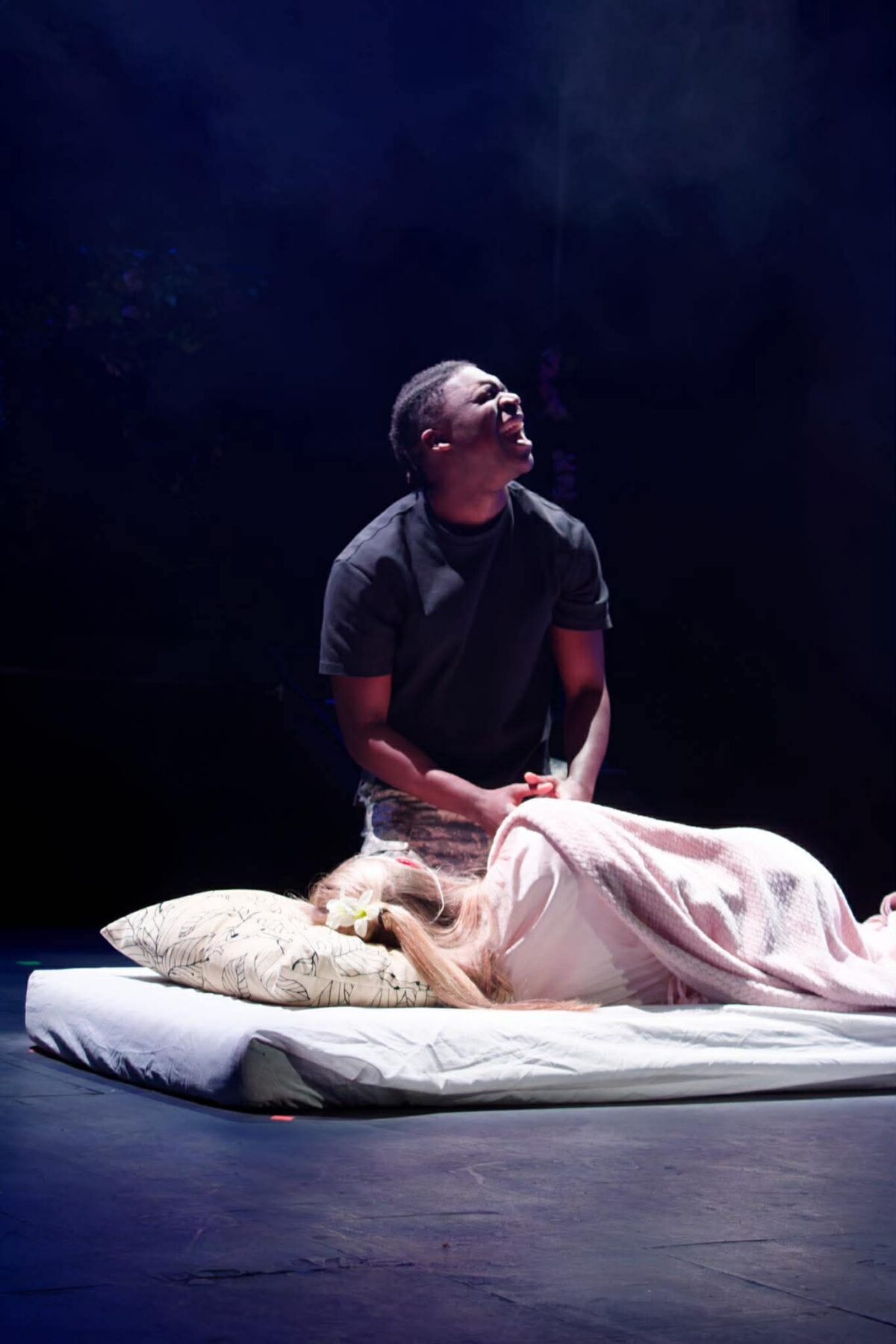
For me, the glue of this production is surely Dan Katsande as Othello. He is mighty and magnanimous when he first comes on stage as the brave ‘Moor’ General greatly renowned in Venice, until he is sympathetic and vulnerable as the lowly cuckold, self-pitying as he bears his soul out due to what he believes is a mortal wound from his lover. Katsande becomes unhinged and manic, fully embracing the beastly cuckold and the horrid Moor that he believes he has become, before doing the unthinkable to the woman he had risked his office and reputation for just a few short acts before.
It is a terrifyingly good performance – one where he commands his body to act before a line is spoken and, when the line is spoken, the audience are captivated all the more by his grand delivery, reminding them that Othello is a man of great power and poise. Katsande’s shrieks of pain and manic ramblings make us sympathise with Othello almost by force, we are shocked by his horrible treatment of Desdemona (played by Liv Fancourt), yet our hearts break watching this once great general become something more akin to an animal than a man – which Katsande delivers perfectly in the latter half of the play by lowering his shoulders and prowling around Desdemona when he speaks. Although at times he runs the risk of over-acting, particularly in scenes where he is howling in pain at Desdemona’s apparent betrayal, he grounds the performance, commanding the stage with his presence, physicality and booming voice.
A performance like Katsande’s is difficult to match, but Ollie Painter’s devilishly charismatic portrayal of Iago is certainly up to the task. Painter does something seemingly impossible in this show: he almost makes Iago likeable. Speaking directly to the audience in a crisp Cockney accent, Painter moves naturally in his dialogue, making them laugh through sheer charisma. He mocks and jeers at the posh, unexposed Roderigo, played by Sam Garratt, completely unaware that Iago is scamming him. The joke is every other posh, ignorant character onstage, the comic is the whip-smart, perceptive Iago and the audience to this stand-up is us. It is brilliant.
There is a real venom and contempt in Painter’s line delivery. We really do believe that he detests Othello. It is an organic performance that comes from a place of clear understanding of the character. Iago’s struggle is one of class: Iago represents the disenfranchised working classes who feel betrayed, who feel as though despite their hard work they have either been pushed aside by unqualified aristocratic nobles (Michael Cassio) or racial minorities given access to empowerment schemes (Othello). Through his accent, Painter characterises this clearly to the audience. Iago is not like the others, therefore Iago is evil.
The performances on display in this production facilitated the subtext that the directors intended for it. In what I refuse to accept was a debut performance, Amaya Uppal as Emilia delivered a masterclass on how to enhance the performance of others, and deliver one’s own performance just as spectacularly. Uppal was quietly disobedient to Iago, yet disobedient enough to irritate him, sowing seeds for her eventual end. She gives Fancourt’s Desdemona space to be overcome by woe and anguish, and she stands toe to toe with Katsande to create pulpable tension. Yet, where she is left to shine in her own moments, she is passionate, forceful, and fearless, delivering an exceptional debut worthy of praise.
It speaks to the quality of a production’s cast if in a review it takes this long for the name “Cillian Knowles” to appear. Exceptional as always and effortlessly comedic, Knowles somehow turns Cassio into a Shakespearian character that feels like he was written by Wilde. In Knowles’s Cassio we see the absurdity of nobility come to the fore through his absurdly sweet prim and proper boy scout routine with Desdemona. So absurd and sweet is this boy scout façade that Iago can’t help but to use it to bring about the downfall of Othello and Desdemona’s lives. When he is not sickeningly charming, Knowles is delivering an extremely funny drunken, slurring Cassio that does not feel drawn out. Knowles is endearing, even when he is spewing misogyny directed at Bianca, and loveable and far too good at being Michael Cassio.
Stepping away from the acting for just one second (I have plenty more to say), every detail of this production weaves together in a dance full of chemistry. Leyla Aysan and Molly Winchurst are no slouches in the lighting department, as they bathed the stage in fantastic midnight blue that holds a dark brooding atmosphere over this tragedy, only deviating from this colour scheme in the few moments of levity in the show or when using spotlights to showcase key moments in the show’s sequence. Aysan and Winchurst also teamed up nicely with movement director Robyn Bradbury, as all the moments of physicality, such as the hypnotic party sequence, were complimented deliciously by superb lighting. The fight scenes were also well choreographed – at times a little too well choreographed as you could see the fiction behind them – but so long as the performers remained safe, I was willing to suspend my disbelief.
Special mention must be given to the sound of this production. Music cues between scene changes is standard in student theatre, but rarely does it ever match the story being told on stage and the theatre company itself. Emilia Edwards and Shaan Thomas made use of the songs they selected between scenes, as if you paid close enough attention to the lyrics, they reflected the action and the intensity as the story progressed. However, I do wish the ingenuity of sound could have been used to aid some of the performers, who at times struggled with their voice projection and lost some details to the ceiling of the Assembly Rooms.
Back to the quality of performance in this show: I would be a hack reviewer if I did not mention the one and only Liv Fancourt. If I had a pound for every time Fancourt has stunned me to silence with her performances I can safely say I would be a very rich man indeed. In my personal opinion, I have always had a dislike of Desdemona as a character, primarily because Shakespeare uses her as a plot device – the innocent white girl corrupted and murdered by the uncontrollable black beast. In other iterations of Othello Desdemona is this faultless character used to highlight the faults of Othello, but not here. Fancourt gives Desdemona life. She is quirky and quick witted when she speaks with Iago after arriving in Cyprus, sarcastic with a doting Michael Cassio and even slightly resilient, when she refuses to let Iago see her in tears after Othello has just thrown her to the floor and called her a whore. There is strength in Fancourt’s Desdemona, a strength that is created by the love Othello has for her. When she feels Othello’s love wain, her own strength wains, which makes her death that more impactful. Fancourt makes Desdemona’s death matter more because she is not just a plot device. She is a person who Othello betrays by not trusting her loyalty yet she dies still loving him – an aspect of her performance furthered by the incredible chemistry between herself and Katsande. It is a performance that someone like Fancourt can make you think is easy to deliver yet so many before her have not been able to crack it.
As I wind down this review, the more perceptive amongst you would have noticed I have not mentioned Sam Garratt (Roderigo), Becca Morran (Bianca and others), Ross Killian (Brabantio and others), Nia Keogh-Peters (First Senator and others), Nerfertari Williams (Gratiano and others) and Jasper Hinds (Lodovico and others) and I have reasons for that. These performers were absolutely incredible when given time. For example, Garratt embodied Roderigo with such perfection and accuracy I was overjoyed whenever he came on stage, and Killian’s Brabantio was vile in all the best ways, showing a real understanding of the character’s purpose to the story. All the members of the ensemble pieced this story together perfectly, however, I feel that they were all hard done by both the nature of this play and the director’s visions. The overwhelming feeling I had when watching Othello was that Roots had an obvious and large chip on their shoulders. For their first production as a newly established theatre company, tackling such a well-known and heavy play is a very risky bit of business, and that means your cast has no choice but to deliver. The cast did, in fact, deliver but it felt like the director’s had concentrated a vast amount of energy into the main cast, leaving the supporting and ensemble cast very little creative direction to work with. This hurt in particular Keogh-Peters and Williams who I believe are talents that any production would fight tooth and nail to have in their cast. If you do not believe me go and read the reviews of the DDF show Poetry Club. They are immense and I wanted, in fact this production needed, to have the two of them on stage a lot more with a lot more in terms of lines and time to work with. If I can level any criticism against this production it is that: not fully using all the amazing talent at their disposal and never fully removing their hand from the handbrake.
Overall, Roots delivered a version of Othello that I wish I could see over and over again. The directing choices were for the most part informed, precise, and deeply aware of Othello’s greater narrative. The story Roots delivered blended elements of class and race issues in a way that was brave and long overdue, especially in a place like Durham. My only hope for Roots is that they lean into these themes more heavily and fully utilise all the talent at their disposal. However, all things withstanding, this juggernaut of a theatre company is destined for many great things to come and I cannot wait to see what else they deliver. Adieu!
Featured Image: Roots Theatre Company