By Matthew Dodd
Outside the Caffe Giulia, two old men barked at one another across a table gossamered by empty coffee cups. A russet awning cast a shadow, so long as to shade the pair completely, but short enough that it left Paolo, a sedentary streetcat, half-exposed to the shrinking sun of the early evening. Disjunct jazz floated across from the Via Dante Alighieri. Underscoring every few bars was the airy hum of laughter. Paolo stretched his two paws out, in one movement, and extended his body to its fullest length before compacting himself into a curled ball under the nascent twilight. One of the men reached down and scratched Paolo’s right ear, much to the cat’s evident displeasure.
Inside the caffe, the expatriate flaneur sat cross-legged against the back of his chair, squabbling over his cappuccino with the young gentleman at the counter, Dante – no relation. ‘You can’t be serious’, the expatriate squawked, ‘Donatello’s David over Michaelangelo’s?’ Dante threw his hands up defensively; ‘for me? No contest.’ The expatriate let out a scoff heavy enough to leave his saucer rattling for a matter of seconds until being silenced by his picking up the cup. Similar scenes had played out in the caffe most afternoons since the expatriate – William, a man with one-and-a-half working eyes, recently turned thirty despite his best efforts – had washed ashore in Genoa and taken temporary lodgings in the smallest town he could stumble to. After a one-sided battle with the Italian motorway network, he had slumped into a corner chair in the Caffe Giulia and, excluding irregular trips to the nearby pensione in which he had taken board, stayed largely put. On discovering the elevated tastes of this young barista, William had elected to devote much of his time to conversing with Dante on matters artistic, as though his company were a kind of spiritual patronage. In reality, Dante had been more of a patron to William, as the latter’s bar tab had, in the month since his arrival, been never more than half settled.
‘Have you been to the Uffizi, Dante?’, William asked, with no intention of waiting for an answer. ‘I went with my folks when I was a boy; I must go back; I’ve been on a total Botticelli kick as of late; it’s a real beauty.’ He considered what he had said and drummed the fingers of his right hand against the knuckles of his left. ‘So few galleries are themselves worthy of exhibition.’ He beamed noiselessly, an intermission allowing Dante a response: ‘I haven’t, signor.’ William was aghast. ‘Oh, you must! Perhaps we’ll go together.’ – this idea evidently pleased the expatriate. Dante rubbed a moistened rag against the counter, his eyes fixed away from William. ‘I must work, if I want to study. I can’t go to Florence on a whim.’ A muffled, septuagenarian growl and the sound of a hand slamming against a table reverberated through the half-shut door. Ears drawn to the noise, William noted the accelerated tempo of the music across the street. ‘Is Beatrice singing tonight?’, he asked with a coy half-smile to Dante. The counter grew ever cleaner. Dante shrugged. ‘She sings on a Saturday,’ the pace of his scrubbing quickened, ‘it is Saturday today.’ A quiet hung between them, punctured at intervals by a faint hiss from Paolo and a pronounced chuckle from the two old men. ‘Why don’t you go over there? I’m sure of so little, but I know she’d love to see you.’ No response; the counter practically squeaked.
William stood and, under the pretence of returning his cup, strode over to the counter. ‘Look,’ he began, ‘I don’t pertain to have any great romantic insight that didn’t come from a magazine or a horoscope’ – he waited for a laugh that did not come – ‘but I think I know something or other about that ineffable intercourse between man and woman which we, colloquially, call love. Enough to know that that girl out there’ – he pointed exaggeratedly towards the street opposite – ‘is feeling something like that for you.’ Placing the cup on the counter, he sat a hand on Dante’s shoulder. ‘And I know that when you hear her sing misty, you think it’s you she’s getting misty over, and it makes you feel good. Makes you feel like someone people ought to be singing about.’ He had his eyes set on the base of Dante’s ears, where his gaze would be met should the young man feel so inclined. ‘So, what I don’t understand is why you don’t shake off this ratty old place and run over there right now!’ He kept his hand on Dante’s shoulder. The night had set in fully, denoted by the groans of the men outside as they attempted standing up to leave. Ever the pugilist, Paolo insisted on scratching at both of their oversized gabardine trouser legs before they could leave.
Dante shrugged the hand off of him. ‘I have to work.’ He picked up the abandoned cup and began methodically working out the heavy staining around its rim. ‘I don’t work, I don’t earn. I don’t earn, I’ll never study.’ The stains were agitating him. He bore away at them like a bull at a toreador. With sudden vigour, his head snapped around towards William, who had set off back to his seat. ‘And what about you? Swanning around as though you have no cares?’ William interjected, though he knew Dante wasn’t done: ‘Swanning! I don’t swan! Gamble, perhaps.’ Dante ignored the jibe and continued. ‘When will you leave here?’ Seeing on William’s face he’d entered territory resolutely marked ‘no trespassing’, he pressed further. ‘When will you go back to your wife?’ The jazz outside had slowed to a waltz. In the street, the two old men were walking together in time. William receded into his seat. ‘She’s not my wife.’ His right leg bounced at a violent pace against the table. ‘She won’t be my wife until I go back. Hence, I am here; she is there.’ This last geographical distinction was marked by an accentuated movement of the hands: here on one side of the table, there on the other. ‘Why should I leave? Go back and take over the role of upstanding husband? Have a cup of coffee, work hard and come back home to baying housewife? Where’s the time to gamble there, where’s the time to swan? Here, you’ve got freedom.’ This point was important to him, it was clear. ‘Freedom, Dante.’ Behind the counter, he shook his head and brought out a scourer. ‘I think there are different kinds of freedom, signor.’
A faint smile leaked into William’s face. ‘I think you are a wise man Dante, and I think one day the world will know it.’ Standing up, he made his way to the stand in the corner. He collected a military style trench coat from the stand and flung it over his person theatrically. Paolo had come up to the door now, evidently endeared by the sound of argument. William knelt down to stroke his chin. Paolo purred and scurried back into the night. The music had picked back up. William got up, stepped towards the door, paused, spun on his heel and sighed. ‘I’ll see you there, Dante.’ Once more, the young man did not return his gaze. ‘I must work, signor.’ William shrugged and set out towards the Via Dante Alighieri, leaving the second Dante alone in the caffe.
Dante closed up the caffe after a few hours, by which time the music had stopped, and, thirty years later, died three doors down from a bacterial infection of the stomach – having never seen either David.
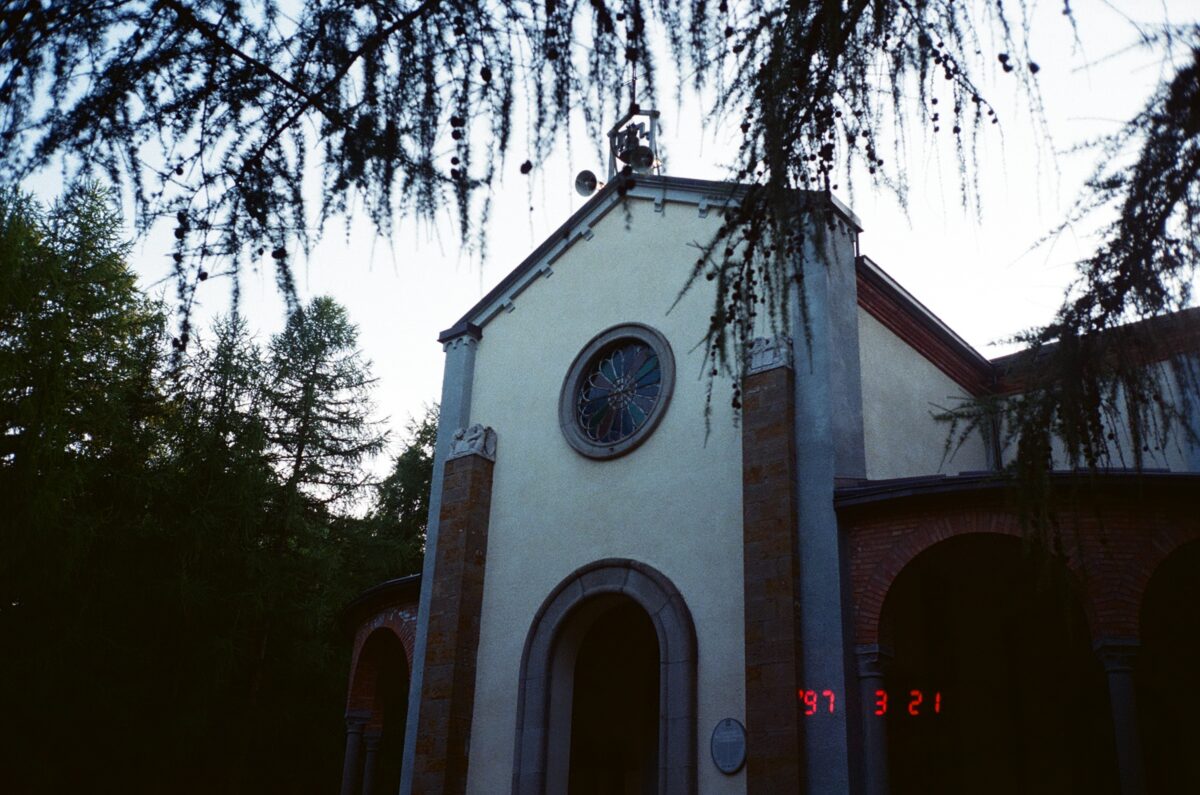
Featured Image: Matthew Dodd