
By Robin Reinders
I don’t remember when I began to drink because I liked it. The first furtive sip of my mother’s vodka-cran, returned with a puckered mouth and distasteful shake of the head. Smirnoff Ice soaked in the saccharine aftertaste of a sticky American suburban desert summer. That cheeky ornamental sparkle in the family-fridge OJ; bubbles and Benedict before noon. I remember thinking adults must be something very far-fetched to have acquired not simply the taste but the temperament to tolerate something that looked like maturescence crystalised, and yet tasted of soap in the mouth. What we seem to forget when we’re piss-taking over pints and pre-rolls at the pub is that apprenticeship in alcohol comes about through mimicry.
For most of us, this education begins in embarrassment.
Every culture of taste has its shibboleths – the books one must be versed in, the films one must feign to have seen, the discographies one must recite top to tail. To carouse, per contra, is to discover that your body will reject the canon, and that each bitter pill you swallow merits you that much closer to an earnest drinker. I don’t like dirty martinis. I tell you this as a truffle-foraging, cornichon-crunching creature of brine and salt and savour. I was cresting twenty when I asked my barman-retiree father to chill me a glass and uncork the Hendrick’s. I wanted to love it for its poise, its cosmopolitan severity. I didn’t laugh so much as bark, embarrassed by my own disappointment, balking at the opaque peridot of the frosted glass, like a birthstone that didn’t belong to me. I am not a dirty martini person. I accept this with a quiet, cognizant sort of amusement. There is a peculiar humility in discovering that you cannot love a drink you so chronically hope to love. It punctures the vanity of discernment. The drinks we abandon tell the truth of our appetites more eloquently than the ones we order ever could.
More and more I find it true that there is a certain choreography inherent to preference. Culture has always been coded in the minor details of consumption; cocktails simply render those codes portable and potable, able to be performed in the theatre of a hotel bar or an airport lounge or the local pub. The process of taste-making – the literal kind, that is – is not unlike the making of a self. There are phases, fads, flirtations. A person’s drink becomes a form of shorthand. The girl watching her weight – Targaryen-blond and terribly boring – perching neatly on a barstool with her vodka-soda. The bubble-skirted, ballet-flatted Instagrammer bending over the counter for a birds-eye of her Aperol. The twenty-something berlioz bloke quoting Bukowski (incorrectly) while he swirls his single malt and checks his crypto portfolio when nobody’s listening.
We were all performing then: in the dewy-eyed dream of our parents’ kitchen, in bolshie adolescent company, in the sticky arena of a student bar. We still are. Drinking, not dissimilar from dressing, belongs to the theatre of self-definition. Every order at a bar is a small audition for the role of ourselves as imagined by others. The city itself colludes in the casting: cafés advertising ‘artisanal’ tonics, bars lit in imitation of some universal nostalgia, menus printed on textured paper that promise depth of field if not depth of flavour. Boozing has always had an anthropology attached to it. The tiki Mai Tais of the 1950s, a sweet postwar reprieve; the vodka revolution of the ’80s, a distilled form of corporate yuppie (in)efficiency; the craft-cocktail revival of the 2000s, a Buzzfeed-bloated mode of taxonomy. What your cocktail screams about you! To drink bitter is to be sage and perspicacious; to drink sweet, jejune. Even taste, it turns out, has a class system.
It’s no accident that bitterness has become the aesthetic of adulthood in our time – espresso, kale, dark chocolate. A comestible sort of cynicism that feels less cringe inside our mouths than it sounds projected out. Holistic, antithetical zoomer ‘wellness’ has a certain flavour, doesn’t it? I like a Negroni alright – what do you want me to tell you? A graduation from the half-hearted G&Ts of early adulthood. I don’t actually remember when or where we were introduced. I don’t remember the first whiff of pine and peel, the first wink of arterial red like the garnets in my jewellery. I didn’t like it, but I did. It’s not a drink that courts indulgence. Quite the opposite; it begs attention with a cruel rather than a kind hand. All this to say at some ill-defined, perfunctorily romanticised moment, I understood I was a bitter drinker. Fond of the acrid, the tannic, the aromatic. It’s a far cry from the pink cosmos and perfumed spritzes of my younger years, but when I order one I don’t do so with panache. I don’t fancy myself some maverick patron with a palate worth priding myself on. I order it because it’s my drink.
These days I keep little in the cabinet. A bottle of gin with a label I like. A bitter that stains the glass vermillion. A dry white I cook with as much as I sip. Maybe a cheeky Italian liqueur for some frivolous, far-future dinner function. I suppose when you finally start to drink like yourself, you have been, in consequence, every kind of drinker: the precocious, the posturing, the self-appointed pundit. And in that gradual ledger of sips, one discovers that taste is no static inheritance nor fixed, natural possession, but some fluid, fey thing. A patient, unhurried negotiation between what we think we ought to drink and what, inexplicably and inexorably, becomes the second-round staple.
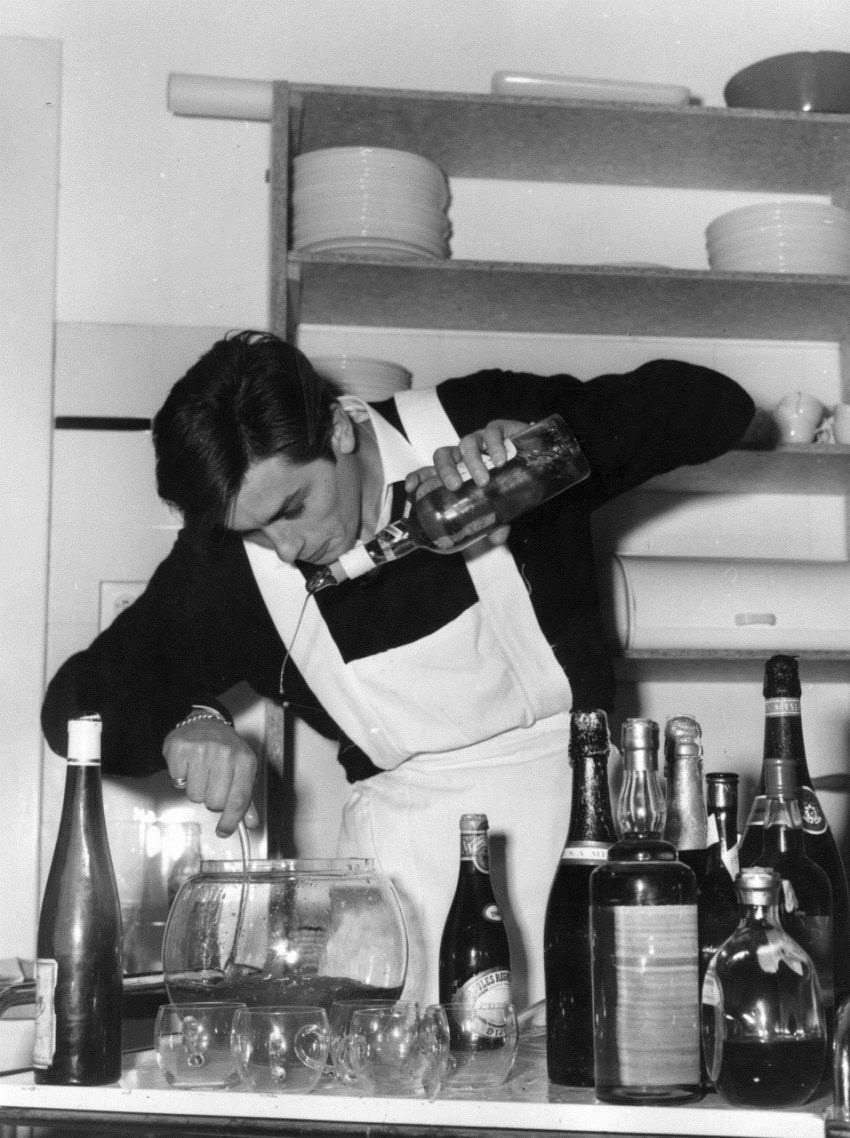
Featured Image: Alain Delon / Getty Images