Categories
Culture

Spanning Time – Buffalo ’66

By Bel Radford

Like any film Vincent Gallo has conjured, Buffalo’ 66 is steeped in narcissism. Gallo stands on stage and essentially cry-wanks in your face, captured on 35mm film, It’s a blatant display of self-aggrandising and a masturbatory pat on the back (or dick) – perhaps best surmised in one of the beginning scenes of the film, in which Gallo beats up a man in at the urinal next to him for staring – and exclaiming – it’s just so big! Naturally, it is my favourite film, ever. There is a job-lot of chin-scratching discourse and pacing back and forth over the success of Gallo’s attempt to curate an ‘art film’, and his portrayal (and in-film treatment) of his deuteragonist, Christina Ricci, but before discussing such a heated debate one should be familiar with the plot of Buffalo’ 66. 

In the rotted, snowy streets of New York we lay our scene. Billy Brown (Gallo) has just been released from prison for a crime he didn’t commit. Following a montage of greyscale, grainy overlays chronicling Billy’s 5 years locked up – cue crying in shower – cue mugshots – cue piano tune (written by Gallo himself) lamenting on being such a lonely, lonely boy. We then cut to a scene of Billy running into every nearby shop locally available maniacally searching for a bathroom which he finally finds in a dance studio (where the aforementioned urinal scene takes place). Gallo is all sharp shadowed brows and spindled limbs – speaking in staccato whines and quips, the cold daytime shots of New York were, to me, reminiscent of a more expansive and somewhat hollowed colour grading akin to Wong Kar Wai’s ‘Fallen Angels’. It’s all set up to feel very alien. Billy is strange looking, strange speaking, running around this apocalyptic cold expanse. After relieving himself, he calls his mother from a payphone – declaring he’s just touched down from a nondescript work related trip, staying at a fancy hotel, and wants to introduce his family to his wife. Wife? You ask – well Billy proceeds to snatch a girl walking out of the bathroom – wife acquired! Her name is Layla (Played by a 17 year old Ricci), wearing a powdery blue babydoll dress, silver sparkly tap shoes and a white shrug cardigan. Layla is bemusingly passive – obliging Billy’s demands to drive him to his parents house, pretend to be his wife (under the alias Wendy Balsam) and to essentially ‘make him look good’ – promised with the reward of being his best friend. Billy then has a panic attack sort of episode on the porch before his parents open the door – and we are greeted with worlds best mum and dad. 

After serving Billy courses of food he is allergic to the vast majority of, Billy’s mum explains to Layla her devotion to the Buffalo Bills, recounting how the only game she missed was the day Billy was born, sighing how she wishes she never had him as they eat platefuls of tripe (cow stomach lining, for the less culinary inclined). Billy’s dad is a retired singer, now part-time pervert, occasionally motorboating Layla under the guise of a fatherly hug – ‘ you know, daddy really loves his new little sweet young daughter!’ It is difficult to say whether Billy’s father really looks at Billy during the entire dinner scene, but we do get a fond flashback scene of him killing Billy’s childhood dog, Bingo. During the Godard-like dinner scene montage, it’s my belief that this is where Layla really falls in love with Billy. Mummy AND daddy issues? Bless. She takes it upon herself to declare that Billy is her boss at the CIA, where she worked as his typist, and that they have a child on the way. The parents aren’t overly affected, watching the Buffalo Bills game over Layla/Wendy’s shoulder, but it’s a tender moment.

It transpires that the reason Billy went to prison was in order to keep a bookie from hurting his parents, a bookie whom he owes $10,000 after betting the Buffalo Bills would win the 1991 Super Bowl – presumably in an attempt to connect with his emotionally negligent mother. We discover that the next chunk of the movie is a manhunt for Scott Woods, the disgraced Buffalo Bills kicker whom Billy blames for losing the Super Bowl, in turn losing everything, who now owns the local strip joint, Billy learns that Woods doesn’t show up at the strip club until around 2 in the morning, so we then see Billy and Layla killing time, shuffling through his hometown. The meat of the film here becomes tender, and warmth pervades the vignette of scenes as the neon city signs are woken up by the dark, we arrive at the bowling alley where Billy’s countenance softens oh so slightly, it seems to be the place in which Billy spent the majority of his youth. This is my favourite scene of the film, for a great number of reasons really: the first being Billy’s incredible outfit, a striped grey and black wifebeater, with tight flared trousers, and patent red platform cowboy boots. The harshness of his nose, his jaw, his eyes as he hits strike after strike, his body is all angles. We then pan to Layla, ambling around, a noncommittal observer – the lights dim and all is a deep red, with her silver tap shoes spotlighted, she then breaks the fourth wall by tapdancing to King Crimson’s ‘Moonchild’ – the baby blues of her dress, eyeshadow and tights chime in accordance with the song’s vibraphone and chatter of symbols, puncturing a tight staccato through the hollow grey of the film. The scene operates as a rare invitation to Layla’s interior world, underscored by a warm and deep loneliness, top-noted by innocence. 

‘Lonely moonchild, dreaming in the shadows of the willow’ 

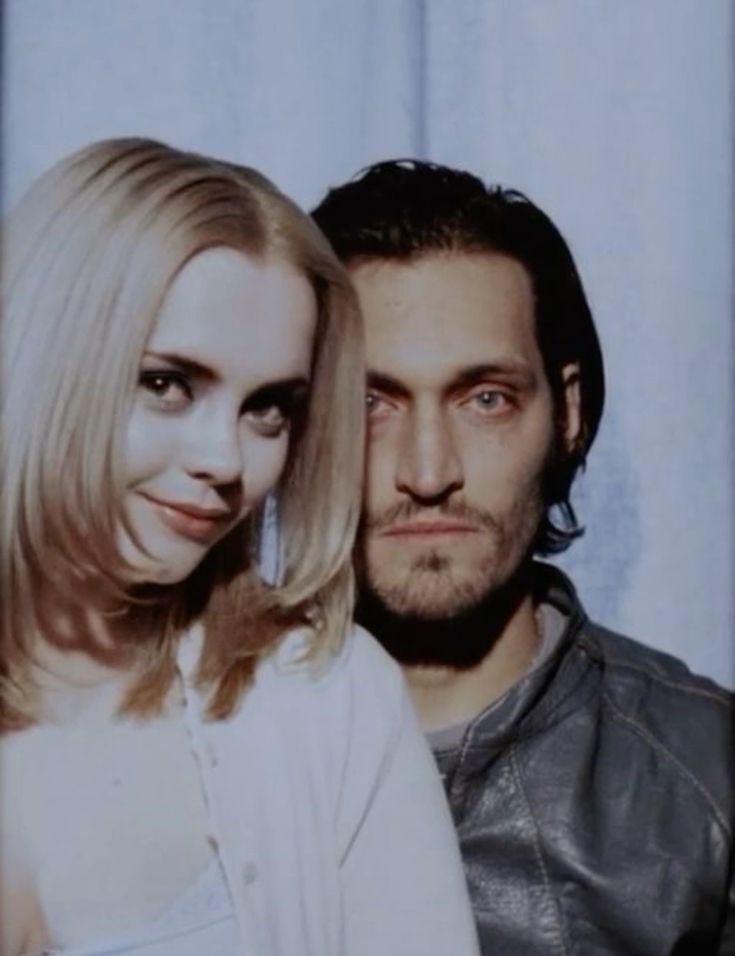
The next scene, arguably the film’s most famous, is their time in the photo booth – shot through the photobooth camera, we’re peeking through a small, grainy rectangle in the centre of the screen. Layla sits on Billy’s lap and is chided over several attempts to take photos, first for sticking out her tongue, then for kissing him on the temple – ‘we’re a couple that doesn’t touch’. Billy is scared, albeit moved by Layla’s burgeoning empathy she bludgeons him with, he consistently berates Layla in his broken, repetitive and disjointed sentences while she peers back doe-eyed and unaffected. Like Layla, it’s quite difficult to see Billy as venomous, he comes across as a gentle yet imperilled piece of shit with a frustration that hurls itself toward any moving target – it appears he wants to be loved, and he slowly allows himself to feel what it may be like, they have a bath together (clothed, naturally) then lie in silence next to each other awkwardly-limbed, like discarded barbie dolls. A dulcet saxophone seeps into the background of the scene, as they touch hands – snatch them away – touch again – eye contact – look away – then kiss. It’s brief and angular, reminiscent of Billy’s bowling, but then he folds in on himself and lets himself be held.

Billy then wakes up at 2:08, we’re reminded of his sacrificial mission. As he sneaks out, he wakes Layla:

‘I really like you

I’m gonna be really sad if you don’t come back.

Unless you tell me

If you’re not gonna come back, just tell me, don’t lie to me.

Are you going to come back or not?’

Layla declares her love for him as he closes the door. Next, is one of the greatest examples of scoring in the history of film (I believe) and even if you won’t ever watch this movie – I completely urge you just to skip to 1:38. Heart Of The Sunrise by Yes begins to play as Billy walks into the velvet-clad strip club in slow motion, topless dancers (in granny pants – weirdly) lit up in icy neon and surrounded by fat, wobbling men – it looks like a scene from the Twin Peaks backrooms with an incredible prog rock bassline. Billy pulls out his pistol and shoots Scott, then himself – everything is still, yet the camera pans around the scene and then away to some faraway vision of Billy’s largely unmoved parents watching a Buffalo Bills game on his grave, naturally. 

But what’s this – we pan back in – it was all a dream! Rejoice! Billy flees and runs to a shitty 24-hour café where he buys Layla a hot chocolate (large) and a special heart cookie. It’s a truth universally known that narcissistic homicidal depressed maniacs can, in fact, be fixed, girls. The movie ends with a still of Layla and Billy in bed, sleeping, and holding one another.

Now there’s plenty of discourse surrounding its semi-autobiographical nature, as Gallo himself grew up in Buffalo, New York and had similar parents – in fact, in the premiere of Buffalo 66, attended by those who knew the family, continually burst out laughing in recognition of the parents’ depictions. Gallo describes Billy as a character portraying feelings true to those that Gallo has felt himself, and the last five minutes of the film are him on a really good day. So, in essence, Gallo Dr Frankenstein-ed Billy using the darkest parts of himself to depict what he could have been. The semi-autobiographical nature of the film, paired with its total self-indulgence, (the fantasy of its plot is apologised for by its atmosphere, which is uncontestably beautiful) persuades many watchers to land in the ‘this film is a piece of shit’ camp. Many firmly situated in this camp owe it to Gallo’s deeply bemusing online presence; he famously advertises himself as an escort on his website, in which he writes, 

‘I, Vincent Gallo, star of such classics as Buffalo 66 and The Brown Bunny, have decided to make myself available to all women. All women who can afford me, that is. For the modest fee of $50,000 plus expenses, I can fulfil the wish, dream, or fantasy of any naturally born female’ (transphobia duly noted), he goes on to say: ‘Heavy set, older, red heads etc can have me if they can pay the bill (…..) However, I highly frown upon any male having even the slightest momentary thought or wish that they could ever become my client. No way, José. However, female couples of the lesbian persuasion can enjoy a Vincent Gallo evening together for $100,000. $200,000 buys the lesbos a weekend. A weekend that will have them second-guessing. 

Gallo is also selling his sperm for $1,000,000 (cash or check only, mind you). Owing to his online ramblings, nobody would really be surprised if Buffalo 66 is really just his incel wet dream, an intangible simulacra in which Layla represents the fantasy of unconditional female care in spite of the woes and hardships of being a man of the narcissistic variety. Gallo, in interviews following Buffalo ‘66’s release declared Christina Ricci to be on cough syrup – or just drinking heavily – throughout filming, however it’s clear he just didn’t like Ricci, who has since called him a raving lunatic. It is obvious Gallo is a bad man, whether his persona is some kind of reactionary performance art or tasteless extremism, it still pulls us back to the age old question – can we separate the art from the artist? 

Many Substack articles frame Buffalo ’66 as a chronicle of misogynistic romanticism, yet I like to think Layla is, in fact, the only character with real emotional agency in the film, taking emotional charge of each scene she inhabits. Billy does not overtly assert a coherent or sustained form of male domination (though his frankly futile attempt at kidnapping her cannot be ignored) and is objectively desexed. This leaves us with the question: if Billy is not meaningfully exerting control over Layla, does she instead function as a Manic Pixie Dream Girl – existing to facilitate his self-actualisation? While the film undeniably traffics in a dated belief in the transformative power of a woman’s love, Layla is neither narratively contained within a neat psychological arc nor positioned as someone who ultimately ‘fixes’ him. It’s interesting, and awkward to position their dynamic – I think Gallo as a person, and director enormously taints what could be interpreted as two people, a strange encounter, and an unlikely sweetness. 

Nonetheless, it is my favourite film, ever. I think I put this down to the outfitting, the prog-rock scoring and the cinematography that synthesise to create such an offbeat, alien, experimental yet extreme atmosphere. If you have, or are planning to watch the film, you’ll note the downright strangeness of the dialogue, it’s stilted and devoid of natural cadence in a way that’s blackly comic, Billy is merely the body of a broken child. I sustained a very emotional reaction when watching Buffalo ’66 for the first time, so maybe you will too – my legs and eyes both pricked, I felt wrought with an urgency I couldn’t quite articulate, pioneered by excitement. I was seeing something totally new and weird and epic – look guys are you seeing this? holy shit, guys, are you fucking seeing this? – pan round to ten minutes of a man trying to find somewhere to piss. Hey, whatever moves you, moves you.

Featured Image: Muse Productions
Categories
Reviews

To Rest Our Minds and Bodies: My Thoughts and a Discussion With the Author

By Bel Radford

To Rest Our Minds and Bodies is an incredibly yielding book. Its contents are tender and vulnerable, falling clean off the bone and seeping hot into my palms — my fingerprints were stained for hours after, marking everything I touched. Yet there’s weight to it too, a pressure that finds old bruises I’d almost forgotten — ah yes, we’ve been here before.

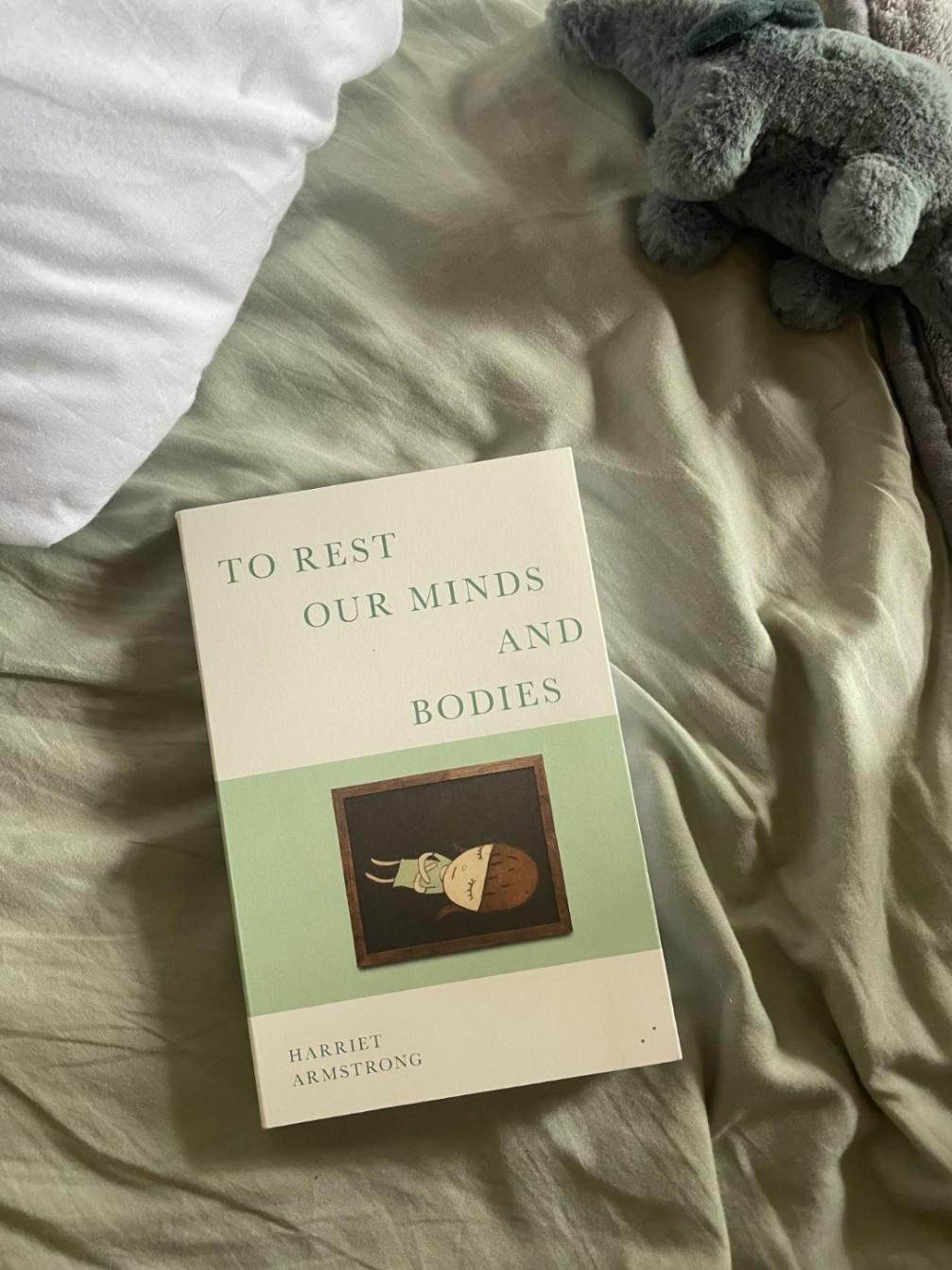
Harriet Armstrong’s book is, at its simplest, a reckoning with intense feeling: it weaves through the debris of unrequited love, the attempt to contextualise oneself within the world, self-destruction, redundancy, and mundanity. I am ashamed to admit I did entirely judge the book by its cover — it shows a Yoshimoto Nara-esque girl, pale and lying (or perhaps floating) in an oaken abyss. Her arms are crossed, the mark-making is gentle and roundish — the girl appears acutely peaceful in a way that made me envious. I recall being curled over, kneeling on the bookshop floor and finding myself enjoying the front cover — it anointed my scorched retinas, a cruel aftereffect of the pervasive LED shop lighting. I was also particularly frayed that day. Oh book so small and gentle, if you look like a lullaby, will you read like one too?!

It doesn’t exactly. It’s not necessarily a happy nor uplifting story — in fact, a great many bad things happen. It bleeds out slowly and hums along with the low timbre of humiliation thick in the everyday negotiations of awkwardly aged semi-adults. We are ripe with shame! The narrative engages with themes of redundancy and mundanity within these hangnail years; one hand turns over these old stones, the other hand holds your own — guiding you through an exacting jaunt across the minefield of your own souring youth. I found great comfort in its deep recognition; the novel really is good, compassionate company. Just a few pages in, I typed into my Notes app: “somebody appeared to be taking minutes in my brain a few years ago. they’ve since gone, gathered their findings, and returned it back to me bound in paper. harriet armstrong … who are u….”

The plot is as follows: the nameless protagonist begins her final year at university studying psychology. The book spans the entirety of the academic year. She meets her flatmate, Luke, one afternoon in the kitchen. He is a postgraduate student doing a vaguely defined degree in computer science. Luke is a kind boy, though some might categorise him as the manic-pixie-dream type — he introduces the protagonist to The Microphones, he wears guyliner, his presence is soundtracked by breathy, incomprehensible, and highly distorted music that fills the kitchen he cooks in, and he vaguely resembles Tilda Swinton. In one of their first encounters, Luke kicks a loose wooden board beneath the stove, making a soft, punctuated staccato that he remarks sounds like that of a heartbeat. He then feeds her spoonfuls of his curry.

“As he laughed he passed me a teaspoon of his curry and I couldn’t even taste the curry because I was thinking about how his fingers had touched each piece of onion, each piece of potato, some of the lentils, some of the mustard seeds — all of these things which were now inside my mouth.”

But despite his charm, irreverence, and unavailability (as we later discover), it would probably be very wrong to call Luke a manic pixie dream boy. The term is mostly used to describe a Ramona-Flowers-adjacent character, defined by Oxford Languages as “a vivacious and appealingly quirky character whose main purpose within the narrative is to inspire a greater appreciation for life in the protagonist.” These characters often exist as a mechanism or catalyst for growth, lacking real depth, and are defined more by the effect they have on others as a force for optimistic change than by their own interior lives. Luke is not vapid, and his feelings do not synchronise with the protagonist’s to produce a neat arc of self-learning. The protagonist falls in love with him, but it is fraught with resistance — unlike a classic manic pixie dream scenario: a down-and-out protagonist meets a quirky, optimistic character, a chemical reaction occurs, and the protagonist emerges enlightened. Our protagonist arguably ends the novel even more down-and-out than she began: punching trees, vomiting in a gutter, and running drunkenly into a lake.

Throughout the book, Luke and the protagonist form a seismic connection. Though the novel gestures toward friendly coffees and catchups with a handful of other friends, none possess the same intimacy nor gravitational pull as theirs. They show each other music and talk and talk and talk and cook and sit and talk. Luke and his girlfriend break up, thus galvanising the protagonist — their connection is so deep, makes so much sense — they should surely be together! It is frustrating even to us, the reader, on some level. It feels so emotionally and practically right and inevitable. The protagonist describes a kind of vaginismus, or perhaps an emotional block that has only ever been transcended when Luke is thought about. As Harriet herself puts it, love and truth collapse into one another in the book — the desire is undeniable, yet fundamentally inaccessible. This impossibility is heeded early on in the novel, when the protagonist imagines the two of them living together.. Luke insists they never could; it wouldn’t work. They’d never have time, he says, “to rest their minds and bodies.”

It is fruitless, and so the story becomes an exercise in trying to exist alongside this unresolvable attachment. From Luke’s perspective, the intensity of their bond is unsustainable — alas! The candle that burns twice as bright burns half as long! In the novel’s latter half, the protagonist spirals into a kind of blackly comic mode de la self-destruct: she seeks out sex with seedy men and runs until she shits herself or vomits, etc. etc.

It’s this specific trope I resonated with the most deeply — the pursuit of breaking through a period of murky bleakness with anything of dramatic consequence; provoking big feelings or big repercussions to bring you out of yourself and into the realm of consequence and danger. In To Rest Our Minds and Bodies, this translates for our protagonist as seeking out sexual relationships online. At one point, the protagonist meets an older comedian, Richard, on a dating app. She asks if he has any pets — he replies: “Only if you count this monster cock.” Richard is her first sexual experience, and the protagonist mentions the seediness of the encounter feeling appropriate, somewhat pleased when he reveals a gauche tattoo of some coyote on his upper arm. Her exploration of sex reads like an experiment with self-harm. I talked to Harriet about it:

BR: Does the protagonist seek out encounters with men like Richard as a craving for some kind of consequence — as if bad, awkward, degrading sex is still something to be felt? I sort of imagine she wants to get as close to the edge as possible, to provoke the universe into giving her big, intense feelings or repercussions as surrogate intense feelings that Luke gives her.

HA: That’s actually so moving to read because yes, I think that’s exactly what I wanted to get at! The protagonist is definitely seeking out intensity and extremity to try and find some kind of outlet for her intense and inexpressible feelings for Luke — and I think she’s also trying to prove to herself that she’s capable of causing intense, serious, “adult” things to happen, because she’s so unable to make anything “happen” with Luke. I honestly feel like your question puts it better than I can — she’s definitely trying to get closer to the edge and to access these extreme situations as surrogates for the intense way Luke makes her feel, I love the way you put it! I think she also perceives a kind of very binary split between Luke, who she loves, and other men, with whom she has these horrible encounters — and perhaps it feels easier, to her, to keep those two things so extremely separate. I couldn’t really imagine her having more pleasant or neutral “dating” experiences: I felt this character would be drawn to these more sort of degrading, unemotional situations because they reinstate Luke’s role as the only safe/special person. Also, I definitely remember having those sorts of sexual experiences at that age, and maybe not even seeing them as degrading or bad because I didn’t know what a more healthy, comfortable sexual experience might look like. So I think there is definitely an element of that too!

The vast difference between the tenderness she shares with Luke and the physical awkwardness, clinical detachment, and general unpleasantness of her encounters with these other men is really, truly palpable. Many might wonder where the comfort I found in reading this book really came from — it’s just good to know the self-destruct button has been as appealing to others as it has been to me.

As I’m sure is normal when reading, one tends to contextualise the story and situate it somewhere familiar within their own world. In café scenes I imagined them at Whitechurch; at the pub, under the heated lamps at the Swan. During the protagonist’s monologues, my mind surrendered to peculiar feelings; that which resonated in the book felt as if it came from some muddy dream. The closest comparison I can make is the act of trying to make out the shapes of your childhood bedroom in the dark — your carrot-lacking eyes squinting in an attempt to discern a dressing gown from some Slenderman figure at the foot of your bed. That’s how it felt. Sometimes, when the protagonist described her isolation, I imagined a waxed wooden floor — maybe a ballet studio — big mirrors in my periphery that I couldn’t quite look at, shame-bound and anchoring my gaze to my feet. It’s the same room I often find myself in when I’ve been alone too long and my feelings start to become physical sensations. Particle emotions rub against one another in my head, hot, volatile, and fast like a kettle about to boil. I feel it pressing against my temples. The protagonist’s thought process often brought me back to this room, particularly in moments when loneliness, or Luke, was discussed. When we are trapped in ourselves like this, and we feel (at last) a big feeling from something outside of ourselves — we feel as if we have found God.

The novel reaches its crescendo after a period of semi-estrangement between the protagonist and Luke, culminating in her invitation to Luke’s twentysomethingth birthday party. She arrives, knowing nobody else. When Luke quips that he “can’t spend the whole night just with her,” we see, paradoxically, both constraint and release. The protagonist then goes outside and watches the party through the great glass door. She sees Luke’s gangling limbs curl and twist around the faces and bodies of those he knows. His body fractured betwixt the rooms and people — the intimate yet dispersed birthday boy politely doing the rounds — his presence dispersed yet shared among many. How unfair: they get to be touched by him, feel him move past and through them with no consequence and in a way that’s not completely devastating. The protagonist is on her knees in Luke’s father’s vegetable patch. She proceeds to vomit in a gutter, send Luke an unelucidated unkind message, then run, drunk, into the lake they swam in just weeks before. The protagonist’s corporeal reactions are, of course, extreme; perhaps mental devastation becomes more tangible, more legible when translated into bodily experience. I also talked to Harriet about this.

BR: On the back of the book a guy called Luke B. Goebel describes the book as “the real truth about being too big for the container of the body of youth.” The protagonist’s obsession often manifests in extreme bodily acts — vomiting, running into the lake, punching trees. Do you see these gestures as the body attempting to articulate emotions or intensities that exceed the self’s capacity for containment?

HA: Yes!! Again — beautifully put!! I think the narrator is feeling such intense things emotionally, and cognitively even, but lacking a physical outlet for those things, and an understanding of how to gain that outlet. Even her sexual experiences feel so random and failed and don’t really allow her to express anything or even have a real experience — I think she finds them all so partial and unfulfilling, and totally unrelated to her real feelings and instincts. The book is quite concerned, I think, with her dis/connection from the physical world — and how, even through sex and her vaguely self-harming actions, she remains essentially insulated from the world. And I think she’s also having these feelings — like love, I guess — that feel huge and almost transcendent, but again, can’t be physically expressed or even expressed to Luke through language — and there’s definitely a claustrophobia in that, and a desire to try and break out of the self.

A final note I made whilst reading was the culturally referential breadcrumbs left along the way. When setting up her dating profile (to meet the aforementioned disappointing men), the protagonist includes a photo of herself dressed as Phoebe Bridgers from the Halloween before. She mentions listening to Mitski and “The Place Where He Inserted the Blade” by Black Country, New Road. Luke introduces her to The Microphones. Anyone familiar with these artists will immediately note their common denominator — a certain attentiveness to the emotionally fragile and generally soul-crushing. We spoke about this also.

BR: I really liked the musical references dotted along the way; it made a sort of soundtrack for the book in my head. Why was it important to include these musical references?


HA: I really liked the idea of the book feeling like an accurate depiction of life — or at least that narrator’s life — and to me that meant including lots of little daily details like music, just because those things are a big part of my day-to-day life, so it felt really natural and almost obvious to add those details into the book too. I also really liked the idea of exploring how the character is experiencing her own thoughts and feelings through music, as a way to make sense of them — I felt this fitted with her tendency to overanalyse things and try to understand their deeper “meaning.” Also, it was fun to explore the excitement of her connection with Luke — and the way it made her see herself in a new way — through her excitement about his favourite music. I wanted, also, to explore the way she uses music as a way of expressing how she feels when she speaks with Luke — I thought there was something sad and maybe interesting in the idea that she doesn’t know how to communicate her feelings to him except through other people’s art.

I think it’s particularly interesting that this impulse — to find resonance elsewhere — runs throughout the entire novel. The amorphous presence of identity is slippery and exceedingly difficult to pin down. It is hard to know who you are, what you like, what you mean, or what you give, and To Rest Our Minds and Bodies gently bears witness to this. It soothes the neurotic twenty-something heart with teeth worn down to the gum — and for that, it deserves to be held like a precious stone. Alongside its practical and emotional acuity, it is written with a compassionate beauty — a feat, considering that at the same time it kneels beside you, elbow-deep in your wretched guts, tugging out long-carried feelings that can finally be felt and made sense of.

By no means should you take my thoughts as universal truth; everyone I’ve lent my copy to has offered staunchly different emotional accounts of their experience. My mother read the second half over my shoulder on a long train ride, convinced the protagonist was chronically self-interested. My boyfriend was unsettled by her pursuit of unpleasant sexual encounters as a way to feel — a surrogate of sorts — even when he recognised it as a symptom of her desperate attempt to access her own emotions. He was particularly frustrated that the protagonist and Luke couldn’t end up together, though they inhabit the same orbit. These different responses fascinated me; it reminded me of the first time I watched 500 Days of Summer, labelling myself a passionate Tom sympathiser, then scrolling through the Letterboxd reviews of the majority. Safe to say, I learned something about myself that day. I think these varied reactions also illuminate the most profound facet of Armstrong’s writing: she accommodates the kaleidoscope of human feeling, offering complicated yet very real scenarios that each reader digests and responds to differently — a reflection of the ways we inhabit our own interior worlds. In all, To Rest Our Minds and Bodies is a truly beautiful book. Most readers will derive their own unique meanings from it, but I suspect that those in their twenties will find themselves recognising much of the prose — rehearsed, written, thought, and even cried — as their own.

Featured Image: Bel Radford

Categories
Perspective

A Glutton and a Sloth

By Bel Radford

My new bedroom overlooks Durham bus garage and the lucky passengers on the top deck I’ve managed to flash a handful of times. I’ve taken to sitting on my window ledge each morning equipped with cigarettes and coffee, soundtracked by Spotify’s finest Gregorian chant mix, and conducting some furious online shopping. The rituals are already piling up: a cyanotype bra, a top my housemates mistook for an upcycled binbag and anti-bloating pills that I suspect (and maybe hope) are some kind of black market Ozempic. 

This has become the best part of my day. It’s a very soothing practice, bringing various receptacles up to my mouth, sipping or inhaling their contents that soothe and corrode in equal measure. Freud would have called it symptomatic: a psychosexually stunted adult pacifying herself like an infant. And the chanting complicates things too. I don’t especially enjoy it, but perhaps that’s the point. Exposure therapy via my shitty wired headphones – sip, puff, submit to whatever sonic affront the algorithm conjures.

The more I think about my morning rituals, they resemble a kind of budget hedonism – a far cry from the Gatsbyesque sort that populates novels, but a cheaper pursuit of sensation that still feels vaguely philosophical. Epicurus is more flattering than Bacchus anyway. He distinguished between kinetic pleasures – minor ecstasies of caffeine, nicotine, tracking parcels across the country – and static pleasures – the quiet equilibrium that follows. This pursuit of modest satisfactions works to stave off acute pains, or the pain of seeing everyone you’ve ever gone home with in Tesco, or the indignity of subpar university grades. Epicurus deems such static pleasures the ‘highest good attainable’, thus dosing oneself in indulgence perhaps aids the aimless plane of existence that one finds themself navigating as a student. 

I try to believe I’m a good little Epicurean, yet instinct tells me I’m a twitching meatbag human stupefied by sensation; gawking, shopping, sipping and grasping at that which makes me feel alive. And here is where the self-awareness hits – am I just trying to excuse my own laziness because the world frightens me? When my mum asks why I’ve only bought antipasti in my weekly shop, will Philosophy shield me? Doubt it. Epicurus reads less like a moral compass and more like a cover letter for being a glutton, exhibitionist and a sloth. Student life seems to be the ideal laboratory for such negotiations between obligation and desire. Pleasure-seeking as a means of self-preservation is interesting to me, and shooting up dopamine to punctuate the banal rhythm of campus life is like shock therapy: drinking too much, spending too much, sleeping too much. Health is boring, people are boring, virtue is boring – there’s simply too much else to be thought about.

Deleuze might argue this laziness is honest; an openness to ‘affective intensities’- pleasure as a defibrillator rupturing inertia’s hold. I think of myself perched on the window ledge, limbs jittering, and I wonder if pleasure is as much about agitation as it is about tranquility. Perhaps to hyper-charge oneself is to insist on presence and refuse flatness while our limbic systems are still half-baked and irresponsibility is still charming. This might explain my fondness for my errors. The hob left on overnight after heating chicken soup; repeatedly getting the wrong train home from work and ending up stranded at the seaside; discovering two nights before a holiday that my passport is marooned in Durham. Horrible, dangerous and inconvenient, yes, but there’s a certain pleasure to be taken in the intensity of mistakes. The sheer unpredictability of my own half-formed adulthood feels like proof that I’m still in motion and irresponsibility has not yet calcified into flaw. 

I’m not sure these scattered thoughts (or excuses) arrive at any conclusion. The practice of mashing flesh onto theory and hoping it sticks seems vapid and closer to decoration than revelation. We contort ourselves into narratives, retrofitting philosophy to excuse appetites, and tell ourselves Epicurus or Deleuze would understand our overdrafts and intensities when they perhaps wouldn’t. But if Epicurus really did think modest (often superficial) pleasures could stave off pain, and Deleuze really did believe in the pursuit of fully charged embodiment to be at one, then I’d like to think these small indulgences aren’t failures as much as methods – undignified but workable. Chainsmoking and listening to Gregorian chanting is hardly a grand pursuit of ataraxia, and missing every important train doesn’t really gesture towards ‘becoming’, but the theory bends and clumsily adapts alongside us. My parcels, my Year-Of-Rest-And-Relaxation-adjacent amount of sleep, multiplied by the pills I take and caffeine in my blood don’t make me enlightened, but they keep me moving. If that makes me a glutton and a sloth, so be it. Philosophy can posture all it wants –  the bus passengers don’t seem to mind. 

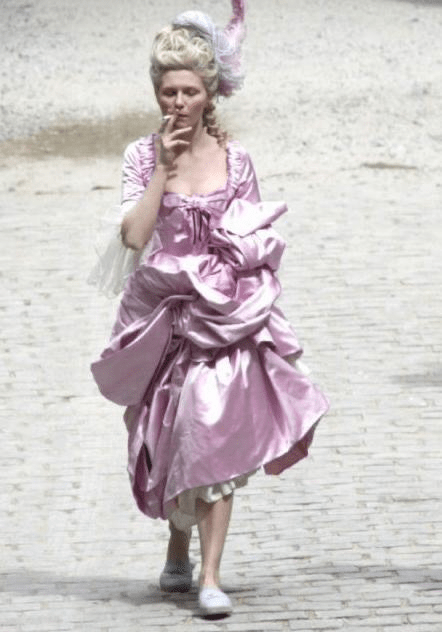
Featured Image: Kirsten Dunst on the set of Marie Antoinette (2006) / Unknown paparazzi