
By Matthew Dodd
A gangly, quasi-spectral figure in a pale grey suit walks onto an empty stage. The camera clings to his feet – white plimsoles against a black floor – as he wanders purposefully into a light. He, placing a jukebox on the ground before him, proclaims quite calmly, “I’ve got a tape I want to play.” As the opening chords of Psycho Killer are violently strummed, the camera pans up to reveal our lead player, David Byrne. So begins the greatest record of human creativity ever put to screen.
In 1984, Talking Heads – the great pioneers of the 80s new wave scene – had found themselves at their commercial peak: Speaking in Tongues had produced their biggest hit, Burning Down the House, and Remain in Light had assured their place in the highest order of musical talents. With the benefit of hindsight, this was a peak to which they’d never quite return. Their next two albums, Little Creatures and True Stories, were hits but failed to reach the sonic highs of their earlier work. The tour recorded in Stop Making Sense was to be their last. As such, the resultant film feels like a lightning-in-a-bottle crystallisation of unstoppable talent, a consignment to screen of a moment in time at which these musicians were not only the best band of their generation but, probably, the greatest of all time. Fresh off his Oscar-winning Silence of the Lambs , director Jonathan Demme approaches Stop Making Sense less as a concert film and more as an argument for the expansive possibilities of human creativity.
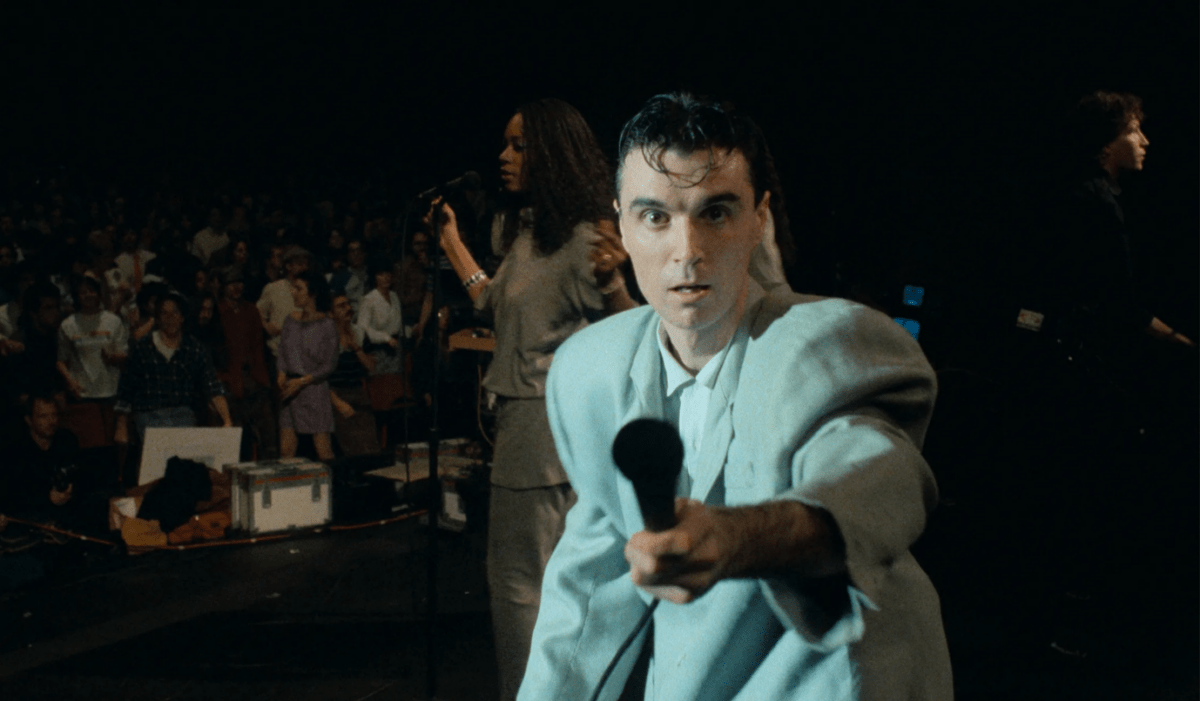
As Byrne is revealed to the audience in Psycho Killer, he immediately establishes himself as scene-stealing leading man. He jerks around the stage, as if attacked by his own chords, and maintains, in his steeled expression, a look somewhere between deathly shock and religious epiphany. He gambles towards the camera as though his actual audience were mere spectators to a world entirely his own. Behind him, stagehands assemble the sort of apparatus that would look more at home on a construction site than a concert stage. The deliberate exposition of this work – Demme makes no effort to shield the stagehands from view – is central to the argument that underscores the music. Art is, unavoidably, a collaboration. David Byrne is doubtlessly the central figure, but his efforts are nothing without those working around him.
At the end of Psycho Killer, bassist Tina Weymouth steps out to accompany Byrne on Heaven. Demme holds our view, for the most part, on a side-by-side of the two artists, their vocal and physical harmonies kept in gentle balance. As the song runs out, yet more stagehands crowd the two performers, assembling pedal-boards and drumkits. The camera follows Chris Frantz as he makes his way to the newly assembled drumkit, capturing a momentary glance between him and his bandmate-cum-wife, Weymouth. During a brief pause after the next song – in which David Byrne makes his second announcement to the crowd: ‘thanks!’ – Jerry Harrison arrives on stage, rounding out the quartet. By deconstructing the band – revealing the specific importance of a vocalist, bassist, drummer, and guitarist song by song – Stop Making Sense becomes a narrative thesis on the joys of communal music making. After Found a Job, the band is joined by another drummer, two more backing vocalists, another guitarist, and a keyboard player – Steve Scales, Lynn Mabry, Ednah Holt, Alex Weir, and Bernie Worrell, respectively. By this point, as the expanded group starts performing Slippery People, the performance has become an orgy of sound: ‘Lord help up, help us lose our minds’ sings Byrne. Taking their time to construct this massed ensemble, the band shows us that they could do this with one player, or two, or four, but they choose to do it with the whole troupe. It reminds us that music isn’t just some auditory phenomenon that arrives pre-constructed into our ears, it is something that people DO together, to entertain, to have fun. The stage is built, the band is built, right before our eyes to remind us that human hands made it. The little moments and looks between members of the band are just as magical as the performances. It reminds us, perhaps, that we’re all just animals, looking for a home, to share the same space for a minute or two.
For a film so delicately choreographed, it is the space it allows for spontaneous human moments which elevate it to its note of all-conquering tenderness. During Burning Down the House, Demme’s camera is distracted for some time by Alex Weir as he, evidently caught in the throes of the music, begins jumping around the stage. Immediately after, we watch as Harrison joins in an awkward shuffling dance with backup singers Mabry and Holt, eliciting a noiseless chuckle from the latter. Talking Heads, then as now, were a band renowned for their mystical inscrutability. Stop Making Sense is replete with that impenetrable charm – David Byrne wiggling through Life During Wartime; the quasi-nonsensical words that appear on screens behind the band, e.g. ‘BEFORE DINNER TIME’; the massive suit, of course – but they are buoyed throughout by the unimpeachable humanity of their performance.
The stage becomes a church; Byrne becomes a new-wave evangelist. His sermons reverberate through the audience, whose reaction Demme offers us only sparingly: ‘watch out, you might get what you’re after’. He, like any great prophet, understands that he is not the centre of the universe and briefly cedes the stage to Weymouth and Frantz’s side project Tom Tom Club for a section in which the sonic wizardry of Genius of Love is only somewhat marred by Frantz’s barrage of ad-libs, including but not limited to ‘the girls can do it to, y’all’ and ‘James Brown!’ Reclaiming the stage and, having guided his flock through the spiritual journey of Stop Making Sense, Byrne leads us to a final baptism with Take Me to the River: a sweaty, noisy, beautiful absolution. Rounding off with the frenetic Crosseyed and Painless, we are finally treated to a view of the audience in their convulsive, magical reverie. A small child holds a stuffed unicorn, two sound technicians stand arm-in-arm. Byrne waves for the stagehands to join the band on stage, providing a final tableau of massed creativity in all its myriad forms, before the concert wordlessly ends, subsumed by applause.
Talking Heads make a friend out of time’s passing, out of the knowledge that all experience is fleeting and all moments will be lost. When spent well, when spent with the right person, the dispensation of life’s transient currency is a gift gladly given: ‘You’re standing here beside me, I love the passage of time’. Such is the revelation at the heart of Stop Making Sense. A song is a few minutes, a concert is an hour and a half, this time will never return. But this is no cause for concern. We are the masters of time, and of life, because we spend it how we care to. The suburban paranoiac who narrates Once in a Lifetime feels that, in modern America, he is quite unconsciously ‘letting the days go by, letting the water hold me down.’ His life has been folded together, he has found himself unknowingly sat ‘behind the wheel of a large automobile ’ – beset with wife, job, and house, wondering, understandably, ‘how did I get here?’ His mistake is resistance. As David Byrne howls in the final chorus, his oversized suit wibbling in the darkness, ‘time isn’t holding up’. Equally, however, ‘time isn’t after us.’ Time is no predator, clawing at our lives. It will never stop, but it holds no grudges. Forty years later, the 90 minutes of Stop Making Sense remain as potent as ever, drawing crowds together in ecstatic movement as surely in the screens of London’s Prince Charles Cinema as it did in Hollywood’s Pantages Theatre. We live life as we choose and, if someone asks, this is where I’ll be.
An incidental post-script:
I first watched Stop Making Sense with one of my best friends in a packed-out BFI IMAX, a week or so before starting university. About a month later, I performed This Must Be the Place in a since-closed cocktail bar at my first open mic night with a newfound friend who would later become my housemate. One particular lyric stuck out to me in that moment, as a frightened fresher taking his first flight out of the nest, uncertain of his place here or anywhere: ‘home is where I want to be, but I guess I’m already there.’
Featured Image: A24