
By Matty Timmis
The Mocking Stars has arrived, seemingly out of the blue, and as I write this I am wondering if I am even capable of lauding this new album the way I did its predecessor The Girl, the Cat and the Tree.
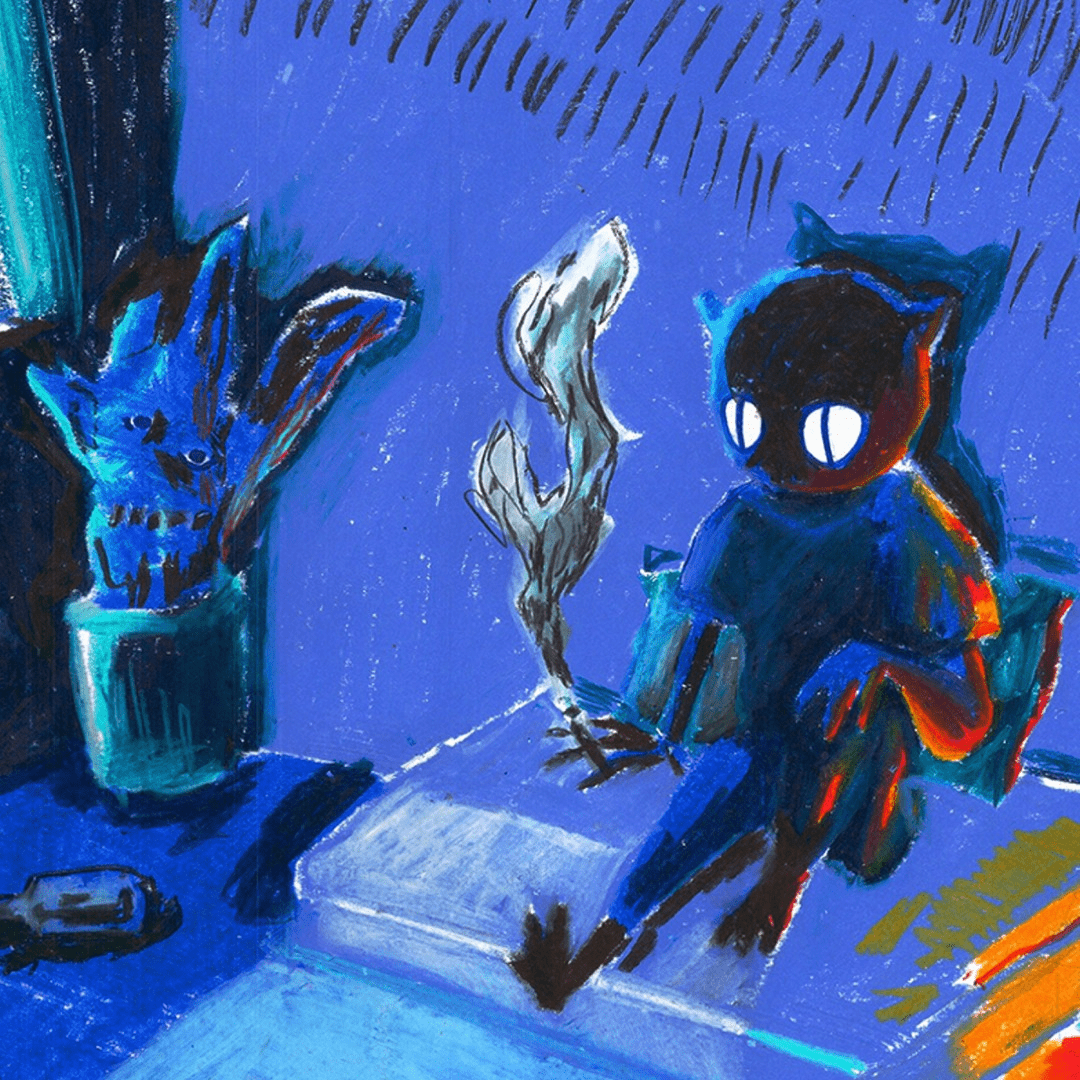
For the uninitiated, LAUSSE THE CAT is the character inhabited by an anonymous rapper, spinning tales of a semi-fantasy life from Hyde Park, Leeds. The maestro of rippling velvet and head-fucking instrumentals he raps, sings, and orates in both English and French, conjuring strange yarns of louche living; both its pleasures and its consequences. Much like The Girl, the Cat and the Tree, The Mocking Stars is a concept album in the strongest possible terms, one that blurs boundaries of language, instrumentation and genre into something almost reminiscent of a theatre production. This second production drops us into a more adult world, ornamented with far richer, indulgent details and plaintive, mature anxieties. LAUSSE has descended into madness again, this time concerned less with the hedonism and toll of being a student than the reluctant transition from student to functioning member of society. Across 12 tracks our narrator pops up, much as he did in his prior work, to marshal us through the dusk like a ring master in a midnight musical circus. This circus is not concerned with hedonism anymore, but the freakshow of anxiety that makes up post-grad aimlessness.
The record’s opener, “Blue Bossa”, immerses us in LAUSSE’s sanguine anguish, establishing beneath a muted bebop trumpet and hazy xylophones the insomnia that will lead him through these dashing, and at times uncouth, visions. We meet the ‘mad hatters round sainos’, who seem to offer some company, and an outline of Lausse’s journey begins to take shape. The track ends with increasingly frantic screams of ‘slay bitch’, as consumer items seemingly drive him to hysteria through both their unattainability and gaudyness. The maddening cries of ‘slay bitch’ further move LAUSSE into the delirium of adult life as he realises the only praise he will receive for his capitalist endeavors is an over-used internet speak of the apathetic generation he finds himself in, the anxiety of their situation unable to produce originality. This little squib leads aptly to early album highlight ‘I.D.W.G.A.J’, standing for I Don’t Wanna Get A Job, Lausse articulates the anxieties of the moment between graduation and fully fledged adulthood. He is concerned with getting a driving license and buying a car, all the things that employment and being grown up precipitate. The tension lies in his inability to afford any of this, and as his musings grow the fantasy expands to a life of dripping, idle wealth that seems all the more seductive for its distance, as Lausse saunters off into something starting to resemble a dream.
“The Midnight Hour” then is a more gentle affair, as LAUSSE drifts away from his forlorn reality to the clave pulse of a lounge-samba backing. Here he switches for the first time into a melodic French refrain, and navigates amiably his twilight sinking. A dour sun then operates like an amusing and harmonious bridge of A capella layering, pleading to be spared from the doldrums of employment.
All this builds to our title track, “The Mocking Stars”, an expansive and apocalyptic epic that sees biblical floods sweeping through Hyde Park, cannibalism running rife, and our LAUSSE beset by a river of tears. There is an undeniable mania to this 10 minute song, dancing through genres and emotions with phantasmagoric ardor. This is an odyssey, warbled through smoke rings and desire, in much the same sense as “Redstripe Rhapsody” was. This however is a far darker affair, the scope of lyrical ambition and musical prowess far exceeding its predecessor’s journey through a Leeds house party as our protagonist sails away, with a rizla for a flag, into a chimerical world.
“Space Cadet Cat” floats far from the tax payer funded rhythm of the relentless days, providing a rest-bite from the drama with a chirpy dose of the absurd. Similarly the opening chords of “Tea Party”, played on an echoing piano, almost call to mind a Debussy song. LAUSSE updates the surreal imagery of childhood, taking Alice in Wonderland and dreams of astronauts into our current world of angst. Here he reaches furthest from objective reality on his journey, delving into a debauched collective psyche with a naive escapism. Repurposing the fairy tales and space stories of more innocent childhood have certainly been done before, but here our youthful dreams are subverted with such striking precision and such dense interweaving that it is hard not to reflect upon our journey into our current selves.
“Keep Walking” walks us down from the inebriation of our own becoming with a heady kind of lullaby that sees LAUSSE shake loose the timbre of Hades evensong. He stumbles away from his mad hatters, away from his twisted fantasy and reflects upon how he found himself here. “Keep Walking” seems to pull us away from Leeds to potentially explain his absence for the last seven years, falling in and out of love and bars in London, the south of France and Berlin.
LAUSSE seemingly awakens as “Keep Walking” concludes, and finds himself grappling with the consequences of his actions and the destruction they wrought in “Moonlight Waltz”. Redemption creeps in as we are serenaded with a descending progression of vocals that take stock of the voyage we are finishing. A girl appears that offers the tenderness and romance that sustains our feline friend on the penultimate track, another highlight, “Peonies for Breakfast”. Beckoning to us with a welcome reprieve of brass and chorus it is a cathartic evocation of the charms of being loved that add a delicate and heartfelt charm to an album of high strung concepts and questions.
The album’s conclusory track, “Lotus Blossom”, is a more confusing affair, playing like a stoned Kanye song from his Yeezus era. That is not to say it is not energetic, it fizzes with the beeps of a childlike beat over which layered vocals and cultural references welcome LAUSSE back to a reality that seems more palatable. It is a fitting end to a record that sees LAUSSE grown up, still grappling with the same demons and still spinning them off in his languorous, enigmatic drawl, but now with the creeping onus of responsibility. This is a far broader canvas, and whilst still rooted in Leeds it is no longer the flow of a debauched student, but someone pondering where they are going and where they have been.
The first time I heard The Cat the Tree and the Girl it was quite a formative experience for me, bunking off of college, smoking a spliff in a mirror maze with a strange bloke who used a kettle as a book-bag. Then I was enraptured in my mildly miscreant youth, and I thought I saw it yawn out eternal in front of me in LAUSSE’s strange world. Then I was caught up in the vibrancy of living, of smoking a spliff with the boys and trying to pull at a house party. Now as I approach adulthood and consequences turn from abstracts to concrete, self perception grows some facets and the future begins to warble, The Mocking Stars appears ripe to guide me through my newest chapter of living.
As a footnote it is of the utmost importance that you roll a fathead and stick this record on your headphones looking out at the twilight.
Featured Image: LAUSSE THE CAT on Spotify