By Freyja Hollington
The Durham Opera Ensemble attain brilliance and professionalism in their masterful production of Will Todd’s Alice’s Adventures in Wonderland. The technical promise of the performance is anticipated in the thrill of the exposed orchestral accompaniment, which gradually breathes music into the theatre. The strength of the band is matched by the performers themselves, as the whole assembly weaves an intricate tapestry of symbiotic sound, with voice and string and brass raising goosebumps and thrilling audiences.
The transformative work of the production team is foundational to the success of the performance. There is an intricacy of thought and detail which brings Wonderland to life, as towering flowers, playing-card-mushrooms and suspended butterflies spill over the stage and into the audience. In a particularly enchanting detail, book-pages cascade from the ceiling to mimic our heroine’s tumble down the rabbit hole. Such a self-conscious reverence for storytelling works as a constant thread throughout. The backdrop is transformed into a large storybook, whose pages are turned by the discrete ministration of the Stage Management team – Leon Ansorg, Aoife Bowles, Lily Beetles, Izzy Richards and Isabelle Owen – effecting a series of act breaks like the turning of a chapter. A very warm congratulations is due to Co-Set-Designers Libby Simpson and Eva Ryan for such visionary detail, and to the talented Set Production Team who realised their dream: Sarah Richardson, Veritas Dubik and Becky Hale. Included in their applause must also be the artful management of lighting, delivered excellently by Lighting Designer Zac Jackson and Lighting Operator Val Devereux, without whose technical contribution the brilliance of the set would have lost lustre.
Such sensory delights are intensified by the accompaniment of the band, whose talented ministrations make the production breathe. The score is itself a delicate medley of classical and jazz, with the conventional operatic sections achieving haunting levels of tension that are brilliantly offset by the funkiness of blues. Such moments of musical summit are especially delivered through the success of the Cello, played by Tom Shaxson, and the Drum Kit, mastered by Isaac Short, and their gravity is balanced in the perfect airiness of Keys, played by Patrick Owen, and the Tuned and Auxiliary Percussion, delivered by Dan Hume. The Violins, provided by Cameron Davies and Katherine Iveson Vandy, and the Viola, played by Charlie Lineker, give body to the score, assisted by the strength of the wind instruments of Flute, by Emma Phipps, Alto Sax, by Annie Sullivan Qosja, Trumpet, by Leo Vernaglione, and Trombone, by Thomas Pennington-Arnold. In the playfulness of the Accordion, played by Sam Caskie, the intensity of the ensemble becomes grounded in childhood wonder, innate to the nostalgia of Wonderland. The band are themselves a united body, working in oneness to enthral and ensnare, and this is a credit to the success of Conductor Zac Smith.
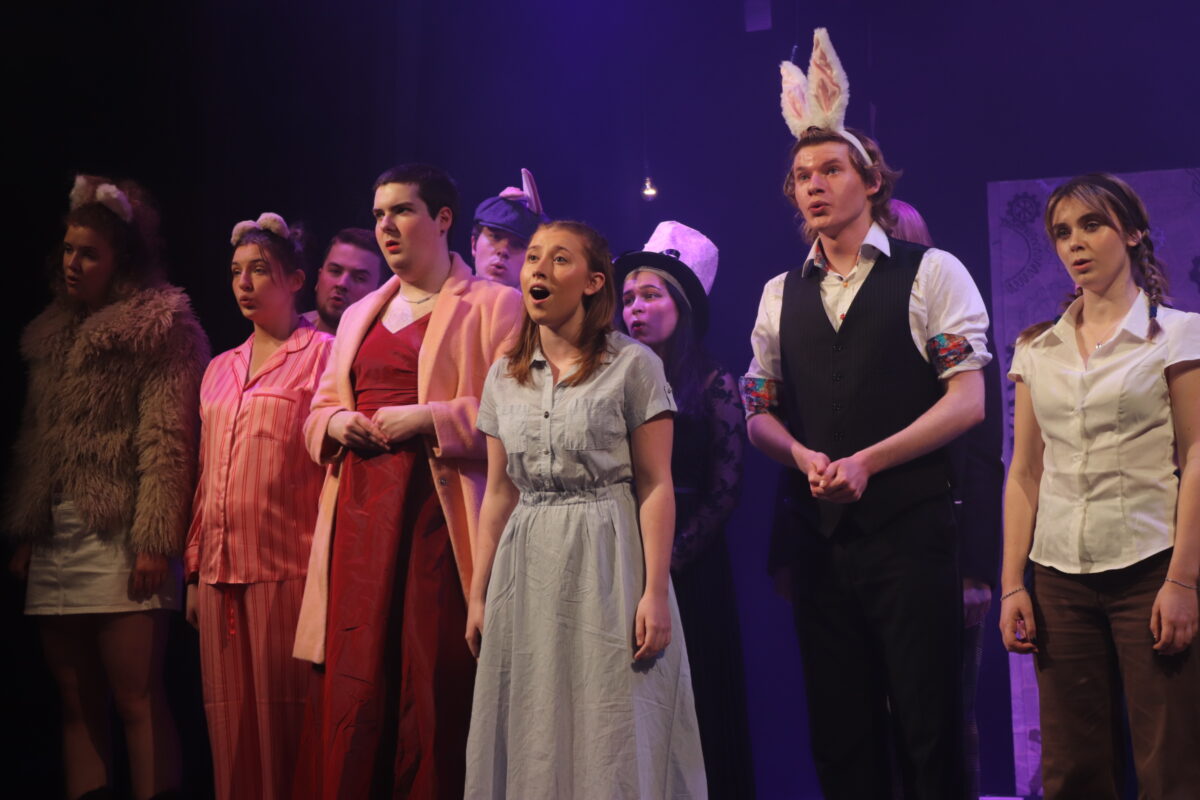
When the cast of performers joins the enchantments of the stage, the magic is complete. Every voice compels attention and emotion, and the power of projection is astounding. The opening scene is a particular showcase for the extraordinary talent of Maia Harris Lindop, starring in the dual role of Mum and Mad Hatter, and her co-star Ash Marshall as Dad and Queen of Hearts. In the ironically dysfunctional domestics of the real world, Olivia McClintock and Eleanor Barnes provide skilled hilarity in the comedic relief of the Two Brats, and as their dreamed mirrors Tweedledum and Tweedledee. In his role as the White Rabbit, Sammy Jarvis is sensational, bringing the world of Wonderland to life with a voice that is almost transportive. Nonsensical and psychedelic, the delivery of the Cheshire Cat by Francessca Fitton elevates this dream-realm, with Fitton’s mastery of physicality and facial expression matched in power by her strength of voice.
Amongst the chaos, the chorus provide lucidity of narrative, as the figures of Daphne, Scarlett, Velma, Norbert and Fredrick give interludes of exposition and cogence that guides audiences through absurdity; excellently sung by Isabelle Bruce, Mathilda Ketterer, Izzy Cochrane, Ben Glover and Joe Wilson. Likewise, the exceptional talent of Kiera Barrett delivers brilliantly the guiding roles of Bottle and Duchess, with Barrett’s voice promising the potential of aria, and yet seamlessly blended with the community of the wider cast. The Caterpillar, performed by Fred Walmsley, intensifies the elements of jazz included in the production, in a clever adaptation of the traditionally intoxicated bug reflected in Walmsley’s play with voice. The tea-party retinue offer similar moments of hilarity, as the Dormouse played by Hannah Mayes and the March Hare performed by Matthew Dodd become comical victims of the Mad Hatter. In his secondary character as the White Knight, Dodd offers striking moments of physical hilarity whilst maintaining skilful control of voice. In the starring role, Eleanor Brown shines. Brown lavishes audiences with exquisite song, expressive and controlled. Alice is especially alive in the heights of the musical score, where Brown’s clear and bell-like soprano most excels. Though undeniably accompanied by the brilliance of the wider cast, the sustained excellence of the lead is to be commended, and in every scene Brown attracts the focus of the performance. Delivering Alice’s Adventures in Wonderland with exceptional success, the Durham Opera Ensemble outdo themselves, performing with a calibre and talent far beyond the expectations of an amateur company – they have achieved magic on stage.
Featured Image – Durham Opera Ensemble