By Toby Dossett
A week can be an awkward unit of time: too brief to claim familiarity and too indulgent to pretend it changed you. Travel writing had taught me to distrust the “short stay”, to almost apologise for it, to pad it with fact and disguise its thinness with beauty. The Perche region in Normandy, France, resisted this instinct, and I wanted simply to show the week as it was.
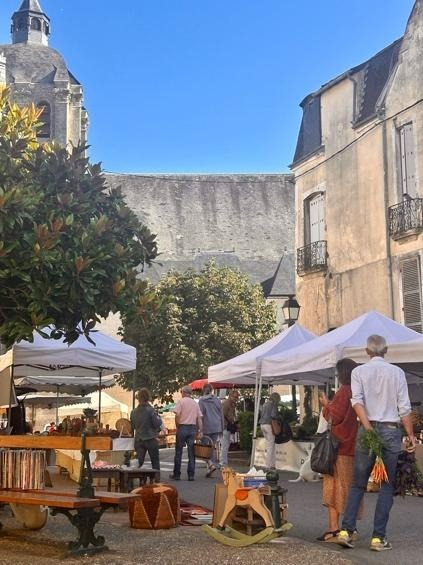
On Saturday morning, the bells of the Church of Saint-Sauveur spilled over tiled roofs into the Place de la République, drawing locals and visitors toward the weekly market. I followed the crowd through the stone archway and into the square, where garlic hung in thick, snug bundles and plump, grooved tomatoes blushed against half-timbered façades. Artichoke petals were lilac at the tips and tiny fresh radishes a deep pink. The sun was beginning to press down, and I swallowed the warm air in giant gulps. Stalls meandered across the square; at the far end, books and frames lay on the cobbles beside a pottery stall, crates of records and more antiques. My favourite piece there was a handcrafted rocking horse with a burnt-red saddle. A breeze tried to lift it into motion but only nudged it upwards so it looked permanently on the verge of rearing and bolting down the hill.
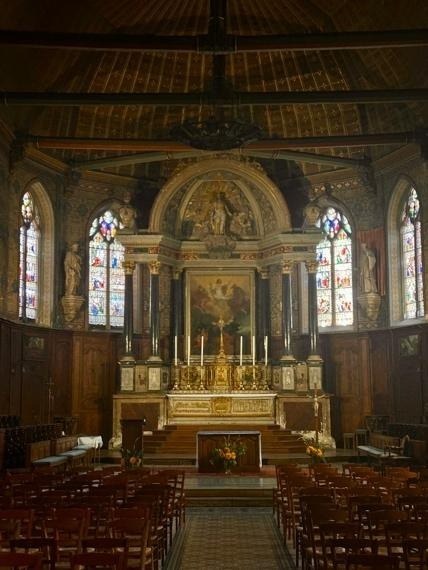
L’Église de Saint-Sauveur, a seventeenth-century reconstruction of a fifteenth-century church, sat at the town’s centre and looked down on the market’s slow churn. Inside, subdued light filtered through faded stained glass onto rows of straw-seated chairs. At the far end, the marble altar and tabernacle formed the main decorative focus, while the rest of the interior was restrained and pale. The ceiling lifted gently above the nave, its height felt more in the dark timber of the beams than in empty air, so that the proportions stayed balanced and the atmosphere calm. This calm was anchored by the mixed smell of stone, wax, incense and sudden gusts of cold air – a smell immediately recognisable to anyone who has spent time in old churches elsewhere in Europe. When I left, I stepped out through a curved doorway that felt almost like a portal in itself with the outside light already tracing its frame. On the tower, the most unusual feature was a clock placed deliberately off-centre. I wondered why, as it seemed quietly defiant, and so I was glad I’d noticed it despite the sheets of light layering down in front of it; we don’t look up enough these days.
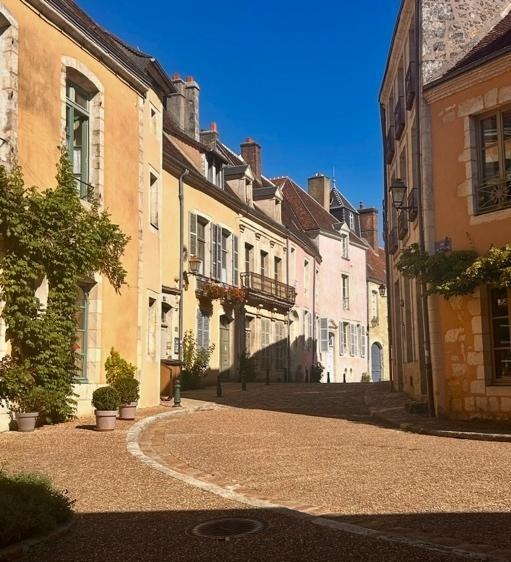
The oldest house on the square bore the date 1580 carved into its stone, and Rue Ville Close, the oldest street, was lined with half-timbered houses that leaned conspiratorially towards one another. Six antique sundials were scattered across façades in the rest of the town; it would have been easy to spend an afternoon hunting them down one by one. The buildings that held antique shops and small galleries appeared barely altered by their commercial lives. One such shop, Métamorphoses – Bois Métal Lumière – specialised in elaborate door knockers, their faces, animals and abstract whorls made it easy to imagine the elaborate doors they might one day belong to.
From the square I followed the edge of the medieval wall, still mostly intact, and stopped at a plaque explaining how Bellême had once been the seat of a powerful Norman barony. The original arched gateway, the Porche de Bellême, which I had walked through not an hour earlier, still framed the town’s entrance, while fragments of ramparts slid down towards what remained of the old moat. A single swan circled the pond, leaving an oval of ripples that continued to widen, like loops of a gaze. From the bottom of the slope, I could see the houses on the hill bending down to peer into the passing streetcar windows; the whole skyline carouselling past in separate panes of glass.
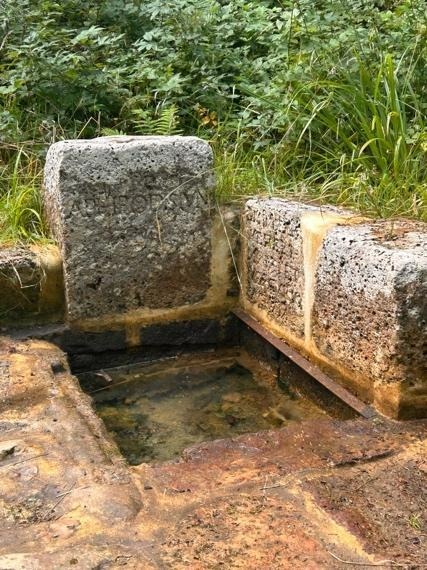
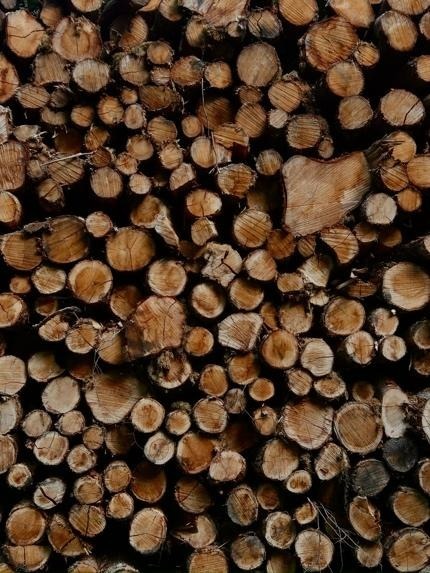
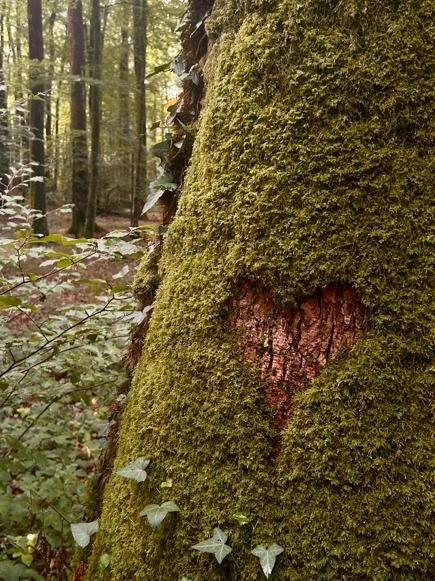
Later in the week, on Tuesday, we walked through the forest near Belforêt-en-Perche to find the Fontaine de la Herse. The site consisted of two landscaped basins ringed by six sandstone blocks; on two of them, Latin inscriptions translated as “To Aphrodite” and “Consecrated to the lower deities, to Venus, Mars and Mercury”. It was a small Gallo-Roman sanctuary in a clearing, its stones darkened by their time in the water. In the forest, rain nibbled at the leaves and the path softened underfoot. When we stopped by the side of the path, I noticed a heart-shaped patch of moss on a tree, a deer with wings on a waymarker and several stacks of cut logs waiting to be taken away. I wanted to roll the ends of those logs with ink and press them onto a large canvas, to see if I could keep their intricate rings forever if they were only going to be burnt or chomped into chippings. We ended the walk with chips and a beer, a hot, salty round off to all the green and grey.
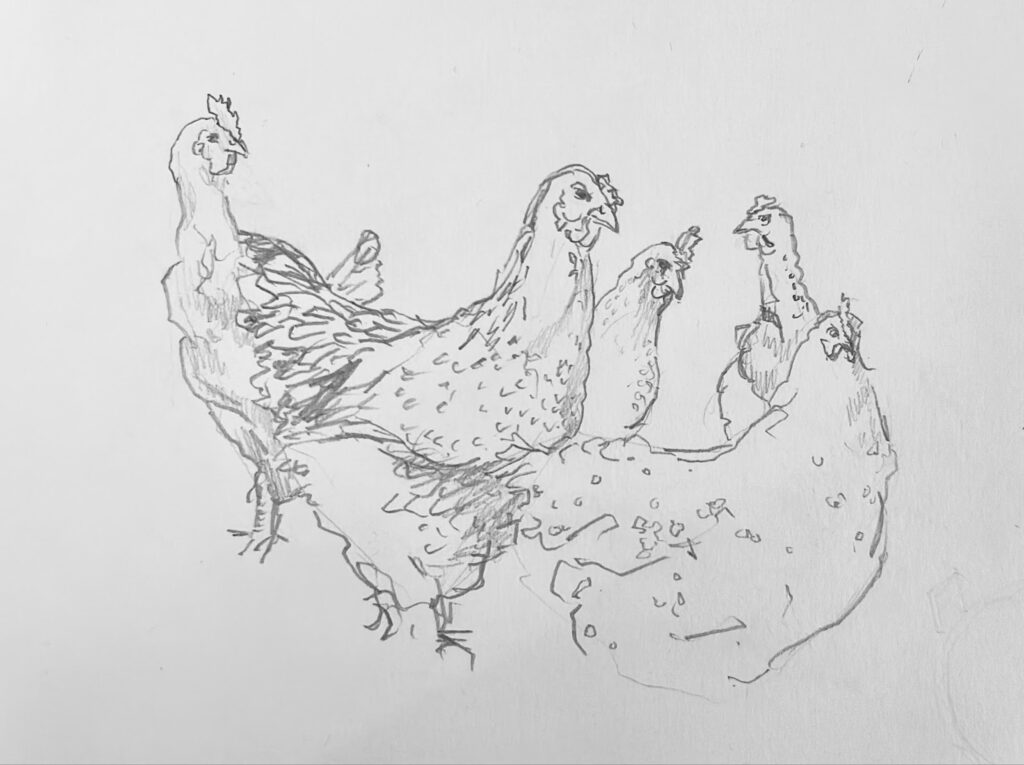
The next morning, tractors in the neighbouring field pulled us awake. We had coffee in the sun, spooning sugar from the tarnished yellow tin. Louise and I went down to see the horses, (she enjoyed feeding the smaller one green apples) and we managed to free a tiny blackbird from a wire trap. We collected eggs from the chickens, while Pop set up his easel, painting the house from different points in the garden at different times of day, tracking the light like a human sundial. The house itself had old beams and plain corniced walls, and a long, benched dining table in the kitchen that invited chopping and spreading and laying out. Lunch was crisp baguette with slabs of salted butter and a salad of roughly chopped beef tomatoes – tomatoes that tasted briefly, insistently, of having been somewhere else that morning. They were drowned in olive oil, splashed with balsamic, and finished with a generous throw of salt and purple basil snipped from the herb bed by the back door. We ate cantaloupe melon afterwards. In the evening Jérôme scattered thyme onto the fire while he cooked the meat, and we drank wine from Bourgogne while Jacques Brel and “Alexandrie, Alexandra” by Claude François triggered tipsy singing round the table. A dozen lanterns hanging from the nearby trees cast small, steady circles on the floor, encouraging the night to move on inverted wings, aloft.
Mortagne-au-Perche gathered itself around the Église Notre-Dame, with its hexagonal terracotta tiles, pale stone exterior and a square edged with cafés, estate agents and bookshops (many Parisians enjoy long weekends in the region and rent.) We took an early coffee there, watching Thursday’s shoppers move between stalls and neighbours greet one another. Sixteenth-century houses organised themselves beside modest modern buildings without fuss. In one window, model cars and bottles of cognac were lined up in rows and in another, an antique shop was so densely layered that, staring into the glass, I came to see that each item had a label from who it was donated by.
From there, we drove on to La Chapelle-Montligeon to see the Basilica of Notre-Dame de Montligeon, a muted stone structure set against open countryside. Inside, the space was high and white and full of gathered light. Nuns dressed in white moved quietly between the pews, a line of similarly dressed children followed. During our visit, a choir rehearsal filled the nave with children’s voices that rose easily into the vaulted ceiling. I didn’t understand the words, but the sound travelled along the ribs and arches of the building, and it was enough just to sit and listen.
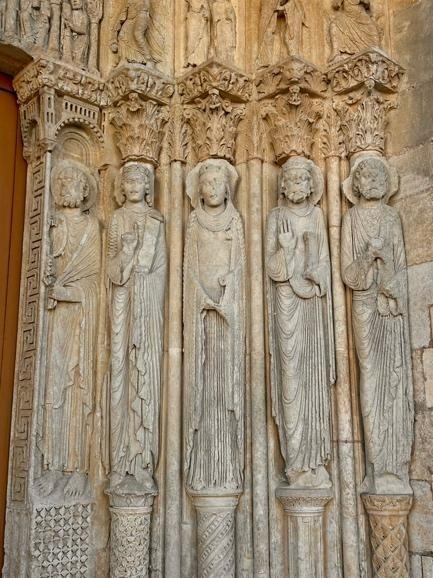
On our last day we drove an hour or so out to Le Mans and climbed up into the Plantagenet City. At the Place des Jacobins market, stalls were packed close together, selling old stamps, enamel pins, waxy paintings and hundreds of second-hand books. Watches and jewellery cases glinted on blue tables, and beautifully carved violins leaned against their cases in the sun. The town hosted a medieval festival each year, but we had just missed it, though we could sense the anticipation for banners to be raised in the following days. We crossed the square and followed the old town’s narrow, colour-beamed streets as they rose towards the cathedral. Along the way, we spotted a carved doorway depicting Adam and Eve which stood beneath a teal-framed window, where a scruffy dog had wedged its head between the shutters and was almost dribbling down onto the cobbles below.
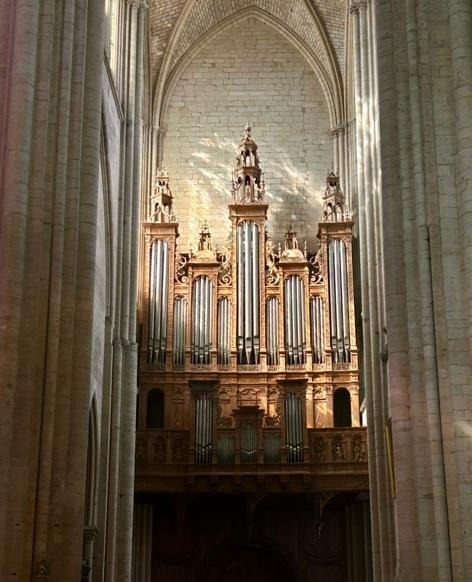
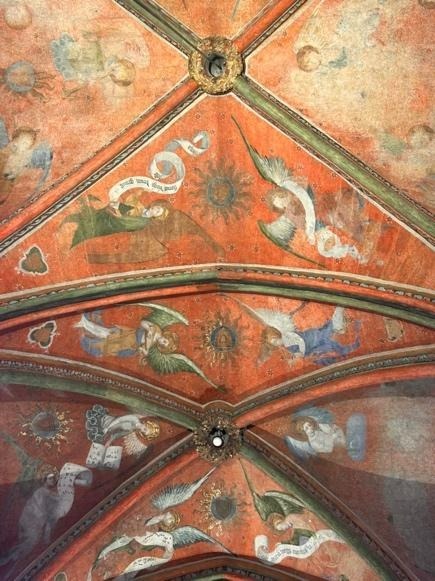
Inside Le Mans Cathedral, the great sixteenth-century organ anchored the space; light drifted in and glanced off its pipes so that it looked as though it were in a shimmer of shallow water. In one of the chapels, nine angels backed by red were painted high on the ceiling and we lit candles and thought about our loved ones: each of us held for a minute in our own small pool of light. We spent half an hour or so admiring the space until lunchtime where we ate pizza in the Place de la République. Then my dad led us through the backstreets to find Robert Doisneau’s 1962 photograph of a little girl and her teddy bear; above the arch, a toy bear in the window still stood in for the child frozen in the image.
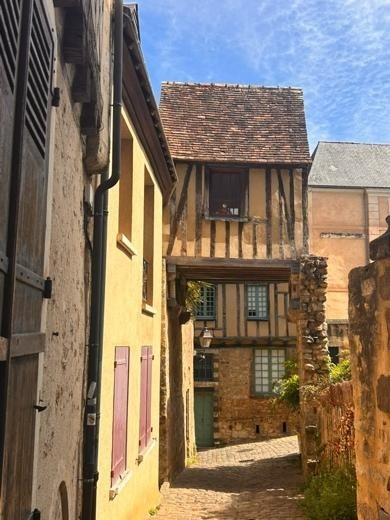
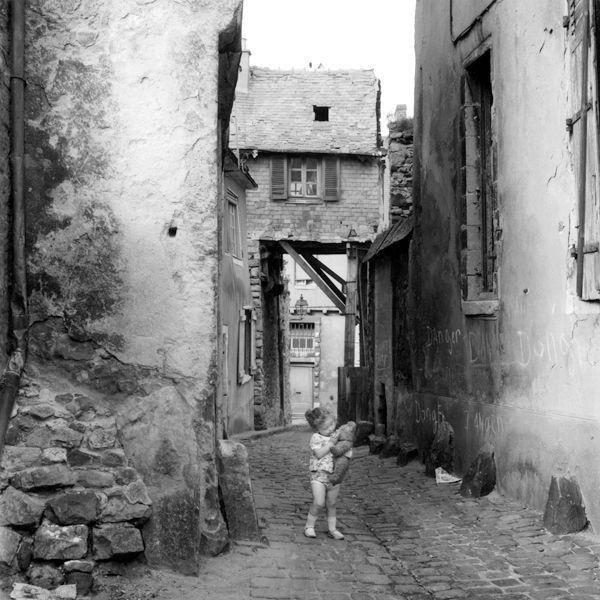
(Robert Doisneau’s 1962 photograph)
We left the Perche region with the sense that we were only just beginning to get our bearings. It had been a rare kind of trip: three generations together, exploring a part of France that was new to all of us, fitting markets and forests and basilicas around shared meals, games of boule and long conversations in the sun. As we drove on towards Rouen, the week sat behind me like a sequence of modest scenes: a swan circling a moat, thyme on a fire, a heart-shaped patch of moss, a bear in a window. On their own, they didn’t seem spectacular enough to hold my attention, but linked together they felt like the start of knowing the Perché – or at least of wanting to know more.