By Lucy Atkinson
There’s something about George Harrison’s All Things Must Pass that feels uncannily British — not the old empire kind of British, but the rain-soaked, quietly resilient, half-resigned version. Released in 1970, the triple album came out just as the country began to feel the slow ache of decline: post-Beatles, post-utopia, post-swinging-sixties London. Even its title felt like an elegy for a fading Britain.
Fifty-five years later, the sentiment lands harder than ever. All Things Must Pass now plays like a requiem for a country trying to convince itself it’s still special — a soundtrack for the long, unglamorous hangover after the party of empire, of cool Britannia.
When Harrison wrote All Things Must Pass, he wasn’t being cynical. He was being spiritual. He’d seen the machinery of fame and ego up close and come out the other side searching for something gentler, truer. The song’s calm acceptance of “sunrise doesn’t last all morning” felt like wisdom at a time when Britain still thought the sixties might never end. But in 2025, it sounds more like a prophecy. It seems like the sun’s been setting for a while now.
Public services are crumbling, rivers are filling with sewage, and politics has become performance art for bitter men with microphones. Reform UK gains traction by promising renewal but selling racial resentment; Labour promises competence, not hope, yet fails to deliver on both. Everyone’s tired, and the rain keeps falling.
Harrison’s voice, patient and forgiving, may hum through the noise like a counterpoint: It’s not always going to be this grey. But yet, it is — for now.
Britain has always excelled at melancholy. We make poetry of drizzle and drama of decline. From The Waste Land to The Crown, we aestheticise decay until it almost looks romantic. Harrison, though, wasn’t interested in performance. His melancholy wasn’t self-pitying; it was cleansing. He offered resignation not as despair, but as liberation, which is a lesson the modern political class could use. Today’s leaders — Farage shouting from a pub, ministers performing contrition on breakfast TV — cling to power like it’s still 2012, still possible to summon optimism with a slogan. “Levelling Up” has become a punchline; “British values”, a meme.
Harrison would have recognised this noise for what it is: pure ego.
Beware of Darkness, one of the album’s most haunting tracks, could be mistaken for a sermon to the electorate. “Beware of greedy leaders / They take you where you should not go.” In 1970, that might have sounded like Eastern mysticism. In 2025, it’s practically the daily news cycle.
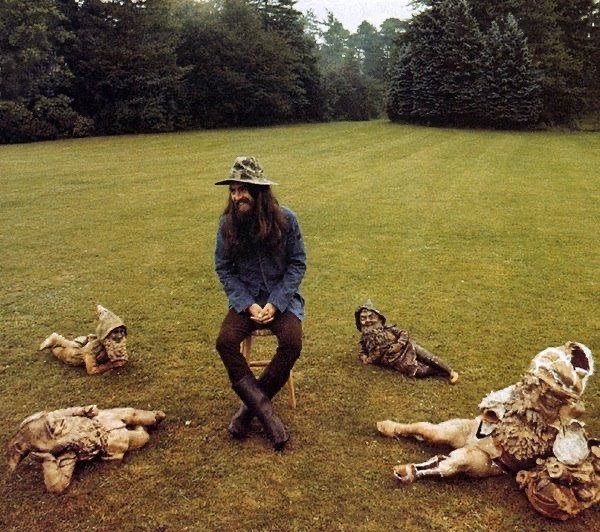
The album was partially recorded at Friar Park, Harrison’s eccentric gothic estate, and the iconic album cover was shot there — half-mansion, half-monastery. The walls, lined with gargoyles and silence, gave him the distance to write a work of self-reflection, something Britain rarely manages. Today, the country feels like it’s still living in that house — ornate, damp, haunted by the past. We’ve filled the rooms with nostalgia: wartime mythologies, royal weddings, Great British Bake-Offs. It’s charming, but it’s also claustrophobic. Every institution, from Parliament to the BBC, feels like it’s decaying in slow motion.
Harrison’s mantra — all things must pass — isn’t just an observation; it’s an instruction. Empires fall. Economies falter. Cultures shift. The task isn’t to stop it happening, but to let it happen, and then begin again.
But Britain doesn’t let go. We polish the relics instead.
But for one moment, imagine if we actually took Harrison seriously — if the country released its grip on the fantasy of exceptionalism. Reform UK wouldn’t exist; it depends on the illusion that decline is reversible, that we can simply vote our way back to the 1950s. Nor would the endless nostalgia industry that props up our media — the monarchy, the Blitz spirit, the Beatles themselves — work without the promise that the past can be restored.
Harrison’s message was the opposite: transcendence through impermanence. Growth through surrender. The idea that endings aren’t failure, but natural order, and maybe that’s the radical politics we need now — not rage, not revival, but acceptance. To look honestly at what’s rotting and stop pretending it can be repainted.
Listening to All Things Must Pass in 2025 Britain feels like stepping outside the chaos for a moment. The songs drift like prayer — full of humility, humour, resignation. Harrison’s slide guitar sounds like light breaking through fog. It’s an album that insists, even amid decay, on grace.
And perhaps that’s the hope we’re left with. Not a new golden age, but a quieter one — where kindness outlasts the slogans, where humility replaces bluster, where we stop shouting about greatness and start doing small good things.
Because if Harrison was right — if all things must pass — then this too will. The populism, the cruelty, the endless decline. The question is what we’ll build in the silence that follows.
Until then, the rain keeps falling. The records keep spinning. And somewhere, faintly, George Harrison’s voice reminds us:
“All things must pass away.”
Featured Image: Barry Feinstein