By Lizzy Holden
“I love you.”
“It’ll pass.”
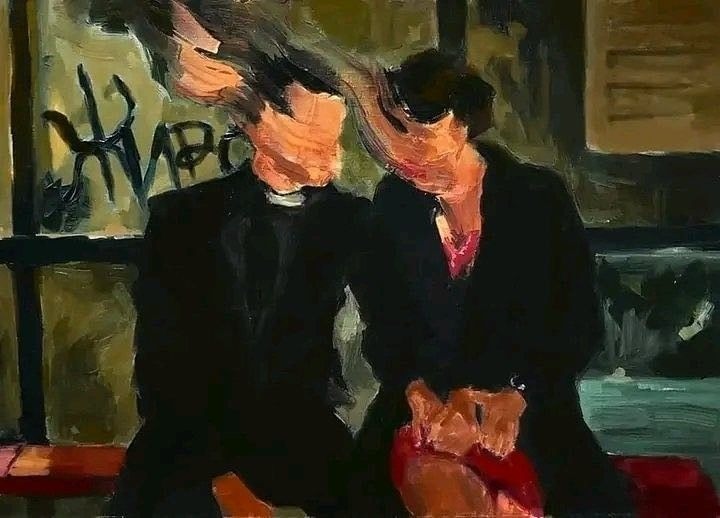
Spoken under the drizzling lights of a quiet bus shelter, Fleabag and the Hot Priest’s confession is one of soul searing heartbreak. Throughout the season we see their compatibility, and yet the show concludes with them all the more in love and all the more impossible. Upon rewatching this scene amidst the heart-shaped paraphernalia of Valentine’s Day, I found myself reflecting once more on the Hot Priest’s words.
He is so certain of love’s transience.
It is something that can fade, a bruise that, with enough time, will recede into the skin and exist as a mere memory. Media often assures us of love’s indomitability, its steadfast existence that – when you have found the allusive ‘one’ – will never fail you and carry you into bliss forevermore. There is a hope in this kind of love, it is a parachute catching you as you plummet into the heady wonder of ‘falling’.
But in Fleabag we are presented with an alternate narrative.
With Fleabag and the Hot Priest, we realise that we can stumble upon a soulmate and still let that person go. Love, quite simply, is not an immediate guarantee for a long-lasting relationship.
Throughout the second season, the Hot Priest alludes to a past of sexual and alcoholic indulgence and estrangement from his parents and paedophilic brother. The church gives him structure, and although we still see lingering struggles in his hidden G&Ts and swearing, it is clear he is overall much happier. He tells Fleabag that “celibacy is a lot less complicated than romantic relationships”. It gives him someone to hold him accountable and, in doing so, takes away the torment of decision making. He has found the person who tells him how to live his life, just as Fleabag whispers in the confessional, and to pursue a life with her would be to throw away his peace.
He may love Fleabag, but that love isn’t worth a life in chaos.
I think this is, in part, why Fleabag stayed with so many of us, to the point that I am writing about it ten years after its TV premier. Waller-Bridge respects the values and realities of her characters’ lives, understanding that to have the Hot Priest and Fleabag end up together would be a cliché and a disservice both to the characters and the audience. Not every love story ends with forever, in fact few do, and the media we consume should also recognise this. We engage with these narratives not just for hope, but for a reflection of ourselves.
This reminded me of Bell Hooks’ All About Love, a thought- provoking book discussing love, its role in our lives, and its treatment in the media. When recounting a meeting with her “true love,” she describes a dinner with a man and explains that it felt as though they had always known each other, despite the fact that he was already in a committed relationship. Regardless of this ‘soul connection’, their story ended with this dinner, just as Fleabag and the Hot Priest’s ended at the bus shelter. For Hooks, however, this isn’t tragic, but rather a testament to the commitment, timing, and devotion it takes for a relationship to last. We shouldn’t see fleeting love as a reflection of its futility, but as a reminder of the dedication long-term love requires.
Hooks also discusses at length the impact of childhood in shaping our understanding of love, and how the love exhibited by our family serves as the blueprint for our adulthood. Waller-Bridge illustrates this dynamic perfectly through Fleabag and her emotionally distant father.
Drunk by the doorsteps of her family home, the door halfway closed on her, Fleabag tells her father, “I have a horrible feeling that I’m a greedy, perverted, selfish, apathetic, cynical, depraved, morally bankrupt woman who can’t even call herself a feminist.” The silence stretches between them, her brows creased as she pleads for recognition, but all he can bring himself to say is “Well. Um… You get all that from your mother.”
By attributing their daughter’s struggles to his deceased wife, Fleabag’s father deflects responsibility, treating his daughter not as an individual who needs him, but as someone who has inherited issues from her mother and can thus be placed in the realm of graves and dismissal. This rejection is reinforced by him calling a cab for Fleabag and banning her from going upstairs… his emotional distance mirroring a physical one. Ironically, in the following scene, Fleabag fulfils her father’s claim by stealing a statue made in the likeness of her mother’s body. By taking the statue, Fleabag quite literally carries a piece of her mother with her, removing it from a house in which both of them have become unwelcome under her godmother’s influence. Fleabag is excluded from her family, just as her mother is, if neither of them can belong, they will at least leave together.
Yet, even her thievery is met with apathy from her father, who simply says “Well you’ve said no, so now I can go” after Fleabag denies her actions. He shows zero interest in truly understanding his daughter, content to stagnate their relationship in non-conversations, where they talk around topics in stop-starting sentences, with little to no connection regarding what the other is actually saying.
Waller-Bridge contrasts this with Fleabag’s confession to the Hot Priest, echoing her fears in Season One, when she says, “I just want someone to tell me how to live my life, Father, because so far I think I’ve been getting it wrong.” Even beyond the appeal to a “Father” in both conversations, Waller-Bridge parallels the two relationships by having Fleabag express her fear that she is a terrible person making all the wrong choices. But, unlike her father, the Hot Priest meets this vulnerability with affection and kisses her, pulling Fleabag close rather than rejecting her.
Similarly, earlier in the episode, the Hot Priest tells Fleabag “I’m just trying to get to know you” in the same cafe her father so desperately tried to escape conversation. These echoes in setting and conversation, though driven with opposing intentions, reveal to the audience how the Hot Priest begins to rewrite Fleabag’s understanding of love. He seeks intimacy where her family distances; he accepts where they reject; and, most importantly, he loves where they criticise. For the Hot Priest, she doesn’t have to “not be herself.” Instead, she can make poorly timed comments at Quaker meetings: she can be vulnerable, she can be broken, and scared, and witty, and honest, and caring. She can love. And he will love her in return.
Through the Hot Priest, she not only learns that she is capable of loving another person, but that they can also love her back. She is not the unlovable child whose flaws and jokes make her unbearable to her family, but instead someone worthy of being seen and adored.
This is not an easy process for her to learn, however. Fleabag tells the Hot Priest that she “doesn’t want” him to get to know her, and she freaks out when he acknowledges the fourth wall. As much as she craves love and validation, she is nonetheless scared of being truly seen.
Hooks too experiences this fear, writing that she was “afraid to be intimate.” Not physically, but spiritually. To be seen without all the masks, into that secret, private sphere we keep for ourselves. But to love someone is to allow them to see these hidden parts of ourselves, and for them, in turn, to acknowledge and accept us. For Fleabag, this private sphere is the audience, we are her witnesses, her companions of the inner self. The Hot Priest’s recognition of her disassociation, therefore, becomes symbolic of him seeing her true nature. Her acceptance of such is allowing him to look at the camera and see her soul, her audience.
Maybe Fleabag’s love for the Hot Priest will pass, maybe it won’t. This is, in fact, of minimal importance. Instead, it is Fleabag’s learning that she can find connection and embrace vulnerability with another person, without being met with rejection. But amidst this love, she cannot fully possess the other person. They too have their own internal world, and sometimes this means that you cannot stay together. Even so, to have known and been known by that person for a short while, is still a beautiful thing. To bear witness to their love, however temporary, remains a blessing.
We may not have one, true cinematic love story. But in the loves that we have and the lives that we touch…we can heal ourselves again.
Featured Image: @ratsandlilies.art on Instagram