By Jacob Cordery
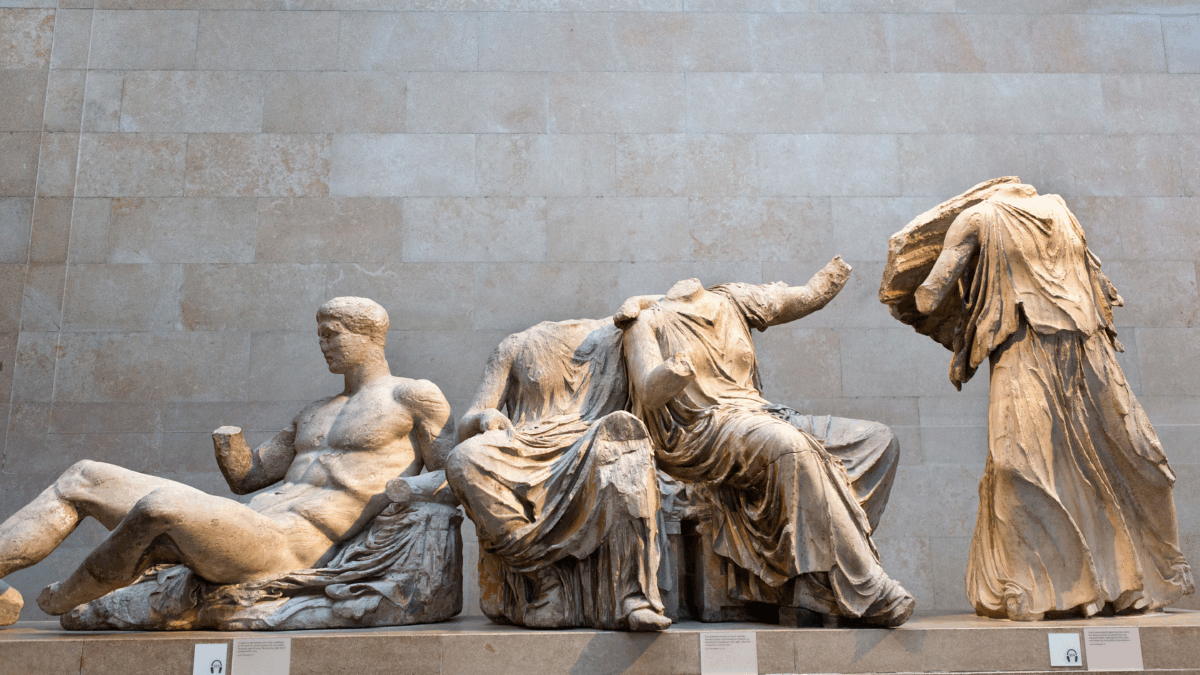
“Who owns great works of art?” is a question posed by classicist Mary Beard. It’s a good venture into the flaws of identity politics in a world where things ranging from cuisine to museum exhibits are increasingly appropriated or stolen. In a globalised world it is hard to know who gets to own what, whether words, traditions or objects. Few examples display this better than the Parthenon (or for the traditionalists – Elgin) marbles.
The marbles displayed in the British Museum, taken from Athens, have become the poster child for dismantling Western colonial structures. But this misses the point – the marbles are not colonial spoils of war but always have been, and will continue to be, nationalistic propaganda.
Carved in the 5th century BCE under Pericles, the marbles the British Museum have are some of the friezes, metopes and pediments that decorated the Parthenon at the peak of Athens’ imperial swagger. Scenes on the stone – like the Centauromachy – man triumphing over beast, civility over barbarism – cast the Athenians as superior and enlightened, most likely in symbolic comparison to their Persian rivals. The marbles are not neutral works of beauty, but obvious declarations of superiority over the East. Athens also subjugated other Greeks within her empire, the Parthenon itself housed the treasures of all the plucky Greek cities that had to pay tribute to Athens – out of obligation, and surprisingly not out of the kindness of their hearts. Ironically, sending them back to Greece would not subvert Western dominance but reinforce it – since they represent the very idea of the civilised West looking down on the rest. If Greece is the cradle of Western civilisation, then the Parthenon marbles are the cherished toys that still get thrown out the cot.
The legal story is equally hazy. In 1801, Lord Elgin, ambassador to the Ottoman Empire, received a firman which now only an Italian translation survives. The text states that “no opposition be made when they wish to take away some pieces of stone with old inscriptions and figures”. Questionable? Yes. Illegal? No. Elgin obtained the marbles from a state which no longer exists, before the state of Greece was conceived. There was Parliamentary concern that Elgin had abused his influence as ambassador, but this was considered mute when it was suggested the French might have taken the marbles if Elgin had not. When Elgin went broke, he sold the marbles to the British Government; Parliament grumbled but voted 82-30 to buy them for £35,000 – half of what Elgin wanted. Crucially, Elgin acquired them as a private citizen, not as a colonial looter.
That distinction matters. If the Museum returned the marbles, it would set a precedent for artefacts originally acquired privately or under grey-zone circumstances, to be returned – the J. Paul Getty Museum, The MET and half the Vatican would theoretically be empty – but where would their exhibits go? For example: take a Roman statue, commissioned by an Italian, made of Egyptian stone from a quarry owned by a Jew, sculpted by a Syrian, then painted by a Greek, all over two-thousand years ago – to which modern country should this return to? Repatriation is not a moral crusade; it is too often a modern projection of national pride upon ancient stone.
It is also different to cases of colonial theft, like the Benin Bronzes, ripped violently from what is now Nigeria through British colonial violence. That is a valid and just argument for their return. The marbles, however, were not looted. Several other museums, well actually seven, hold pieces of the Parthenon – why then is Britain the only villain in this story?
Much of the commotion comes from emotion. The ‘silent sister’ caryatid – one of the six female columns of the Erechtheion temple, that now resides in the British Museum – has been turned into a melodrama about exile and sorrow, and thrown in with the Parthenon marbles, just because it is also from the Acropolis. The sculpture is described either as a “lonely girl” or even a “diva”, trapped in a pseudo-empowering Madonna-whore complex. A solo cabaret by Evi Stamatiou even dramatized the loneliness of the caryatid in England and called for “her” return. In 1950 the British MP Julian Snow argued that the “poor girl” should be given back on the basis that Greece were “trying to create a new conception of democracy”. It’s a great metaphor, but it is just that. A country with a monarchy that has constitutional power to dissolve democratic processes, cannot claim to reward democracy with marble. There is only one other problem with this – Greece has not actually asked for the sculpture back – the 2000 Greek petition refers only to the “repatriation of the architectural sculptures and structural elements of the Parthenon on the Acropolis of Athens”. The caryatid is from the Acropolis, yes, but is “of” the Erechtheion, not the Parthenon. It cannot be allowed to be used as an emotionalised poster-child for the return of the Parthenon marbles. Repatriation deserves logic, not poetry.
Even if Britain wanted to give back the statues, it legally can’t. The British Museum’s Board of Trustees adhere to the British Museum Act of 1963, which restricts “de-accessioning” objects unless they are duplicates or fakes. Both the current British Parliament and the British Museum Board of Trustees are unlikely to back a reform to this act. For the marbles to be returned, the laws of Britain would have to be changed, which is left to quarrelling political parties, lobbyists and the whims of the few MPs that can be bothered to show up to Parliament. However, there is British desire to return the marbles, which takes the form of the British Committee for the Reunification of the Parthenon Marbles. The Greek government also ought and rejected advice for taking legal action to retrieve the sculptures, preferring a diplomatic approach.
That is not to say that the British Museum is not blameless. An overzealous “cleaning” in 1937-8 stripped away any remaining paint or patina, erasing history in service of a fantasy of Classical purity. And the argument that Greece cannot look after them is no longer valid, the new Acropolis Museum is as impressive as it is accurate, with its more authentic display of the remaining Parthenon marbles. Still, Elgin did not steal nor oppress – he arguably saved what the Ottomans stored gunpowder in, and what Venetian artillery had blown to bits in 1687. Furthermore, the British Museum is free, while the New Acropolis Museum charge €10-20.
Both sides have turned marble into ideology. Greece hide their nationalism with a thin veil of emotional victimhood; while Britain hides behind legal formality. Both claim virtue, but neither face the truth – there are no moral absolutes here, only pride in dubious Italian documents or cabarets that don’t really prove anything.
The debate is pervaded by people who would turn ownership of the marbles into a matter of nationalistic pride. If the marbles go back, it should be through collaboration, not guilt or patriotism. A cultural partnership (such as the Parthenon Partnership) could reflect what both sides say they care about – shared cultural heritage, not competing ownership; although, the minute the marbles set foot on Greek soil, I am sceptical if they will ever leave. Until the day of their demise, the marbles will continue to do what they have always done – reflect the politics, pride and vanity of those who claim to speak for civilisation.
Featured Image: The Times