By Martha Thornycroft
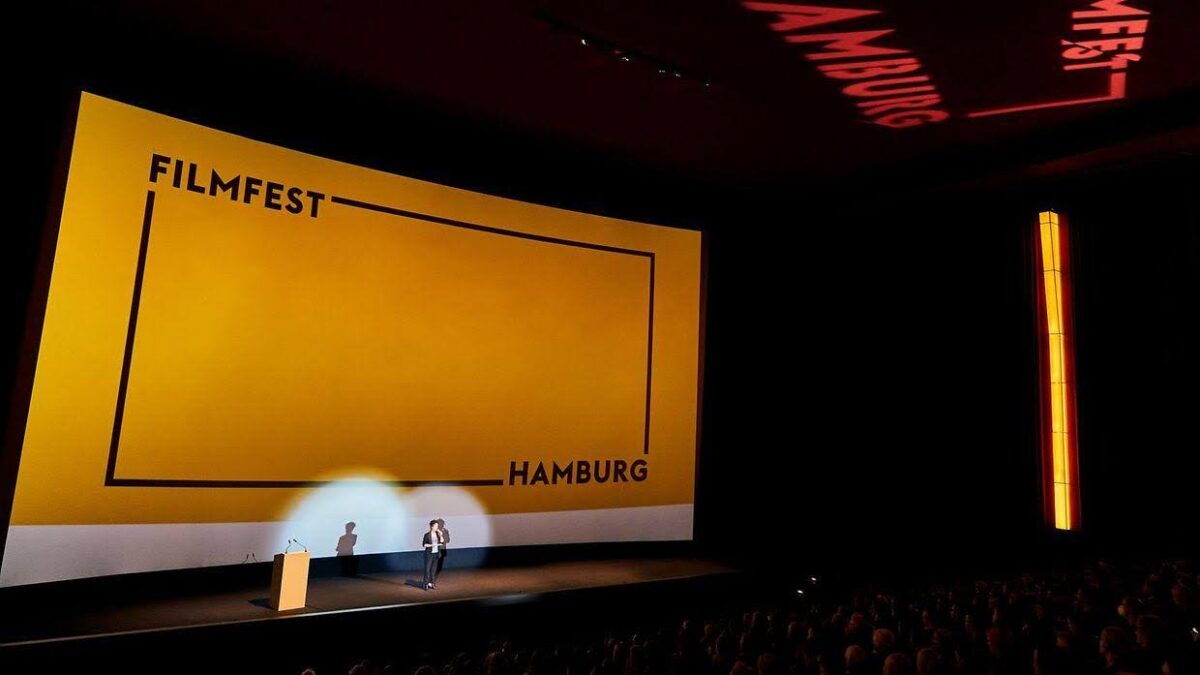
Persevering through watching often-alternative German films on a 14-inch laptop screen in the name of my degree is a far cry from experiencing German cinema in a local Kino, surrounded by its intended audience; serendipitously stumbling upon a semi-premiere of a new German film was hardly how I had imagined my first visit to a cinema in Germany would unfold. Despite repeatedly standing up for Hamburg – the location of my first year abroad placement – and having to convince family and friends that it is, really, the second-largest city in Germany, I was still uncertain about the cultural opportunities on offer in this often-overlooked, maritime city in northern Germany. Within the first month of living here, however, my ardent defence of the city was validated and rewarded when I chanced upon the Hamburg film festival (Filmfest Hamburg), which turned out to be just one of the many cultural gems this city has to offer.
Filmfest Hamburg is an annual film festival that takes place at the end of September. It is by no means akin to the Venice or Cannes Film Festival; attendees do not have the opportunity to catch glimpses of star-studded celebrities and directors. But, like many modest film festivals that steer away from the exclusivity epitomising other renowned cinematic events, this humble film festival offers a pared-back, artistically focused showcase of films from around the world for cinephiles and part-time enthusiasts alike (myself included). In this vein, the ‘Tag des freien Eintritts’ (free entry day), introduced last year to coincide with the day of German reunification (3rd October), has made this event all the more accessible. Thanks to this new feature, I was able to attend free of charge – music to any student’s ears. The film in question was Dann passiert das Leben (2025), produced and written by Neele Leana Vollmar and featuring two prominent German actors, Anke Engelke and Ulrich Tukur. Unbeknownst to me, the film’s official premiere was set for two days later at the Zürich Film Festival, with its cinema release date scheduled for just over a month after that – meaning that I was essentially witnessing its very first public screening. What’s more, the cast and main crew were even in attendance and participated in a post-screening panel.
The film foregrounds a seemingly unassuming couple: Hans, a freshly retired headmaster, and Rita, a care home worker. Their life in Bayern is governed by a ritualistic monotony that, on the surface, appears unremarkable and inevitable, but quickly reveals a deep-seated discontent at the root of the couple’s relationship and existence. As the title – roughly translated as “Then life happens” – suggests, life gets in the way, and their quiet day-to-day is rocked by an accident that has implications for them both.
Speaking during the panel, Vollmar explained how inspiration for the film came to her unexpectedly whilst she was staying at a hotel in Berlin. At the breakfast buffet, her attention was invariably drawn to a couple in their early sixties also seated in the restaurant. Watching the couple interact, Vollmar said she was mesmerised by their mutual consideration of one another. The notion of love enduring through time – remaining constant alongside life’s milestones – began to take shape in her mind. Ironically, when she asked the pair their secret to a successful relationship, they revealed, with a laugh, that they were actually brother and sister. This moment, however, does underline an important truth: the common assumption that romantic relationships enduring into later life will naturally continue to last. It is this assumption that Vollmar grapples with in her new film, where love is no longer taken for granted but depicted as a constant, and sometimes difficult, challenge to sustain.
Although I am evidently far from the stage of life depicted in the film – that of empty-nesterhood and retirement – Vollmar’s commitment to realism managed to immerse me in the world of this hapless couple. The damp, chilly atmosphere of the film somehow transcended the boundaries of the screen, and despite the warmth of the cinema, I had to put my jumper back on, shielding myself from the imagined cold. The film’s arguably bleak depiction of life post-middle age leaves a strong impression, with Rita’s shutters serving as a fitting visual metaphor for the routinisation and mundanity that can accompany later life. One of the cast members admitted that rewatching the film made him feel compelled to call his parents. In this sense, Dann passiert das Leben seems to depict a ubiquitous fear held by adult children: that our parents might be slipping into a static and colourless existence rather than living their life to the fullest. This is a fact the film seems to be self-aware of, as just minutes before the defining watershed moment, Hans, during an argument, refutes Rita’s claim that he barely notices her, asserting instead that she lives her life as though she doesn’t want to be seen.
The film is visceral, which is testament to Engelke and Tukur’s acting, and slowly, as love starts to be rekindled, the ambiance becomes brighter and warmer. A not-quite-happy but more contented life starts to look possible, exemplified by a spontaneous dancing scene in a schnitzel restaurant (an undoubtedly German way of signalling that all is well). That is why the film’s ending feels like a clichéd cop-out. Vollmar goes to the trouble of carefully establishing parallels only to undercut the actors’ powerful performances with an ending that feels both jarring and incoherent. It remained unclear to me what Vollmar intended to convey. As a result, the film proved more thought-provoking for the questions it raises than for its narrative substance. Still, despite its disappointing conclusion, it managed to leave a lingering impression – an outcome I certainly hadn’t anticipated as I walked to the U-Bahn from my flat, unsure of what to expect from the cinema I had discovered by chance on a Hamburg cultural events poster. With this first experience behind me, I plan to happen upon as many of these cultural opportunities as I can before I have to return to watching German language films on my laptop screen – something I know will feel all the more tedious now.
Featured Image: Claudia Hohne