By Emily Mills
(Trigger Warning: domestic abuse)
Cheap booze and melancholia drip from bedframes. Heady cocktails and bodily fluids spill on weathered velour quilts. There are a lot of breasts, but not in an erotic way. At least not for the most part.
This is Nan Goldin’s The Ballad of Sexual Dependency, forty years on from its original publication. Magnum opus of the Boston photographer, The Ballad depicts the beautiful spectre of Free Love in 1970s NYC. Enchanting yet poignant: the Gagosian’s (13 January – 21 March 2026) display of 126 photographs had me mesmerised.
Goldin’s Ballad is a world where the line between friends and lovers blur. Trust is ubiquitous and judgement is distant. The sordid passion of 70s underground New York is hard to ignore. It sparked much thought as I left the exhibition and stepped back out into the manicured streets of Mayfair.
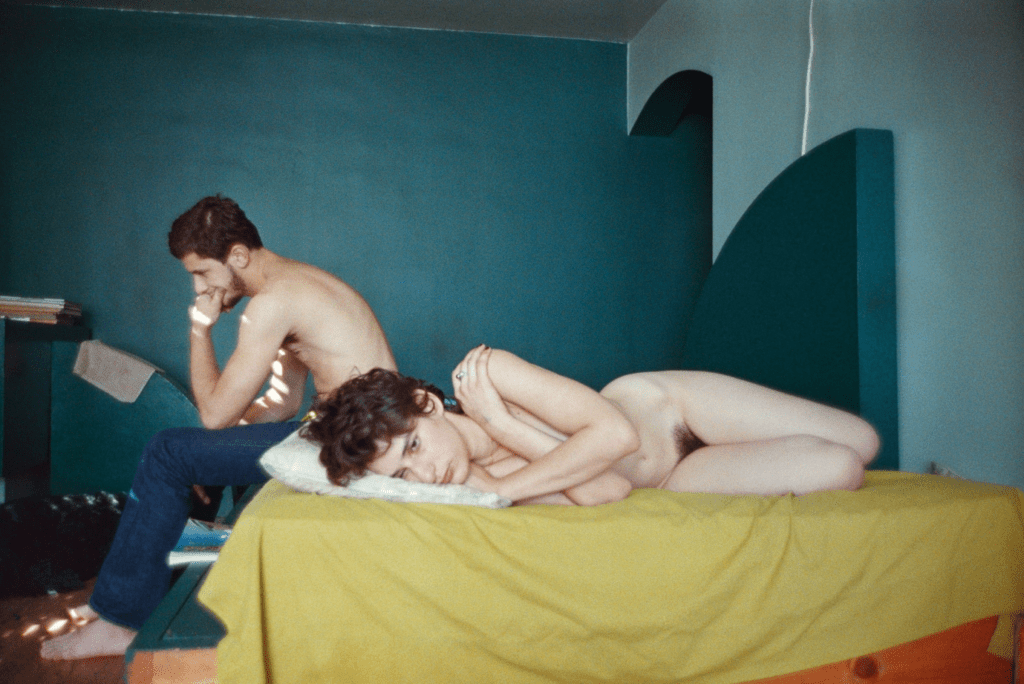
Couple in bed, Chicago (1977). Credit: Nan Goldin / Gagosian
Much of the collection challenges heteronormative structures in both subtle and overt ways. Goldin figures this volatility into the collection’s titular ballad form, also derived from Brecht and Weill’s 1928 The Threepenny Opera.
The sex-fuelled ruminations of the Couple in bed, Chicago (1977) are raw. Their gazes are melancholy. The couple may as well be Marianne and Connell in Normal People. Though these ones aren’t paid actors, nor actors at all for that matter.
Goldin’s ‘actors’ are friends or lovers, or both. Had she even wanted to pay her subjects, it wasn’t an option financially. Indeed, she once exchanged a sexual favour for a taxi ride to develop her spool of film (All The Beauty And The Bloodshed, 2022).
Nan One Month After Being Battered (1984) is a visceral confrontation with domestic abuse, in self-portrait form. It is an act of survival. A vulnerable yet defiant rejection of shame. Her striking red lipstick echoes her bloodshot eye. This image helped stop Goldin from returning to the violent relationship. It’s a deeply personal exploration of the complex interplay between love, violence, unsuitability and dependency.

Nan one month after being battered (1984). Credit: Nan Goldin / Tate
Dependency rules over these scenes. Fair to say dopamine is unlikely to be the only thing the subjects are addicted to. Addiction either to love or drugs. Likely both. They’re indecipherably intertwined. The Ballad was first projected onto walls in downtown New York. These early slideshows were accompanied by a not very ballad-like soundtrack. Think more Femme Fatale by the Velvet Underground. The installation places all the images in proximity on three walls. I had anticipated this curation to dissipate the rawness of Goldin’s photography. Instead, it intensifies its intimacy. The viewer is overwhelmed by the searing mix of desire and pain.
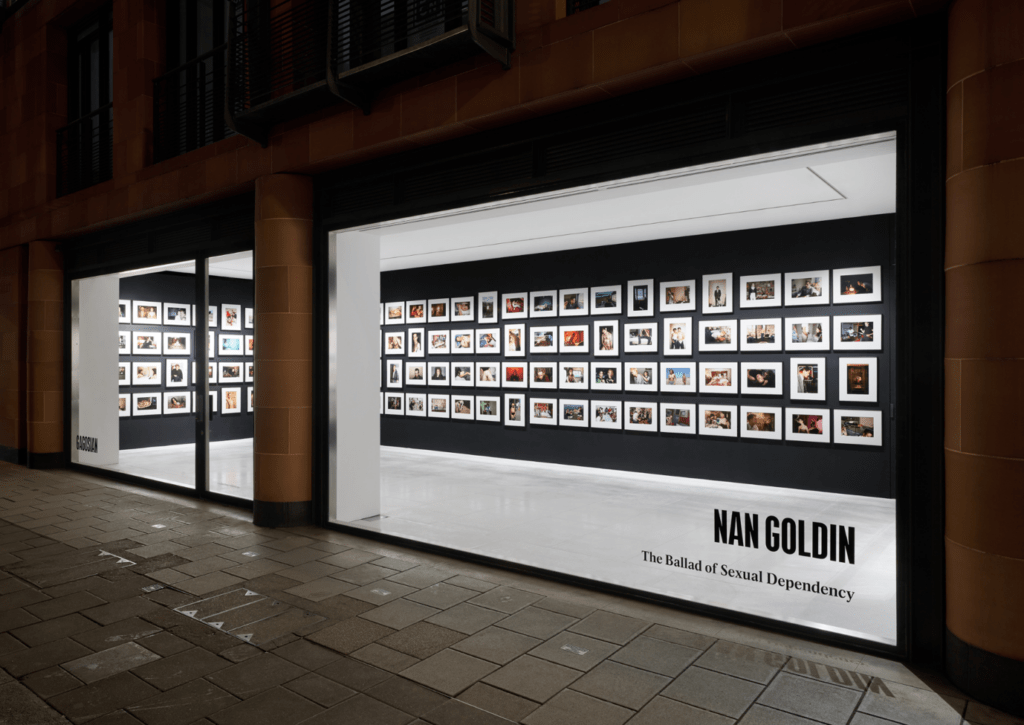
Installation view with Nan Goldin, The Ballad of Sexual Dependency (1973-86). Credit: Prudence Cuming Associates Ltd / Gagosian
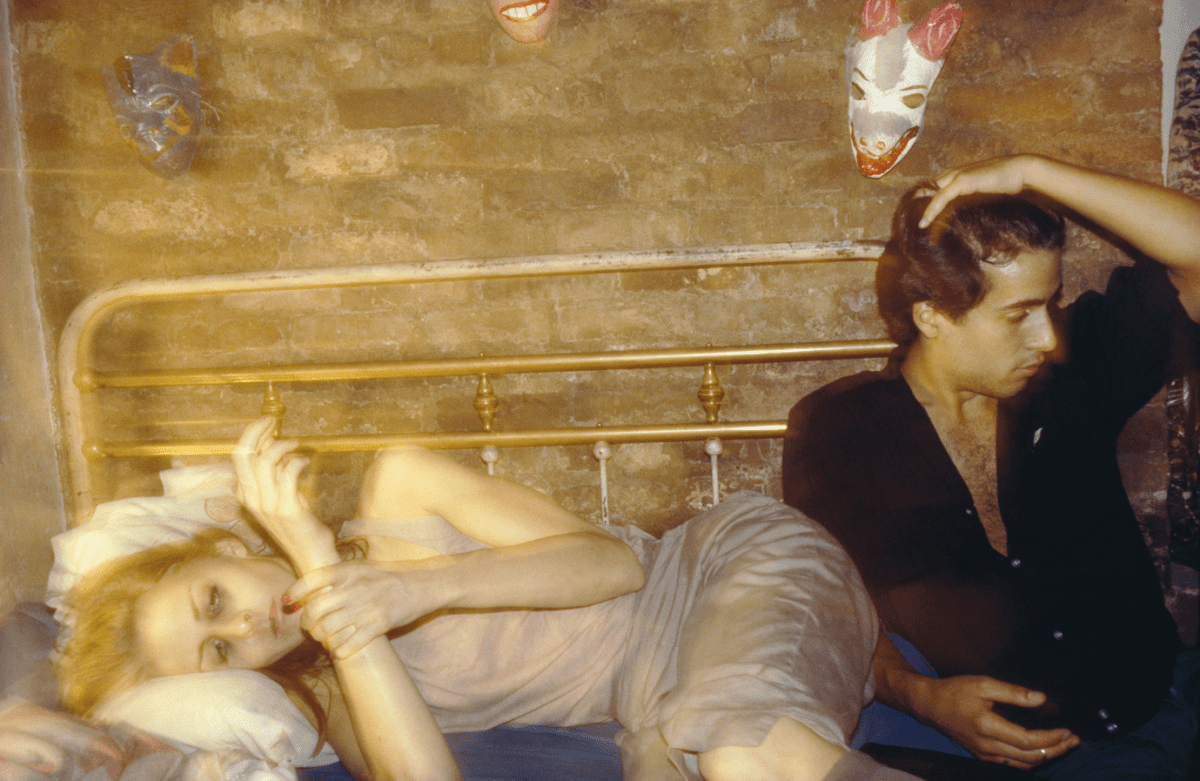
Such impassioned emotion mustn’t be overly glorified, however. Living in a far freer time than that of the 1970s, we are free to pursue love with far fewer barriers to self-expression. The more melancholic images also remind us of the fearful uncertainty that surrounded the early days of the AIDs epidemic, and the love that was to be lost to ravaging illness. The image titled Greer and Robert on the Bed, New York City (1982) depicts a lovers’ tiff, rendered in the blurred ghostliness of a waif-like Greer Lankton.
Drug dependency has defined much of Goldin’s work, in her material art and the art of her activism. Goldin herself, having recovered from heroin addiction in the 1980s, found herself in the throes of an OxyContin addiction in 2014. Being prescribed the drug after wrist surgery, she quickly became hooked. She then flipped the temptations of ruination into a force for advocacy. She has succeeded in overturning status quos in the art industry, campaigning against the Sackler family empire. The family have long financed galleries worldwide, all while covering up the evil source of their success: the ‘snowstorm’ of prescriptions. The 2022 film All the Beauty and the Bloodshed follows Goldin’s militant activism against the opioid crisis. Goldin’s P.A.I.N (Prescription Addiction Intervention Now) campaign has included making prescriptions ‘snow’ from balconies at the Guggenheim. Another: a mass die-in at the Met Museum, accessorised by prescription bottles in the central water feature. Her campaign sparked a momentous movement from museums to reject Sackler funding and begin removing their name from gallery wings.
The Ballad long preceded Goldin’s activism against the Sacklers. Confronting the romantic dependencies of her subjects led me to muse on how shallow the dopamine hits of the 2020s are. By comparison, we’re living in a time of chronic ambivalence- ambivalence to a fated suburban banality, knot tied and two kids in tow.
The neoliberal gamification of love is sweeping people up. This gamification of love, in turn, becomes the gamification of emotion. Indeed, reducing feelings to something swipeable felt like a useful shortcut to romance at first, but today’s generations see this reductionism as the status quo. There is no space for the melancholia of Kafka’s Letters to Milena. Instead, blue light dopamine obstructs the space for melancholy. Or ecstasy, for that matter. We funnel any of our remaining energy into ego-bruising and possessive electronic dating. In neoliberalism, every aspect of love is commodified, digitised and datafied. The apps facilitate a dangerous impunity. And so, we struggle to reconcile the paradox of possessive monogamy with intimate disposability.
Goldin (1986) underscores that men and women are unsuitable to the extent that they require each other. This captures the perils of interdependency, even as yearning outweighs the unsuitability. I think what I love about this description is that it helps us understand how irrational love is. In turn, it vindicates love. Dependency is unhealthy, but also sustaining. Limerence is both the peril of this unsuitability and the urgency of unrequited intensity.
This intensity of feeling is now the topic of scorn by TikTokers, who have co-opted the term limerence to demonise romantic infatuation. Originally coined in 1979 by Dorothy Tennov, the term is discussed in its dual nature. She likens it to addiction, while also stressing its fundamentality to human nature. She claims its force ‘to power the very revolution of the planet’ (Tennov, 1998, p. 33). Yet, co-optive self-proclaimed therapists online provide advice on how to purge and quash these feelings, seeking to rid people of their hopeless romanticism, while ironically profiting from it- encouraging an emotional anaesthesia. Like the gamification of love, people are attempting to formulate a rational response to romance- or worse, an apathetic response. The visceral passion of Goldin’s Ballad is being eroded by this digitalisation of love and empathy. You see, TikTokers urge us to fear this limerent state.
Bygone Ballads on unrequited love have been replaced by the demonisation of affect and melancholy. ‘Self-help’ in a play too hard to get era, instead pushes us to walk away. To shuffle towards a chronic ambivalence, leaving heartache to actors on big screens. Over-rationalisation of feeling is symptomatic of our world’s roboticization. After all, the only thing we will always have over AI is true emotional intelligence.
The perils of succumbing to a digitised apathy run far deeper than just repressed heartache. We face a wider risk: the tendency to anaesthetise affect by resorting to an emotional ambivalence. Goldin’s subjects so powerfully remind us that emotional tumult is fundamental to the human experience.
Bibliography
All The Beauty And The Bloodshed. 2022. [Film] Directed by Laura Poitras. United States: Praxis Films, Participant, HBO Documentary Films.
Goldin, N., 1986. Photographer Nan Goldin Interviewed by Aperture’s Mark Holborn [Interview] (Summer 1986).
Tennov, D., 1998. Love and limerence : the experience of being in love. 2nd ed. Lanham, Maryland: Scarborough House.
Featured Image: Greer and Robert on the bed, New York City (1982). Photograph: Nan Goldin / Gagosian